

You’ve probably heard that a major breakthrough in fusion research was announced this week by one of the US’s national labs. Lawrence Livermore National Labs (LLNL) said on the 13th that they had achieved a net gain of energy during an experiment. They got out more energy than they put in, although there are lots of asterisks associated with that announcement.
U.S. officials announce major nuclear fusion breakthrough
What follows is my opinion only – based on my work in plasma physics research for 9 years in the 1980s. That hardly makes me an expert on anything, especially plasma physics, but it was a great experience. I worked on radio wave heating systems at Princeton – high power radio waves are one way of heating plasma. The projects I was part of were only one small portion of the whole plasma experiment. Princeton was selected as a fusion facility for several reasons: the area has a confluence of major high voltage grid lines, there’s a university nearby (Princeton U.) to sponsor the facility, and research of many kinds has been done in the Princeton area since the 1920s.
There’s an old joke about fusion energy always being 20 years away – that’s far enough in the future to be nebulous, but not so far away that it sounds hopelessly impossible. It’s also about one or two major projects cycle time, from construction to published papers to winding down, and conveniently 20 years is a good part of a career. When I started work my boss told me that same story: when he started he was told practical fusion was 20 years away; he had worked there a few decades, and it was still 20 years away when he retired five years after I started. We joked about the facility name being changed from Plasma Physics to Plasma Engineering in the hope things might speed up a bit, but that would neither work nor fly. The 20 years in the future theme has become widely known and ridiculed; every YouTube fusion video will have a couple of comments about it.
The announcement by LLNL is in some ways a major achievement, and in other ways not just ho-hum science, but even more justification for joking about the famous 20 years in the future. I’ll mostly talk about what that announcement didn’t mean, as opposed to why it’s a major breakthrough. I’ll try and explain why the breathless comments under the YouTube videos that “fusion energy is here” and “finally, we’ll have clean energy” are unfortunately misplaced optimism.
Since my experience is in tokamaks, unrelated to the LLNL research, I first need to talk about fusion experiments in general. In the US there are two kinds of fusion work being performed, and though they differ greatly in method and potential applications, the defining difference is in how the plasma is created and contained. LLNL uses what is called inertial confinement: fusion is created by high powered lasers hitting a tiny pellet. Instead of exploding outwards, the pellet also explodes inwards. Note this is a single shot experiment, a single discrete creation of fusion energy that rapidly goes away.
The other method of creating fusion is via magnetic confinement, where a plasma is created continuously in a large vacuum vessel. Most plasma experiments in the US and the world use tokamaks to confine the plasma. A tokamak is a donut shaped vacuum container which is partially filled by the similarly shaped plasma. Surrounding the tokamak are arrays of equipment needed to run the experiment. There has been a long but mostly friendly rivalry between the inertial confinement and magnetic confinement groups. But since inertial confinement has applications in nuclear weapons research, their funding has been more reliable than the other groups. Funding in the US is mostly provided by the DOE (Dept of Energy); it’s not quite a fixed pie, but it’s close, so any new experiment getting funded will probably cost an existing experiment some of their funds.
Fusion energy has had previous connections to weapons; an Argentinean scientist in the 1950s got funding for his research by telling the dictator he was building a bomb. And speaking of bombs, you really can’t compare fusion research to the atomic bomb project and expect results in 5 years. The Manhattan Project stripped many universities and research groups of their physics professors, who were willing to work on important research for years in awful conditions with no recognition. The universities also lost, as important staff were taken away. War research also commanded huge priority in materiel and other scarce resources. That model probably wouldn’t fly today even if fusion was known to be a simple problem that can be solved by throwing people and resources at it.
Fusion experiments of any kind are by their nature large, expensive, and difficult, with highly uncertain results. Look at any photo of ITER, a large fusion facility in Europe that has the resources of many countries supporting it. This stuff costs billions. Here is a photograph of the ITER facility.
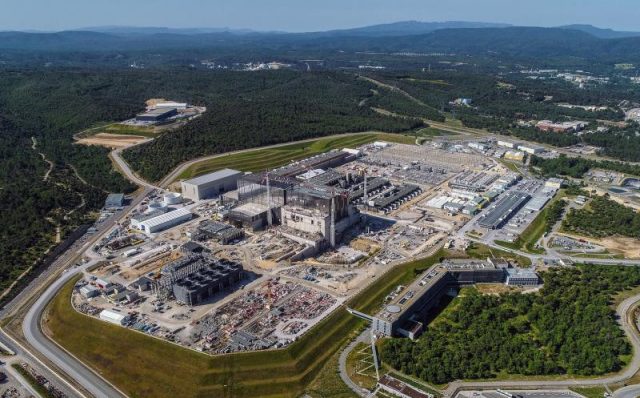
LLNL facility is no different. Watch the first Tron movie to get an idea of the complexity of the systems involved. Then remember this movie was released 40 years ago, and the LLNL facility has gotten even bigger and more complex. The Cray computers shown in Tron are absolutely ancient by now and have been replaced by far more powerful equipment – one of the applications of supercomputers has always been analysis of these types of atomic reactions.
I said earlier that the LLNL announcement is both important and nearly meaningless. Important because it’s a necessary step if we are to eventually build fusion energy plants. You can’t get there without passing breakeven. It’s also in some ways equivalent to Henry Ford pointing to a model of a single cylinder gasoline engine, barely running on a lab bench, while proclaiming “This engine will revolutionize transportation all over the world.” Why, yes, yes it will. Someday far in the future.
On the pessimistic side of the ledger, we can’t even really say that the announcement is one step in an overall series of things that need to be accomplished to make fusion energy a reality. There have been many major announcements from both the inertial and magnetic confinement groups, so yet one more announcement is easily overlooked in the flurry of firsts. If you consider the Apollo moon program, NASA established a series of steps that had to occur for a moon landing to be successful. Development of bigger rockets, better spacesuits, orbiting and landing spacecraft, for example.
I don’t think there is an equivalent series of steps that can be guaranteed to lead to commercial fusion energy. There are too many unknowns. There are issues with scaling fusion experiments from small to large; you can’t just make the experiment bigger because it won’t work the same. There’s also many failure points due to complexity and the unique nature of these facilities – the vacuum system needs to be nearly perfect, everything is highly stressed but has to be maintained in perfect alignment, and safety of personnel is difficult because of the combination of cryogenic liquids, high voltages and currents, high magnetic fields, radiation, and thousands of gallon water a minute running everywhere to keep the equipment cool.
Failures are more likely than successes because this is still a field heavily dependent on theory for its next steps. Testing a theory could take years and cost many millions. I’ve seen experiments that had great promise produce disruption after disruption so badly that three years of engineering work was written off in an afternoon. A disruption is when the plasma collapses suddenly; the building shakes, equipment blows up, and the tokamak machine is twisted enough that it might be unrepairable. You don’t want to have them – an experiment causing disruptions is useless no matter how promising.
I’ve been leading up to just how difficult it will be getting to a goal of a commercial facility, even a pilot plant. My role in fusion research was to help build and run radio transmitting equipment, on a giant scale. We had to make do with whatever we could use from commercial broadcasting equipment, or from other research. There just isn’t money in the budget to develop our own stuff. Radio waves are among the various methods used to heat plasma in magnetic confinement systems – it has a big advantage in that it can operate continuously, while most other heating systems are pulsed, as is inertial confinement systems as has already been stated.
Given a choice, it would seem to be easier to use a continuous operation system rather than a pulsed system, so that’s yet one more problem LLNL will need to solve if they hope to become the model for a commercial facility. Going from the projects I was involved with 30 years ago, to ITER and similar current programs, represent huge steps forward in terms of size, cost, and complexity. Much has been learned and thousands of papers have been written. But it’s not clear to me that the next program after ITER will be a model commercial fusion facility, or if that small commercial facility comes after ITER 2, or even after ITER 3. There may be only a handful of major hurdles to overcome before that pilot plant can be built – or perhaps there are 100 hurdles, and we don’t even know about 90 of them. “Unknown unknowns” comes to mind.
The past few years have seen something a bit encouraging: the entry of private investors in fusion research. Are they serious, or just throwing money away? It’s too soon to tell. I think most of these facilities eventually get quietly shut down and mothballed. I’ve heard only promises, but no real plans or progress apart from platitudes. Duplicating an existing fusion research facility looks good as an investment but actually accomplishes little.
And there’s always a potentially devious motive. Up to now, plasma physics has been very open and public. Every research institution publishes their results. The physicists and engineers from the various projects work together and collaborate well, and people and equipment are loaned from one place to another. However, if one of these private facilities does find some important breakthrough, they’ll patent it, and they’ll own it. Fusion energy might be clean and limitless, but it won’t be “free.” We’ll pay through the nose for it.
I’d like to close with a link that I found to be pretty accurate about where things stand with the LLNL breakthrough.
Nuclear fusion reactor ‘breakthrough’ is significant, but light-years away from being useful
“Scientists are very excited by the results, but wary of overhyping them. The reactor as a whole did not produce a net gain of energy. For a fusion reaction to be practically useful, the tens of megajoules drawn from the electrical grid, converted into the laser beams and fired into the reactor core would have to be significantly less than the energy released from the plasma.”
If you are interested in knowing more about fusion, YouTube has hundreds of videos available. Some of them are even fairly accurate.
