


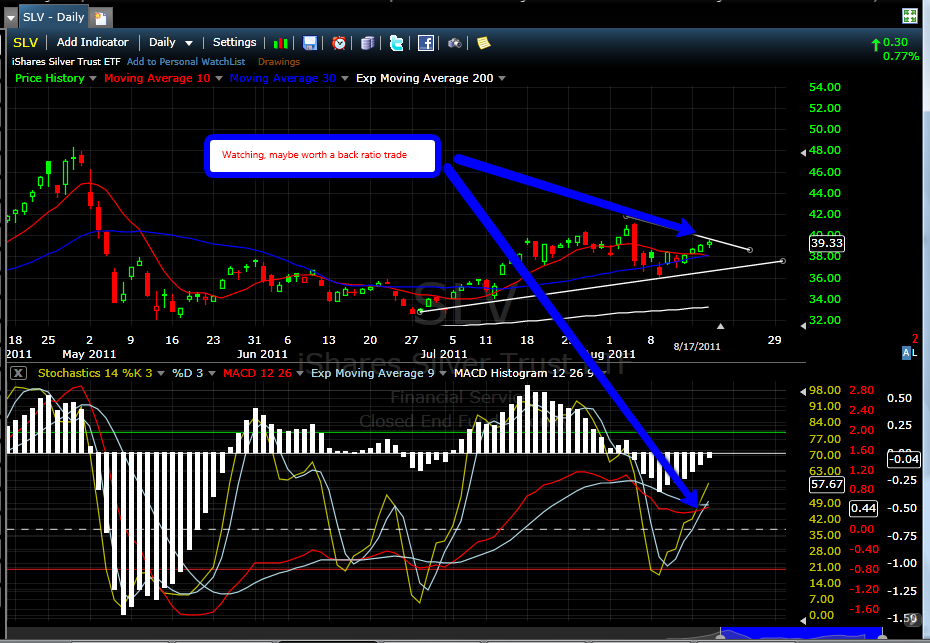
Interesting strength in silver tonight, and the charts are looking constructive, as well. My suggestion is to take a back ratio call spread for September on SLV and buy the breakout on SLW.


Slope initially began as a blog, so this is where most of the website’s content resides. Here we have tens of thousands of posts dating back over a decade. These are listed in reverse chronological order. Click on any category icon below to see posts tagged with that particular subject, or click on a word in the category cloud on the right side of the screen for more specific choices.
Interesting strength in silver tonight, and the charts are looking constructive, as well. My suggestion is to take a back ratio call spread for September on SLV and buy the breakout on SLW.
I currently own some shares, and will add on this upcoming relief rally (dollar weakness), but options are nice for some additional leverage. Right now the vol is too high to buy options, but I will sell strike 15 puts to pick up some shares at a discount, and will buy Jan 12 calls OTM that will give me potential 5 to 1 return at my target price, on my next buy signal.
On a shorter time frame you can see a cup formed and now I suspect a handle before we really breakout.

www.arum-geld-gold.blogspot.com
For this post I will only focus on the food problem for Egypt, and why it is a window on the demons released by our insane monetary printing, and the unwillingness of command and control countries to de-link from a parity dollar policy. The FED is pumping dollars to force China, et al to revalue, allowing for us to export, raise tax funds, and velocity through inflation. Unsustainable food and oil prices will force the hands of these governments to do just that, is the thinking. The game of chicken is on, but an unintended domino in a volatile part of the world fell this week, and has the potential to engulf us all.
Look at the slides and narrative from http://209.157.64.200/focus/f-news/2665495/posts?page=3. You can plug in nearly every North African/Middle Eastern country into this picture, but China, Russia, and India are also in the same boat. Add to this tight supply and the real likelihood that Russia, Canada, and Australia produce less than normal, and we have some big problems coming.
"Egypt is reported to be the world’s largest importer of wheat. In 2010, the oil minister stated that Egypt imports 40% of its food, and 60% of its wheat. The problem this year is that world wheat production is down (at least in part due to weather problems in Russia) so world exports are down:
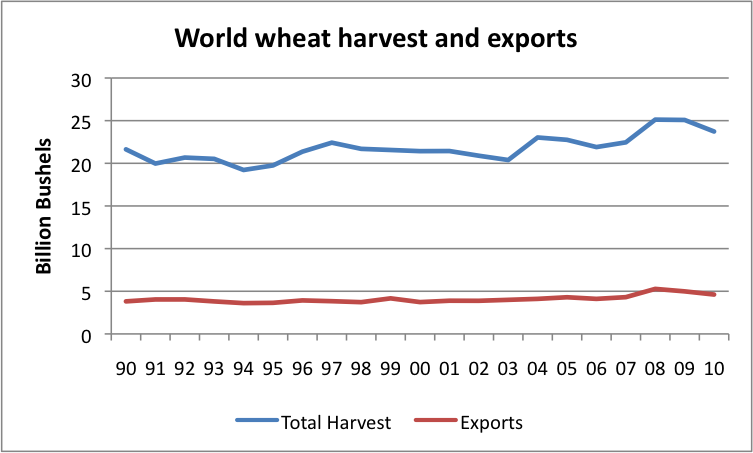
Figure 4. World wheat production and world wheat exports from USDA
A longer term problem, though, is that world wheat production has not been growing to keep up with growing world population. Part of this lack of growth may be competition from biofuels. Part of the lack of growth also relates to the fact that the “green revolution” improvements (adding irrigation and fertilizer) are mostly behind us. While irrigation and fertilizer greatly improved production at the time of the change, gains in production since 1990 have been much smaller.
The cost of imported food, particularly wheat, has risen, partly because of the relatively smaller harvest, and partly because the cost of production and transport is rising because of rising oil prices. Figure 5 shows the close relationship food prices and oil prices. The Food Price Index used in this graph is the FAO’s Food Price Indexrelated to food for export; Brent oil prices are spot prices from the EIA.
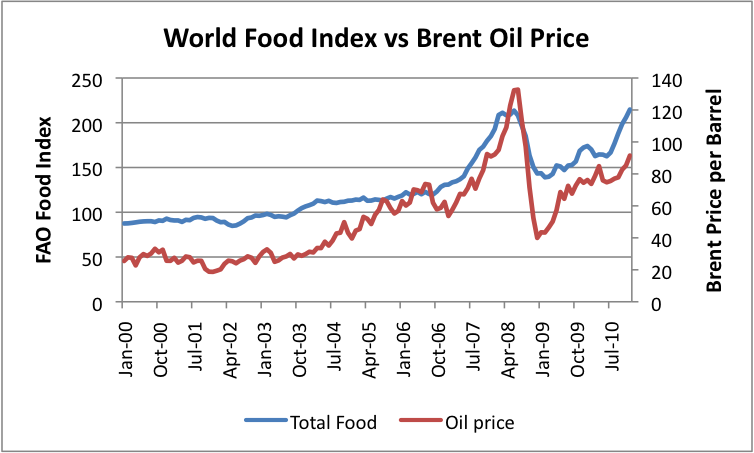
Figure 5. World food price trend is similar to Brent oil price trend.
With oil prices higher now (because world production is close to flat, and as countries come out of recession, they want more), food prices of all types are higher as well. Oil is used directly in the production of grain and indirectly in storage and transit, so its cost becomes important.
The higher food prices contribute to the overall inflation problem that Egypt already had. In 2010, the CIA Factbook estimated the inflation rate to be 12.8%. Since wages don’t always rise to match inflation rates, inflationary pressures have no doubt put more pressure on the government to increase subsidies, at a time it cannot really afford to do so.
Impact on the Rest of the World
Why does everyone else respond so strongly to Egypt’s problems?
One reason is that other Arab countries are also feeling some of the same pressures. Food prices are rising everywhere. Many low income people spend in excess of 50% of their income for food, so a rise in food costs becomes a real issue. People have come to depend on oil and food subsidies. If they are taken away, or not raised sufficiently to compensate for the higher costs of imports, it is a real problem.
Oil prices seem to be affected as well. If the Suez Canal should be closed because of disruptions, it could affect oil transit, particularly to Europe. According to the EIA:
An estimated 1.0 million bbl/d of crude oil and refined petroleum products flowed northbound through the Suez Canal to the Mediterranean Sea in 2009, while 0.8 million bbl/d travelled southbound into the Red Sea.
The amounts being transported through the Suez canal are now likely down a little from these amounts in 2011, because of reduced imports/exports worldwide, but they are still substantial. Europe’s oil imports are about 10 million barrels a day of oil, according to Energy Export Data Browser (using BP’s data). If all of the amounts that flowed northbound went to Europe, they would amount to about 10% of Europe’s imports, or about 7% of Europe’s consumption. In fact, some of these exports go farther–in particular to the US, or to Canada, so the amount in question is probably lower than this relative to Europe’s consumption, say 4% or 5%. But even a small shortfall is a problem, in a world that needs oil for transport, food production, heating, and many other uses.
The inability to send products southbound through the Suez Canal is likely to also be a problem. Part of what Europe does is refine oil, keep the products it needs, and send other products to customers elsewhere. The whole system is set up assuming close to “just-in-time” production and delivery. While there is some storage capability, after a few days or weeks the system is likely to start running into problems. Those in need of the refined products being sent southward through the Suez Canal will be facing a shortage, and Europe will have excess supply. Of course, it is possible to use longer shipping routes, but this uses more oil for shipping and takes longer, so is more expensive. There is also a time-delay when the new system is put in place.
All of these problems (relating to both north and south-bound oil traveling through the Suez) can be worked around, but there could be a period of disruption for a while, as supplies begin traveling a longer route."
If you have not already, I suggest buying MOO, RJA, JJG, and DBA on any weakness. The revolutions may end, but not the food crisis.
For the past month Silver has retraced some amazing gains, pretty aggressively, I may add. But looking at the chart of the miners I selected below, it sure looks like consolidation to me, on the verge of a new upleg.
Up until the unrest in Tunisia became a contagion in Egypt, I was in the camp of silver going to the $24-25 dollar range, and planned on holding any new purchases until the latter part of February to let that scenario play out.
In March, silver the open interest is growing incredibly, and in that OEX the buyers can demand the physical. Also, investors are emptying the Comex of inventory. My view is speculators sensing a squeeze will start putting upward pressure on the metals after the February OEX closed.
Now back to North Africa, this is a game changer, people are being reacquanted with risk, and the Precious metals benefit from this. Also, I cannot see a short term scenario that stops the FED from doubling our money supply again in the next twelve months, So I started buying back into my silver positions this week.
Below, I present three companies for you, AG is a core holding, and above $12.40 I will complete my buy program (gap fill and hold), EXK, I think has already broken out, and added to already. Finally, HL, it looks like AG's chart (I do not own it).
As the mainstream public and media starts grasping the significance of rising food prices around the world, their focus, and the focus of most people is on how terrible it is for poor people or for poor countries, but this is problem is more insidious, and damaging for our economy.
Taking a step back, one of the goals of the Fed is to force velocity of money by raising prices, especially necessities, thus creating the whirlwind of economic activity that can be taxed and diverted to the bankers. In their mind they solve two problems in one for themselves, and cause some inconvenience along the way for masses.
But we are not in a demand push inflation, but a cost push variety with no increase in domestic income, but more importantly, they are neglecting Maslows laws of well being; specifically when people start to worry about food security and in our case ability to pay for food, a multiplier effect takes hold; in the wrong direction. People shut down when pursuing safety.
In my view food, and for purpose of this post, is non prepared grocery food, and it is low margin and low velocity. As prices in the market go up, and wages do not, the first effect is rolling down from restaurant eating, then the high margin prepared foods in the market are target-ted. This brings us to today, going forward the next roll down is from discretionary food items, and label brands to basics and store brands.
Now it gets interesting, as food and fuel push up from here, the next area is distretionary other spending, which rips into the heart of our service economy, margin squeezes on everything not essential will happen first, then these businesses will simply give up and close.
My point is as people focus on basics, and worrying about the future cost of said basics, they are less likely to have the animal spirits to create the velocity the FED desires, buying food instead of something else is not simply a one for one substitution of expense in the family budget, and replacing high margin spending with low margin ones, does not drive us out of this ditch, it perpetuates it.
It is ironic to me that every business in this country either becomes a non profit or extinct, so the bankers can be made whole. Where is the CEO outcry?
