Slope of Hope Blog Posts

Slope initially began as a blog, so this is where most of the website’s content resides. Here we have tens of thousands of posts dating back over a decade. These are listed in reverse chronological order. Click on any category icon below to see posts tagged with that particular subject, or click on a word in the category cloud on the right side of the screen for more specific choices.

Volume by Price Bars Look: FNSR (by Leisa)

By -

I originally did a post, The Importance of Time Frames, on FNSR on my blog. I was considering it as a potential short due to weakness in that sector.   I thought this would have some short potential.  It looked toppy on a daily short term chart.  However, when I moved my time frame out, and I came up with this chart using three years and a weekly time frame.  Going through that process inspired the aforementioned post. 

Here's the chart, which has to my eye, a simply beautiful cup and handle formation.  There is also plenty of airspace above.  There is also the rocket fuel of a 25% short interest. That's generally too crowded for my taste.  As is my norm, I look at vital signs, and FNSR's look pretty decent.  You can conduct your own 10-point safety inspection in the span of less than 30 seconds by looking at FINVIZ's snapshot here.


Snap58
 

How this pattern plays out is dependent on the strength of the broader market.  I think that it is a decent long prospect.

Position:  Long FNSR Aug calls.

The Emotions of Risk (by Leisa)

By -

One book that I frequently recommend is Justin Mamis' The Nature of Risk: Stock Market Survival and the Meaning of Life (1). I believe this book to be foundational to new traders because it discusses, what else?, the nature of risk in the market. What I love about Mamis' book is the unique way that he writes about market risk, and the way that he juxtaposes two seemingly opposing ideas, that are not in opposition at all. From that juxtaposition he illuminates. (Read on for an example). Given some of the conversation at the Slope, I wanted to do a brief post on some of his concepts from Chapter 6, The Emotions of Risk. I think that some will find some resonance. I particularly wanted to share some of these concepts that might engage your brain into thinking about risk differently. Mamis posits:

"Under pressure, emotions determine our action." (p. 72)

Because risk is typically defined as a peril, fear is one of the primary emotions. "Fear is long-term, an underlying pervasive emotion, like the underlying primary trend of a bear market. It doesn't go away until it changes." (p.73) Mamis makes a simple, yet powerful, statement about the pervasive fear needed for stocks to go up. Yes, you read that…to go up. For there to be buyers, there must be sellers. And it is the fear of the sellers that creates the proverbial wall of worry to provide supply for those who have a different perception of current market risk. He also notes that the operative portion of fear is anxiety. Anxiety is what paralyzes and prevents you from taking action. It is this anxiety that "gets in the way of taking a risk."

The flip side of fear is the emotion of greed. The operative emotion of greed is envy. Mamis notes that ". . . whereas anxiety paralyzes, envy cause one to act. . . " It is difficult to see the spectacular trades/success of others, and not feel a small bite from that evil twin of jealousy, envy. Envy can cause very risk behavior which is simply, "the risk of 'denial of risk'." Both greed and anxiety often lead to doing the wrong thing. My sense of this wrong thing is "inertia." : failing to buy when one should buy; failing to sell when one should sell.

These emotions and their operative manifestations into our action (or inaction) govern all market participants. The emotional impetus for buyers/sellers is reversed in bear/bull markets. Regardless of the market participant regalia you dress in each day, it is best to understand both your own and others' motivations and perceptions of the current risk environment. Mamis' book came along for me when I was feeling 'inertia'–that inertia having been brought about by the overwhelming need to have more information, more certainty, more sense of direction. Granted, there is nothing wrong in standing aside when there is great murkiness…but my inertia was spanning a time when there was some market direction, but my emotional state prevented my seeing that. Providence must have set this book into my hands, because it helped me come to terms with that inertia.

As market participants, we have to balance the two opposing points off view of being free enough to take risk and while not falling into the trap of 'the risk of 'denial of risk.' I'm not going to leave you with that concept in a void. How does one find the right action in that balance?

We need, we crave, the trust and belief from others, but when information is insufficient we need trust and belief in ourselves. We need the discipline to accept whatever is available, and the experience to understand all the ifs, ands, and buts, and yet still take the risk: we need to be able to make the decision. (p. 79).

As with most things, the right-rootedness of these important concepts is discipline. My distillation is that we need discipline first to ensure that our trading/investing capital lasts long enough to give us the experience that we need to build mastery. Without experience, we cannot build mastery. It is mastery that produces intuition and insight, and those ultimately support our confidence. Mamis notes:

Discipline means choosing what to do unencumbered by the fear of making a mistake. Confidence means trusting our intuition and that what we 'see' is what we "know." (p. 80)

He closes his chapter with a question that I hope that all of you embrace as your own mantra for coming to terms with this concept of risk: "How do we create within ourselves the heroic condition of confidence wherein risk is not a danger but life?" (p. 80) I also implore (v. suggest) you to get this book. I promise you that it will make you think of and about risk in a way that you may not have considered previously. I particularly recommend it for any who are feeling inertia and feeling compelled to have more information, more certainty, more (this, that, the other) before forging ahead and making a decision.

(1) Mamis, Justin The Nature of Risk: Stock Market Survival & the Meaning of Life. Flint Hill, VA: Fraser Publishing, 1999


Weekly Sector Report | 07/16/10 (by Leisa)

By -


Snap46

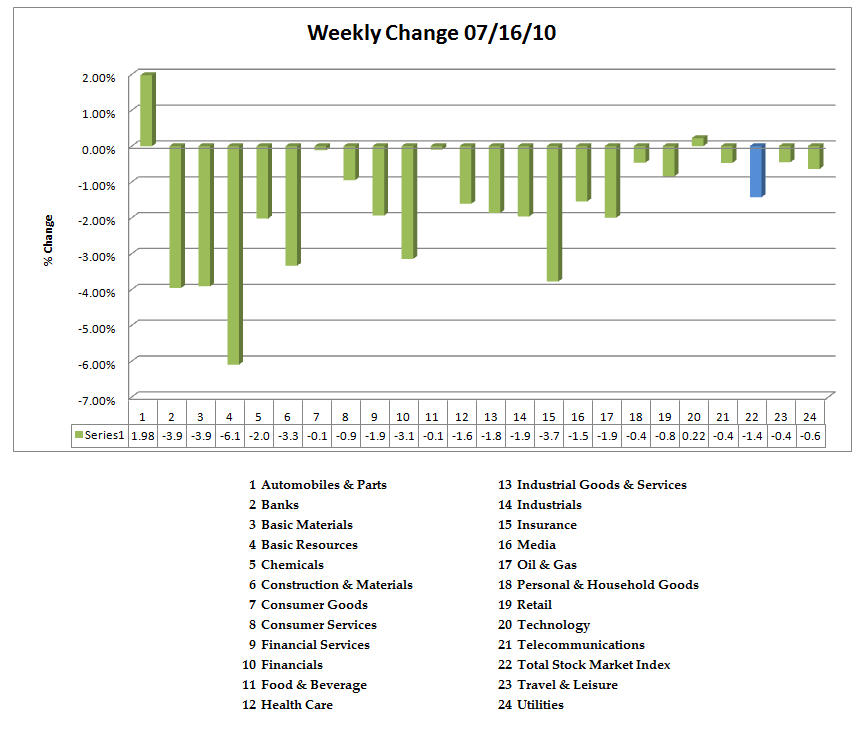
Although the broad market was down 1.3%,  a couple of sectors still managed to hang onto weekly gains:  Automobiles and Parts and Technology.  Also, 18% of the 148 sectors managed to have gains for the week.
As is usual, I have created a PDF for you which you can download here.

I want to share with you a chart of the $DWCF (Stockcharts symbol), the DJ Total Stock Market Index.  This is the index that I  use to show the relative performance in the sectors.  I use this rather than the $DJUS (Stockcharts symbol) because it has volume information.
Let's take a look at the chart before I start yammering about it:

Snap47
 

I have 13/34 week exponential moving averages (EMA's) on this chart.  I have noted for you with the purple arrows the crossovers.

I am still of the mind that the market is at an important crossroads. This week, the market was psychologically bludgeoned by (1) evidence of deflationary forces on the market through wholesale prices decline; (2) the Fed's report did not inspire confidence [Would they really tell us if they expected a double dip recession?  No.]; (3) consumer sentiment lower; and (4) declining Philly manufacturing index.

I'm practicing equanimity with respect to this market.  It has managed to surprise and befuddle many, and I expect it to not veer from that MO as earnings season continues to unfold.

I wish you good trading next week.

Weekly Sector Report | 07/02/10 (by Leisa)

By -

Look familiar?  For the second week in a row, all of the equity sectors were red.  The broad market was down 5.59% an as you can see from the graph above, there was quite a bit of variability.  Of the 148 sub-sectors there were only 3 positive sectors–last week there were 5.  Ugly.
As is usual, I prepared for you a pdf report that you can find here.
Let's take a very broad view. 

Here's the Total Stock Market Index.

I included the time period from 03/09 through current because I want you to see the concentration of volume by price.  As you can see, we are at a very critical juncture. 

Keep your wits and your discipline about you.

I wish you good trading this shortened week.

Luscious and Thurston EXPOSED | Celebrating my Collaboration with Biff (by Leisa)

By -

Tea and sea biscuit copy

I have engaged in a bit of duplicity that I'm compelled to expose. I’m exposing it
because there is a lesson in it, and one that I feel will benefit Slopers.  This shameless duplicity will not continue, largely because I have lost my my co-conspirator
and writing partner, Biff.  Biff has
elected to take a healthful break from on-line life. While I fully embrace
that decision, it is one that brings to an end our collaborative writing adventure.  He is also a great friend to me and many Slopers, and I miss him very much.  I
know that many of you do too—and no one was able to capture the great repartee
(the good, bad and ugly) among Slopers better than Biff.   My little post today is about the spirit and benefit of collaboration and to celebrate my writing adventure and friendship with Bifferific, which I believe models true collaboration.  I'm also hoping that you will be inspired to cultivate your own collaborations with others.

Genesis of the idea.  I frequently send Viscous and Biff some of my
chart ideas. Both were generous in responding back with chart lines of their
own.  Sometime late last year when Tim made
a call for some writing help, a worm turned in my brain. The final turn was the
idea of formalizing that informal collaboration process and constructing a post
for Slopers that was both fun and informative.  I asked Biff  if he would be interested in writing with me.  We wanted to create a piece that was both fun
and instructive.   (Now choosing Biff v. Viscous
is not favoritism…Viscous and I are collaborating on a book called, The Wit
and Wisdom of Lucy and Viscous
.  We’ve
not agreed yet on whose name goes first, so that project may be an incomplete
one).

After some discussion, we thought that presenting counterpoints from two very different approaches that we each employed to the same chart would
highlight how the same information could be viewed through very differently
lenses/perspectives.  We tried to find
charts of interest and create a theme around them. To provide these two
perspectives, we elected to create two fictitious personas—Luscious and
Thurston Drake because we wanted that posting to be separate from our own
contributions
.  Luscious
happened to Lucy’s (my avatar) nickname.

Because we created two characters that were so
different from our own personalities, we got off to a bit of a rough
start.  Sharp-eyed followers of Tim’s
comments will note that his lack of subtlety outed me from the get-go, and then
again post Las Vegas! The avatars came from a print advertisement for the Dubai
Racing Club that was sumptuous—one of the prettiest print ads I had seen.  I had managed to capture it and post it on my
blog in December 2007—and I was glad to be able to recall it (vague reference
to Find Your Inner Blogger—and ease of finding ‘stuff’ you wrote!).  We are both big fans of Nathaniel G’s
sharp-witted posts, so we enjoyed creating some content with references to NG’s
great love of Fieros.  Thank you Nathaniel for playing along!

In
writing with Biff, I realized that while my ideas were good, his beautiful
charting, and concrete and clear entries and exits clarified my own fuzzy thinking–brought the 50,000 foot idea down to the runway without crashing. I also learned the benefit of breaking down my weekly/daily
(which I always used to find larger, compelling patterns) to 60/30 minute charts
to find more attractive entries—a discipline that I have integrated with very
good results.  And, because we were
writing for a presentation to a larger audience whom we respected, we exercised great rigor.  I know that this rigor informed my thinking and improved my techniques and execution.

I get this benefit, too, in having conversations with Viscous as we objectively discuss some of our less stellar trades and what we might have done differently. Or, how we stayed in good trades though our fingers were itchy and our palms sweaty. I have an enjoyable correspondence with Jiny with whom we share trade ideas or ask "What do you think?" questions.  It is not 'what' we think so much but 'why' we think it.  Putting that into concrete terms to another is forced discipline.

The beauty of what we share here in the Slope community,
indeed what Tim and all other committed bloggers share each time they write, is
that they are providing a point of view on which others can collaborate.  The generous sharing of other ideas and
charts, which Jack D is committing to header posts and is a rich presentation
of terrific  ideas, represents the best of collaboration. Nothing is more instructive
than having another look at your chart and present you with a different opinion
about the outcome.  That opinion need not
dissuade you from your own opinion, but it can inform you of some risk of an
alternate view that you may not have considered.

My hope is that you found Luscious and Thurston's posts informative and
entertaining.  Biff and I sure did
appreciate sharing them with you.  I also hope that this post inspires other collaborations. 

I would also like to remind Slopers of SlopeFest East on September 18, 2010 in Myrtle Beach.  You can read about it here.