

Slope of Hope Blog Posts

Slope initially began as a blog, so this is where most of the website’s content resides. Here we have tens of thousands of posts dating back over a decade. These are listed in reverse chronological order. Click on any category icon below to see posts tagged with that particular subject, or click on a word in the category cloud on the right side of the screen for more specific choices.

Has the Euro bottomed? (by Springheel Jack)

By -

Yesterday and overnight were so dull that there's not really much to add about equities today. IWM made the upside target on the small rising wedge and we might see a retracement today into the 81.5 area:

Copper and silver made new highs yesterday, though gold didn't which was interesting. The most interesting thing that may be happening at the moment though is the possible low on EURUSD. I noted yesterday that EURUSD broke through the lower trendline of the falling wedge. That wasn't followed through and so it raises the significant possibility that this is a wedge overthrow after an ABC correction. An IHS could now be forming with the neckline at 1.350-1.355. There's a nice writeup on this as a possible reversal area for EURUSD from a blogger friend of mine at his blog MarketLetters:
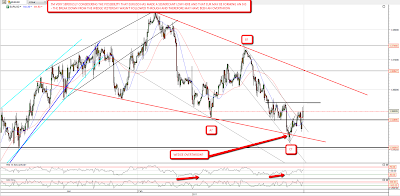
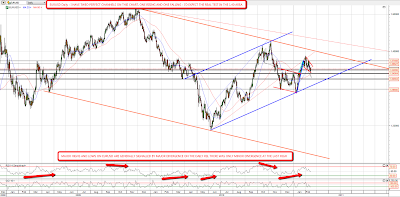
I know almost everyone seems to be expecting EURUSD to go much lower here but I have very serious doubts about that. I have two big active perfect channels on EURUSD, and the last high wasn't at a significant level on either. If this has been an ABC correction then I'd expect the real test to be in the 1.40 area, though to get there might break the main support trendline on USD. I'm watching EURUSD carefully here and at the moment I'm leaning long.Here's the EURUSD daily chart with the two major channels marked, one rising and the larger one falling:
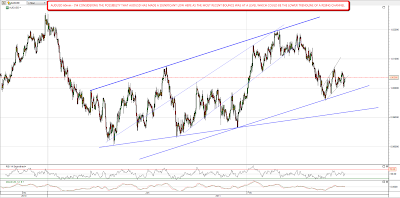
AUDUSD hasn't made my target trendline but I'm wondering now whether it will, as it bounced at a level yesterday which established a possible channel support trendline that is exactly parallel to the current resistance trendline. That may therefore have also been a significant low on AUDUSD:
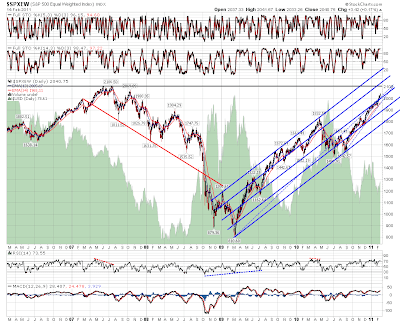
John Murphy posted an interesting chart the other day, and it was a chart of the SPXEW, the version of SPX that gives equal weight to the components. John Murphy made the point that the SPXEW, which gives much lower weights to financials particularly, is now almost back to the 2007 highs. There were a couple of interesting things to note about the four year chart, mainly that SPXEW has a perfect rising channel from the March 2009 low just like SPX, and that it made a lower high when SPX peaked in October 2007:
Looking at the move from the July 2010 low on the hourly chart I was surprised to see that there is no rising wedge on SPXEW. Instead we have another perfect rising channel, though we have been seeing a thorough test of the mid-channel line:

Food for thought. I'm leaning short without great conviction today, but we're still just below main rising wedge resistance on ES, and IWM looks due for some retracement here.

Upmove for U.S. Steel

By -

The correction in U.S. Steel (NYSE: X) from the Feb 4 high at 61.40 likely ended at last Thursday's low of 56.35, and a new upmove has emerged within the larger upleg off of the October low at 39.78. In addition, we can still view the past 10 months as a large, double-bottom pattern that broke out to the upside above 52.00 in December and still points to 65.00 to fulfill its optimal upside target. If my work proves correct, then X is heading immediately to challenge its Jan-Feb prior highs at 61.18-61.40, where I will be interested to see how it behaves.

326c8CLqr
Originally published on MPTrader.com.

Derivatives Overview Part 1 – (By Ultra Trading)

By -

This is a multi-part series that looks at the derivatives market to help understand the systemic risk these products represent to the global economy.  Unfortunately this problem was never resolved after the 2008 financial crisis.  One day it will have to be addressed. 


Wikipedia defines a derivative as:

"A financial instrument (or, more simply, an agreement between two parties) that has a value, based on the expected future price movements of the asset to which it is linked, called the underlying asset."


The most basic of derivatives would be the equity option such as a call.  Using the definition above, the derivative, the call option, is an agreement between the buyer and seller of the option, whose value is based on the future price of the underlying asset in this case, equity.  A 300 call option on AAPL is an agreement between a buyer and a seller and the value of the option is based on the price of the underlying asset, AAPL stock. 

Although scary in name, such as an Interest Rate Derivative, the product itself is relatively straightforward as will be discussed in future posts.  Derivatives are used for various reasons from speculation, increased leverage to arbitrage, but primarily as a hedge against risk.  They serve an important role in the world of finance but like anything moderation is key.


Derivatives can be broken down into two categories: 

  • Over The Counter (OTC)
  • Exchange-Traded


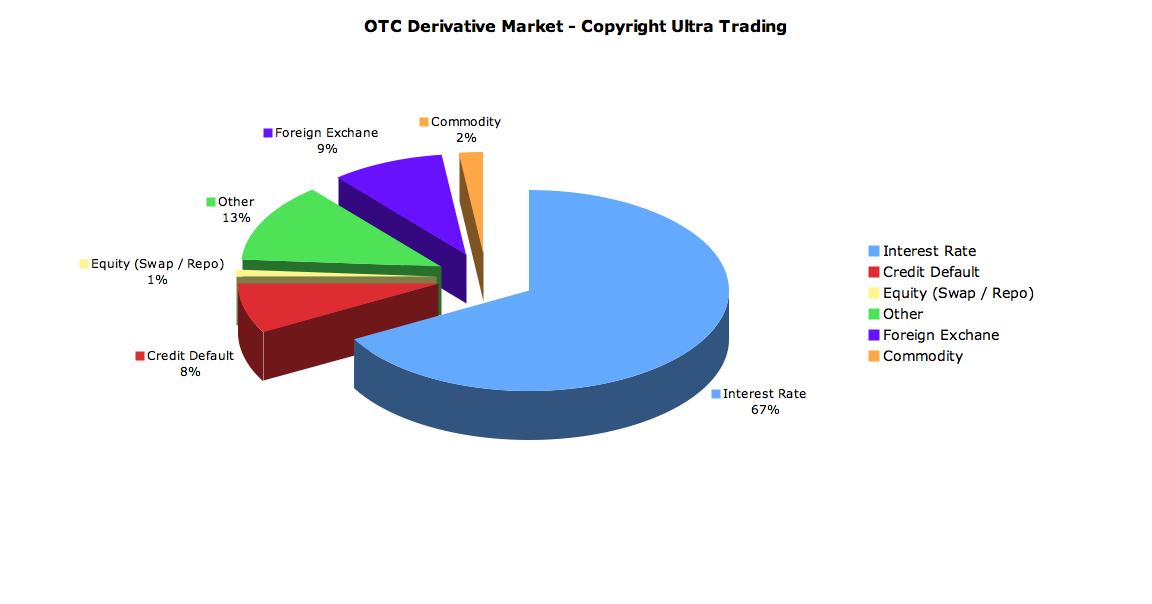
OTC is where we will focus as this represents the greatest risk to the global economy.  In the 2008 financial crisis, derivatives took center stage and became part of everyone's vocabulary. Unfortunately though, the 2008 financial crisis did very little to resolve inherent risks to the financial system.  As you will see the size of this market is truly beyond comprehension.


Global GDP in 2008 was roughly $58 trillion USD.

The notional value of OTC derivatives is 12 times greater at $684 trillion USD


Interest Rate Derivatives are by far the largest of the OTC derivatives market


Imagine an unregulated product that is 12 times greater than the GDP of the world.  Does that make any sense?  Anyone who thinks we have moved past the problems of the 2008 financial meltdown is kidding themselves.  This is a serious problem that must be understood, especially in a financial world where central banks have a heavy hand and whose actions often produce different results than intended. 

In future posts we will discuss various derivative products in depth and the risk of each to the global economy.


Submitted by Ultra Trading.  If you would like to read more, please visit - Ultra Trading

The Latest On The Irish Elections – Fine Gael Close To Majority (by Ultra Trading)

By -

With the Irish Parliamentary elections less than two weeks away (February 25, 2011) things are getting interesting.  The IMF, ECB, EU, German and French banks and pretty much anyone trying to protect senior debt holders must be squirming.  The most recent polls show the two opposition groups Labour and Fine Gael with a pretty decisive lead. They could join forces but Fine Gael currently at 38% could also win the 40% needed for a majority without Labour.


What is interesting about this and something bulls should fear are the following quotes from the Irish Times regarding the views of each party towards future bank bailouts.


From the Irish Times 

"THE LEADERS of the two main Opposition parties have ruled out any immediate recapitalisation of the banks if they are elected to form the next government."

"Under that renegotiation, Labour would insist on “burden sharing” with bondholders as part of bank restructuring, he said."

This would be a wonderful development should senior bond holders be forced to accept risk for a change.  

 Submitted by Ultra Trading.  If you would like to read more, please visit - Ultra Trading