

Slope of Hope Blog Posts

Slope initially began as a blog, so this is where most of the website’s content resides. Here we have tens of thousands of posts dating back over a decade. These are listed in reverse chronological order. Click on any category icon below to see posts tagged with that particular subject, or click on a word in the category cloud on the right side of the screen for more specific choices.

COT Report Week Ending 2/1 (by Ultra Trading)

By -

Some mixed messages come out of this week's CFTC Commitment of Traders Report. Below are six charts with my best estimate of what the data is telling us.  The three key takeaways are


  • Commercial traders appear positioned for further bond weakness
  • Commercial traders are reducing net short positions implying copper weakness 
  • Retail traders are positioned for further USD weakness, implying USD strength


Bonds

Looking purely at the relationship to 30 year yield and the SPX, this chart implies that further bond weakness (lower price higher yield) would be a positive for the SPX.  This cannot be taken purely at face value though.  There are many implications to a weakening bond market beyond this chart.  Still, the data below would imply continued equity strength.


Bonds – Commercial Net

Commercial positions continue to move towards a more net long in the face of 30 year weakness.  At face value this chart would imply further bond weakness to come.  It's important to note though that commercial positions are approaching a 52 week high.


USD – Commercial Net

This is a tough one to read.  The commercial trader position is net long and matches that of the prior 52 week high.  It is very possible their net long position grows but considering this position relative to the prior 52 weeks, it is quite possible they begin getting more short which would imply USD strength.  The USD has bounced off key support which would further argue for a reversal to a more short commercial net position.


USD – Commercial VS Retail Net

This next chart is that of the non reporting positions versus commercial positions.  Non reporting (retail) are relatively short versus prior times in the year so there is fuel for a short squeeze in the USD.  Hard to make any definitive call though.


Copper – Commercial Net

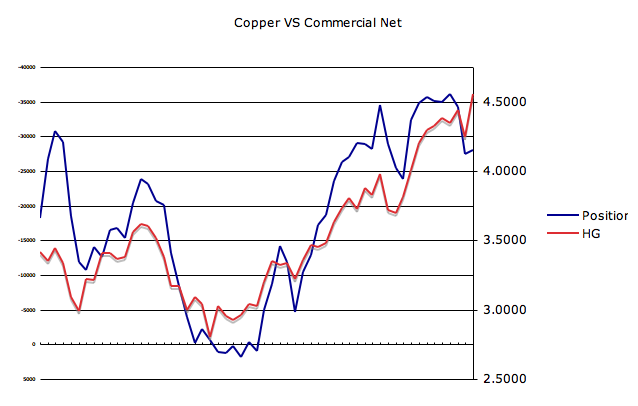
This is a rather interesting chart.  Copper caught a nice bid the past week yet the commercial traders are not buying it (literally).  They appear to be getting more net long (this  chart is inverted for comparison sake) which would imply pending copper weakness.
 

Copper – SPX VS Commercial

Nothing too definitive can be drawn here other than a word of caution for the SPX as commercial positions appear to becoming more net long (chart is inverted for comparison sake).


Submitted by Ultra Trading. If you would like to read more, please visit my blog - Ultra Trading


Weekly Sector Report | 02/04/11 (by Leisa)

By -

The bulls found their footing after stumbling the previous Friday. The broad market sector was up 2.75% Here's how the cylinders were firing on the markets' engine (click all images for enhanced viewing):

Moving to the industry level, here are the Top 10 Best/Worst performers:

The sharks are swimming in the current areas:

We close with the broad market index:

With this week's close, it has poked its price nose above the long volume bar that has previously acted as resistance. As usual, I have created a full report for you:

SPY Daily Recap (by Leaf West)

By -

Phoenix_04 Today was an important day with the pre-market release of the employment numbers … the report was a bit of a dud and it was quickly blamed on the weather.  The market took it in stride and all things pointed to the market being in a relatively positive mood for the day. (read my pre-market blog). 

My plan was to play for long scalps off of support areas and to not chase the SPY if it made new highs.  I didn’t think that there was enough “news” to provide the fuel for a real “gap & go” scenario so the high percentage trade was to sell resistance and buy support.

Let’s do this …


(more…)

QE Headwinds (by Ultra Trading)

By -

QE is a mighty force.  In ordinary times, global food riots and contraction in the labor force (36,000 jobs added does not cover the 150,000 needed for population growth) would cause a fierce sell off in equities. Not in these abnormal times where the perceived deep pockets of the Fed keep a perpetual bid in the market.   

The day QE ends there is a very high probability the race to the exits will be swift and fierce.  Investors are asking themselves how long can this go on.  The vast majority are saying QE2 will not end in June but rather continue indefinitely.  Perhaps the majority are correct although group think rarely works. The Fed's ultimate goal with QE was to drive demand back into the economy.  Whether it be perceived inflation (x will cost more tomorrow so I'll buy it today) or perceived wealth the theory is growth in demand causes growth in the economy thus causing more demand until finally the economy is self-sustaining.  

In the process the banking system is generating income by playing the role of broker between the Fed and Treasury.  So on the surface, from an academic standpoint it sounds good.  Like everything in life though there are unintended consequences.  These miscalculations or unforeseen problems can negate the benefit of the original plan.   One such problem is surfacing rapidly and if not addressed will create another shock to an already fragile banking system.

An economy grows through the creation of credit and the banking system is the heart of credit formation. The US economy is held hostage right now as the banking system, conservative in nature, takes its time to return to health.  The banking system has a balance sheet with vast exposure to residential and commercial real estate.  Should there be another leg down in that sector of the economy, the banking system will be challenged as it was in 2008.   

Unfortunately for the banking system, home prices began their second leg down once the final tax credits wore off in October 2010.  This new leg down could experience a rather vicious  cycle.  Studies have shown a strong correlation between the level of negative equity in a home and one's decision to strategically default.  The industry is currently working through a massive shadow inventory that will cause pricing pressure for years.   The more prices fall, the more the shadow inventory grows due to strategic defaults and thus the problem grows. 

The last thing the industry needs right now is anything that puts additional downward pressure on price. Unfortunately, due to the Fed's QE monetary policy and horrific US fiscal policy, a very real threat has risen in the form of higher interest rates.  

Here's an example.  The debt service on a $300,000 mortgage at 4.75% for 30 years is $1,564 per month. The debt service on the same mortgage at 5.00% is $1,610.  In other words that buyer in a 5.00% interest rate environment can now afford a home 3% lower in price.  Over the past three months, the ten year treasury has risen 100 basis points in yield.  That's four times the example above.

Should this trend continue the bank balance sheet risk and reduction in wealth affect from one's home will have massive implications to an already fragile economy.  The economy will be faced with a reduction in demand and in the formation of credit.  Two very strong headwinds and two which easily can outweigh the benefits of the original goals of QE.  

Submitted by Ultra Trading.  If you would like to read more, please visit my blog at - Ultra Trading

The Newest Status Symbol

By -

Here in Palo Alto (whose weather, for the benefit of snow-bound Chicago viewers, can be seen here) there's a weird new phenomenon going on. It basically involves a person being given the opportunity to be made rich beyond the dreams of avarice and then refusing that offer.

It's the newest kind of status symbol. Just yesterday, the founder of Path.com – a startup about which I've never heard anything – was offered $100,000,000 (that's one hundred million dollars – – say it Dr. Evil style for the full effect) by Google, and he told them to go jump in a lake. It seems Google is becoming a bit of an expert in getting the cold shoulder:

0203-turndown

I was sort of wondering what kind of amazing, world-changing application could come from a new company that would garner such a high price tag. Well – brace yourselves – here it is:

0203-path

Yep. It's an iPhone application that lets you share pictures in some oh-so-sexy social way. I'm guessing their annual revenue is $0,000,000 right now.

Groupon's recent dismissal of Google's $6,000,000,000 offer was even more extraordinary. It wasn't that many years ago that Apple had a market cap of about that amount. Now an online coupon provider with countless imitators has done the same.

My view is that this is just a new twist of what the Silicon Valley went through in the late 1990s, except this time, the payday is massively inflated purchase prices from giant firms as opposed to IPOs. Back in the late 1990s, when I saw firms like TheGlobe.com (remember them?) go public to wild acclaim, I figured I must be somehow retarded in not understanding what was happening. My fears of retardation lasted years, actually, because the bubble blew up from 1995 to early 2000, but in the end, the bubble burst.

This new bubble could have years of life left. We could well see Facebook go public, and Groupon, and LinkedIn (hell, they are coming public – what – this week?), Zynga, and God knows what else. Successful IPOs – and Lord knows Facebook's will be successful – will just spur on smaller companies to join the frenzy. We could well be in the equivalent of 1996 right now when viewed through the lens of the 1995-2000 bubble. Irrational markets tend to chafe me, but there's nothing I can do about it.

As for the folks turning their noses up at getting insanely rich, it could go either way. The founders of Google tried to sell their product to Yahoo for a million dollars back in 1998 or so, and Yahoo told them to get lost. If you had asked the Yahoo management team what the chances were of those kids completely crushing Yahoo within a few years, they would have been too busy laughing to give you a probability.

On the other hand, the guy who founded Pointcast back in 1994 (or thereabouts) was offered $400 million by Rupert Murdoch, and after he refused, Pointcast wasn't around very long until it became utterly irrelevant. Something tells me he wishes he had said yes.

Note to Google: if you want to buy a really nice financial blog for $50 million, I won't say no. I'll even keep writing for you for a while. Drop me a line.