
Slope of Hope Blog Posts

Slope initially began as a blog, so this is where most of the website’s content resides. Here we have tens of thousands of posts dating back over a decade. These are listed in reverse chronological order. Click on any category icon below to see posts tagged with that particular subject, or click on a word in the category cloud on the right side of the screen for more specific choices.

Another QE Head Wind (by Ultra Trading)

By -

The US equity market may be experiencing low volatility but beyond that HFT driven "market" volatility is rising fast. There are a lot of moving parts right now, each of which on their own could cause a severe shock to an extremely fragile global economy.  It is important to stay focused on what is out there and the risks they present.  Maintaining a false sense of security regarding the future of QE is ignoring the real investment risks that are present today.  One does not know when nor which event will be the tipping point so patience is needed.  It's important though to stay focused and educated so when events surface as investors we are ready to react.

I want to focus on global food prices, primarily the recent price action in rice.  Below is an excerpt from a  2009 USAID Study 

"Approximately 1 billion people—or one sixth of the world’s population—subsist on less than $1 per day. Of this population, 162 million survive on less than $0.50 per day. At the household level, increasing food prices have the greatest effect on poor and food-insecure populations, who spend 50 to 60 percent or more of their income on food, according to the International Food Policy Research Institute (IFPRI). Overall, increased food prices particularly affect developing countries, and the poorest people within those countries, where populations spend a larger proportional share of income on basic food commodities."

Even within the US, food prices affect one in seven Americans.  That is because 15% of the US population does not have the income to pay for the most basic necessity of life and that is food. Rice is one of the largest staples of the global diet and its recent price action is signaling yet another threat.  

This heat map of rice consumption per capita shows Asia as the most at risk to rising rice prices


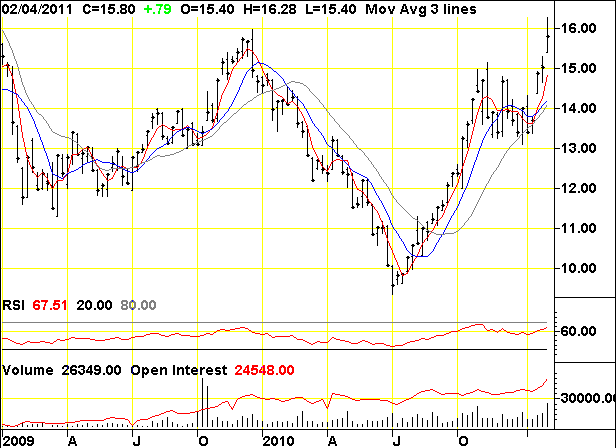
Rice prices in 2010 relative to the 2007-08 highs are relatively low but as the chart shows, price can accelerate very quickly. 


The chart below shows just how fast prices have begun to move since 2009.  In fact the prior resistance level has already been taken out and a massive melt up is not only possible but also probable.  We are in a yield chasing environment right now.  Those who missed the move up in sugar and cotton, etc will pile in to the rice trade and accelerate this move.  
 

 "It's really very simple Governor, when people are hungry they die…"  Bob Geldoff

 Submitted by Ultra Trading.  If you would like to read more, please visit m blog - Ultra Trading
Broken Metal

By -

I think there's only one genuinely technically broken market right now, and that is (allow me a moment to don my suit of armor…..…) precious metals. Below is the gold/silver sector chart. I seriously think that GLD, SLV, and GDX are all poised for meaningful drops. The equity indexes are all still annoyingly, agonizingly, irritatingly strong. But metals………they're bear-ready.

0207-xauwedge

Wild Thing (by Springheel Jack)

By -

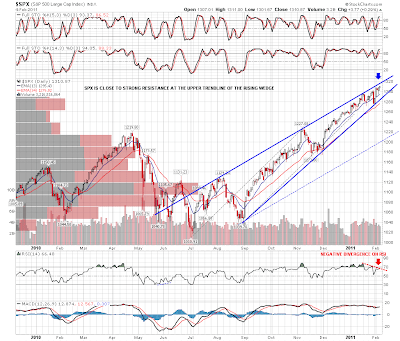
Looking at equities over the last few months, I'm sure the same question occurs to many of us. Can anything stop this wild thing from rising before QE2 finally finishes in June? That's a good question, and no-one knows the answer to that for sure. What we do know though is that there is a solid resistance trendline on SPX that has held so far since this moon shot started in late August, and that we're now just below it again. Until that trendline breaks it has to be regarded as the rising ceiling on SPX, and there is increasing negative divergence on the daily RSI that is suggesting that it shouldn't be broken now:

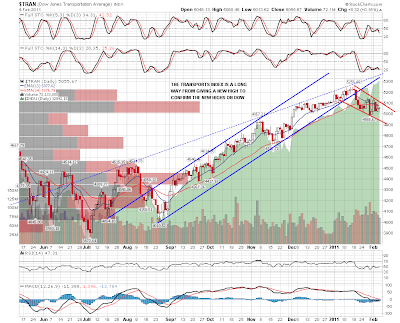
Looking around the other indices the Transports index is still a long way from confirming the recent highs on Dow:

The SPX is leading now, with Nasdaq and the Russell 2000 trailing behind.On IWM (Russell 2000) the broken support trendline has been acting as effective resistance:

One chart that sprang to the eye this morning as I was browsing through my indicator charts was the weekly chart for the Baltic Dry Index, which is in a very ugly place, and looks as though it might soon test the crash lows. The divergence between the BDI and the Transports index is very glaring. Interesting, though I don't think that it tells us a lot other than to say that over-ordering of new ships near the top of the last bubble has led to massive overcapacity now. Still, shippers with low debt might be an interesting long here:

There's not a lot in terms of interesting short term patterns this morning. NQ broke the broadening descending wedge on Friday and made the pattern target overnight, oil may be forming an H&S to resume the decline that was firmly established before the riots in Egypt the Friday before last, and obviously we're just below resistance on a number of indices. The most interesting thing I'm looking at this morning is on AUDUSD, where a serious support break is in progress, and we could well see a 200 pip drop to the support trendline within the current broadening ascending wedge:

Mondays have been very bullish lately and I'm doubtful about seeing any significant downside today. Unless we see resistance break on SPX however, I'm leaning bearish for this week.