Slope of Hope Blog Posts

Slope initially began as a blog, so this is where most of the website’s content resides. Here we have tens of thousands of posts dating back over a decade. These are listed in reverse chronological order. Click on any category icon below to see posts tagged with that particular subject, or click on a word in the category cloud on the right side of the screen for more specific choices.

WHAT Financial Crisis?

By -

Below is a simple graph with a simple point. It is the top portion of the chart of IWM, the Russell 2000 ETF. As you can see, it is presently as high as it was at the very peak – – the lifetime high – – of the market. I've also tinted the giant spike you see in green to note that it is not a data error, but the bullish equivalent of a "flash crash" that happened on September 19, 2008.

This chart shows that, as far as small caps are concerned, it's like the financial crisis never even happened. Astonishing.

0208-iwm

Wedge Hits (by Springheel Jack)

By -

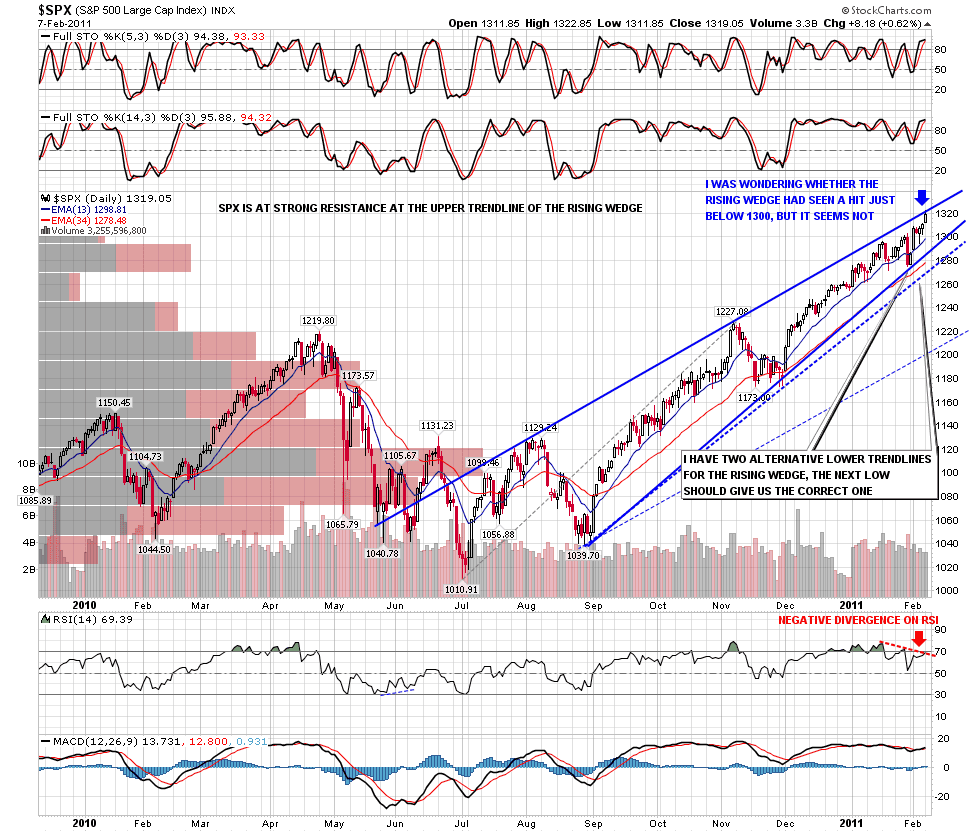
There's fair amount of art as well as science to drawing trendlines. Sometimes it's easy enough with a series of well lined up points, but sometimes, particularly with candlesticks, there are judgement calls that need to be made, and the trendlines are somewhat mushy as a result. I'd drawn the upper trendline of the SPX rising wedge a little lower as I thought the first high under 1300 might be a marginal hit, but the high yesterday was a perfect hit, so I've restored it to its original angle. As well as the wedge trendline hit SPX is also showing strong negative divergence on the daily chart, so I'm expecting a retracement today and tomorrow. I still have two alternative lower trendlines though and I'm expecting the next low to clarify the lower trendline too:

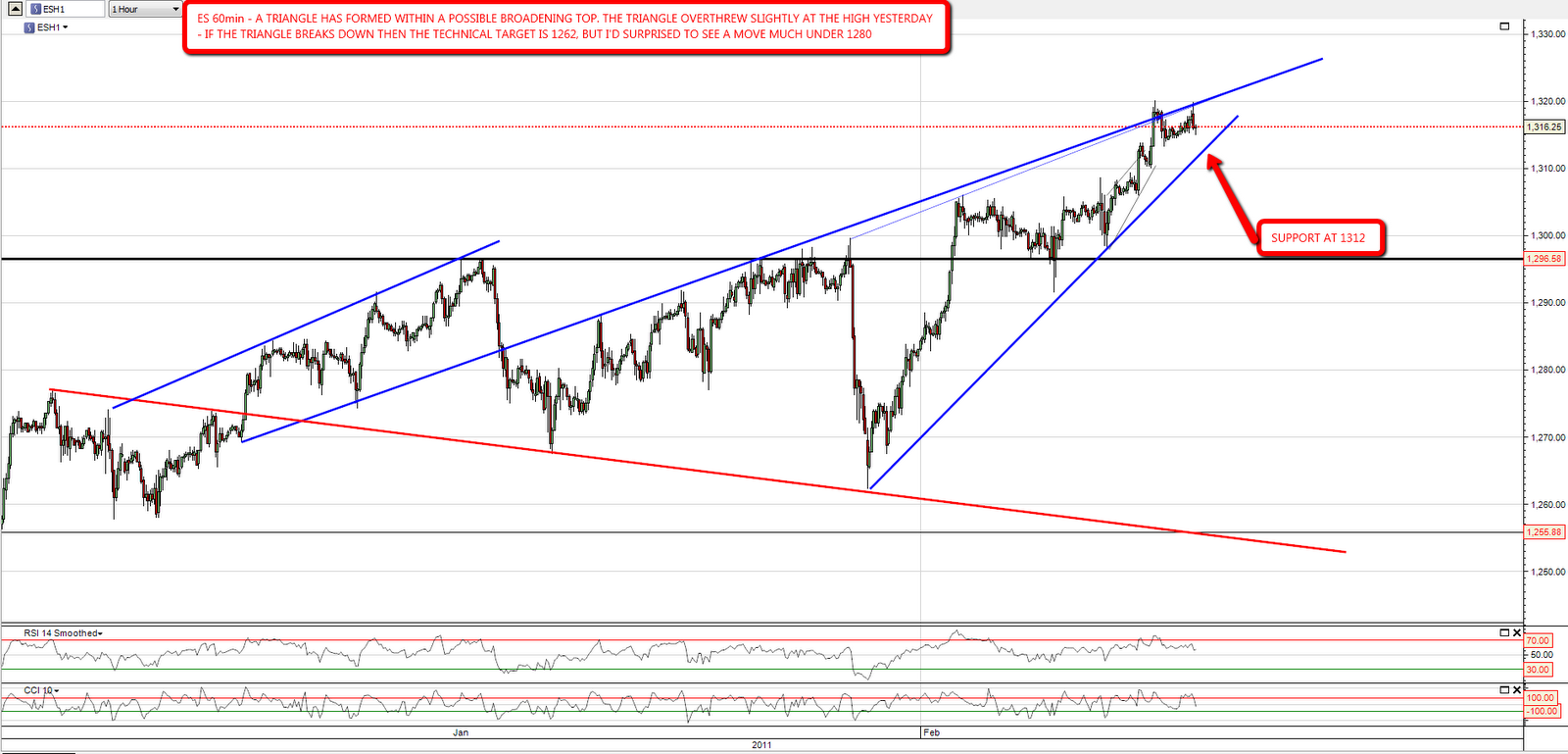
On ES the action for recent days has crystallised into a triangle, which overthrew slightly at the high yesterday and has not yet broken downwards. Triangle support is at 1312, and the target for the triangle is 1262, but we're not going to make that unless the wedge breaks down, which would surprise me. I'll be looking for the low in the 1274-1290 area with the probabilities weighted towards the higher end of that range, and there is strong support in the 1300 area that has to be broken first:

NQ looks less ambitious. The short term rising wedge broke down into a rising channel overnight, and as I suggested was probable on the chart, the channel has now in turn broken down. The wedge target is in the 2295 area and we have some decent support in the 2318 area to get through first:

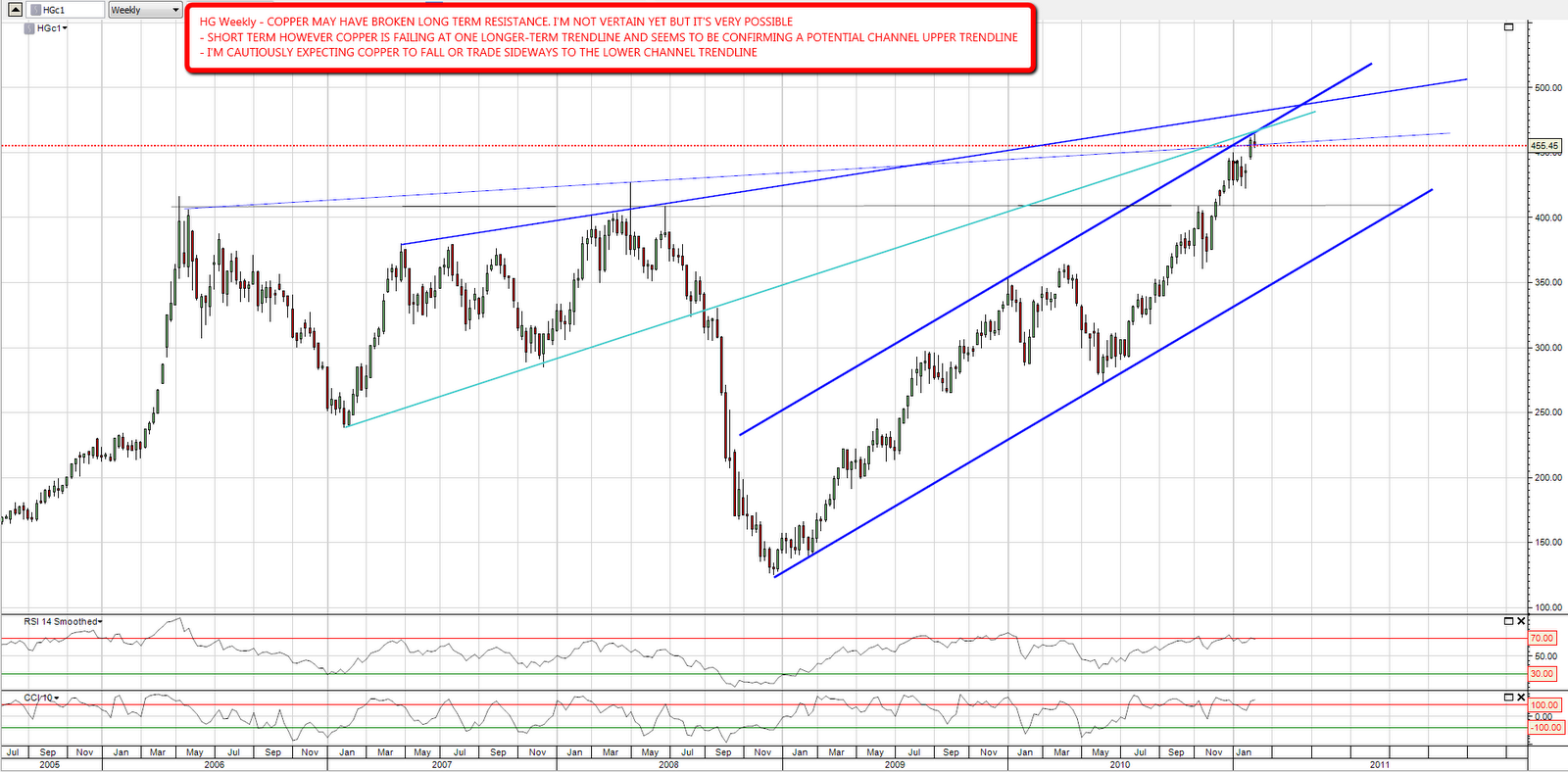
I've been giving the copper chart a lot of thought. As I mentioned copper broke through my long term resistance trendline but it isn't quite as clear as that. Very long term resistance is definitely broken, and copper might well now go higher, but in the short term it has reversed at one longer term trendline and also at a previously unproved medium term rising channel upper trendline. There's also negative divergence on the weekly RSI and MACD, so the odds of a multi-week retracement look good here.

The copper weekly chart is arguing for a deep retracement here to somewhere between 355 and 380 depending on the time taken to retrace, and I don't know whether we'll see that, but on the hourly the short-term support trendline is broken and a small H&S has formed with a target at 443:

Overall the short side is looking very good today, with a dip more than likely coming our way. I'll be expecting to buy that dip, though I'll be watching in case the rising wedge breaks down. We're coming close in time and price however to my upside target near 1381 SPX in late March or early April, and I'm becoming doubtful that we'll see a deep retracement before then so unless we see that break I'll JBTFD.

Fed – Extended Period (by Ultra Trading)

By -

The Fed has clearly stated its policy regarding the Federal Funds rate with each monetary statement

"The Committee will maintain the target range for the federal funds rate at 0 to 1/4 percent and continues to anticipate that economic conditions, including low rates of resource utilization, subdued inflation trends, and stable inflation expectations, are likely to warrant exceptionally low levels of the federal funds rate for an extended period."

Let's take a look at other rates which are less controllable by the Fed as witnessed by changes since August 2 when hints of QE began surfacing.


  • 1 Month: gained 1 bp (basis point)
  • 6 Month: gained 2 bp
  • 2 Year: gained 21 bp
  • 5 Year: gained 63 bp
  • 10 Year: gained 67 bp
  • 30 Year: gained 67 bp


So the shorter end of the curve the Fed has managed to keep rates low but as you move further out on the curve rates have clearly moved up in the face of a monetary policy intended to keep rates low.  If you remember when Bernanke gave his 60 Minutes special he clearly says at 6:45 in the video – "What we are doing is lowering interest rates…"

Clearly QE in the eyes of the Fed is not working and they know that.  They have shifted the bar of success to equity performance but don't lose site of the Fed's failure to achieve a low interest rate environment for an extended period.  They have in fact lost control of the yield curve beyond one year.


  • Recently Fitch issued a report that 30% of commercial real estate that needs to be rolled in 2011 do not meet their standards.  


  • Residential mortgage is negatively impacted by rising 10 year yield. 


Regardless of what Bernanke may say publicly about the success of QE they understand its failures and they understand the extreme negative impact rising interest rates will have on future growth, bank balance sheet risk and credit formation.

Listen to Bernanke in the video below discuss employment.  He's very concerned and this was only two months ago.  Either QE is going to occur for the 4-5 years he says it will take for unemployment to come down to acceptable levels or the Fed will be looking for a way to save face while exiting future QE.  If this move in rates continues, the bond market may very well set future monetary policy and NOT the Fed.


Submitted by Ultra Trading.  If you would like to read more, please visit - Ultra Trading

Picking Off the Sissies, Again

By -

NFTRH 'charter' subscriber and 'Gold This Morning' blog contributor, Jonathan relayed the beautiful title phrase to me in Q4 of 2008 as we both became bullish during Armageddon '08. NFTRH9 noted…

"Yes Gary, I spoke last night with one of the legendary street traders from the old days (pre 1990). He wants to leave Miami and work free at our shop because he has never seen a time when there is more money to be made the old fashioned way… picking off the sissies."

The best traders know when it is time to get opposite the herd. This is not easy to do because the act of being contrary by definition comes with much more negative reinforcement than anything else. Trend followers are awfully right for long stretches of time, until they are suddenly wrong, and go into hiding… or revision mode. Become known as a bull, bear, stock, precious metals or commodity guru, stake out your territory, and then blame the manipulators when the violent turn comes. This is a tried and true tradition in market analysis.

Being a successful contrary player is different, however. If I am doing my job correctly, I am pissing off bulls, bears, gold bugs, commodity gurus and deflationists at varying times, and as their respective favored trends mature. It is imperative not to join any of these teams.

Sure, I have been big picture bullish the gold sector for nearly a decade now, but as noted several times in the past, I would rather not have to be. If I were not bullish on gold, it would mean that I lived in a society and participated in an economy that was in the sweet spot of a secular cycle yet to come, like in 1980, as Paul Volcker got serious about regaining austere control through monetary policy aimed at regaining real confidence in the system.

Volcker did not just talk the talk; he walked the walk and took interest rates as high as they needed to go to show he was serious. It can be argued that he created a wellspring of goodwill that subsequent Fed officials have opened up as a trough for herds of pigs to drink, wallow in and ultimately, pollute.

Timecover

In November of 2008, the 'sissies' theme was put forth in reference to getting bullish on many asset classes, markets and in my case at least, getting bearish on the Deflation argument, which the public had quickly gotten up to speed on, as evidenced by the Time cover that was also included in NFTRH9.

As noted last week, I cannot apologize for the bullish contrarian signals currently popping up in gold, nor the fundamental ones. Does NFTRH have a preordained right to be well, right? If it had that key, I would not be spending two thirds of my weekend writing and editing the newsletter.

But bear in mind that the writer claiming risk is sharply reduced in gold today is the same one who got certain gold boosters' pants in a bunch with some downside targets just weeks ago. There are times to be appropriately bullish, and times to be guarded. It is okay, and it is all part of a bull market. Cheering and bashing are just noise.

What I currently see in gold is a cocksure arrogance creeping in among the usual trend follower suspects that the monetary metal has made an important top. One might assume this is due to the gold bear not having been on board the secular run (the bull market has thrived on these people all the way up), or possibly due to his having been burned badly, compliments of the actions of Mr. Volcker, in 1980.

From 1980 on, gold was a four letter word to my parents after being 'put in' by a stockbroker at the very freaking top. Today, with a little help from their hard working boy, they are doing much better (with the modest funds they were able to bring themselves to allocate) where gold is concerned. And I do not intend to have them sitting there like bag holders when the bull market peaks, either.

As stated in NFTRH120, 'Nominal gold is bullish on a risk vs. reward basis; in fact, it is compellingly so.' This week we will again review many of the fundamental and technical reasons why, and also importantly, review gold's relation to other assets to see if its 'real' price is any closer to indicating whether the 'gold stocks above all others' stance remains on track [edit: after completing NFTRH121 on Jan. 30th, the gold stock investment (as opposed to trading) case has not improved, as explained later in the report]. This in turn, may help indicate coming events in the broad markets, commodities and economies as well.

http://www.biiwii.blogspot.com

http://www.biiwii.com