
Slope of Hope Blog Posts

Slope initially began as a blog, so this is where most of the website’s content resides. Here we have tens of thousands of posts dating back over a decade. These are listed in reverse chronological order. Click on any category icon below to see posts tagged with that particular subject, or click on a word in the category cloud on the right side of the screen for more specific choices.

Hedging Update — ETFs

By -

The Chicago Board Options Exchange Market Volatility Index (VIX) rose 4.47% Thursday, to close at 20.80. The table below shows the costs, as of Thursday's close, of hedging 18 of the 20 most actively-traded ETFs against greater-than-20% declines over the next several months, using the optimal puts for that. First, a reminder about what optimal puts mean in this context, and why I've used 20% as a decline threshold.

Optimal Puts

Optimal puts are the ones that will give you the level of protection you want at the lowest possible cost. As University of Maine finance professor Dr. Robert Strong, CFA has noted, picking the most economical puts can be a complicated task. With Portfolio Armor (available on the web, and as an Apple iOS app), you just enter the symbol of the stock or ETF you're looking to hedge, the number of shares you own, and the maximum decline you're willing to risk (your threshold). Then the app uses an algorithm developed by a finance academic to sort through and analyze all of the available puts for your position, scanning for the optimal ones (there's an example of this, with screen shots, in this article).

Decline Thresholds

You can enter any percentage you like for a threshold when using Portfolio Armor (the higher the percentage though, the greater the chance you will find optimal puts for your position). The idea for a 20% threshold comes, as I've mentioned before, from a comment fund manager John Hussman made in a market commentary in October 2008: 

An intolerable loss, in my view, is one that requires a heroic recovery simply to break even … a short-term loss of 20%, particularly after the market has become severely depressed, should not be at all intolerable to long-term investors because such losses are generally reversed in the first few months of an advance (or even a powerful bear market rally).

Essentially, 20% is a large enough threshold that it reduces the cost of hedging but not so large that it precludes a recovery. When hedging, cost is always a concern, which is where optimal puts come in.

How Costs Are Calculated

To be conservative, Portfolio Armor calculated the costs below based on the ask prices of the optimal put options. In practice, though, an investor may be able to buy some of these put options for less (i.e., at a price between the bid and the ask).

Why There Were No Optimal Puts for TZA and FAZ

In some cases, the cost of protection may be greater than the loss you are looking to hedge against. That was the case with the Direxion Small Cap Bear 3X (TZA) and the Direxion Daily Financial Bear 3X (FAZ). As of Thursday's close, the cost of protecting against greater-than-20% declines in those ETFs over the next several months was itself greater than 20%. Because of that, Portfolio Armor indicated that no optimal contracts were found for them.

Hedging costs as of Thursday

The data in the table below is as of Thursday's close. The ETFs are listed in order trading volume Thursday, with the most actively-traded name (SPY) at the top.

Symbol

Name

Cost of Protection (as % of position value)

SPY

SPDR S&P 500

1.80%*

XLF Financial Select Sector SPDR 3.23%*
QQQ QQQ Trust 2.68%*
IWM iShares Russell 2000 Index 2.93%*
SLV iShares Silver Trust 5.05%*
EEM iShares MSCI Emerging Markets 2.80%*
EWJ iShares MSCI Japan 1.89%*
FAS Direxion Financial Bear 3X 17.31%*
SDS ProShares Ultra Short S&P 500 4.12%*
VWO Vanguard MSCI Emerging MKTS 3.48%*
EFA iShares MSCI EAFE Index 3.12%*
TZA Direxion Small Cap Bear 3X No Optimal Puts
XLE Select Sector SPDR — Energy 3.10%*
FXI iShares FTSE China 25 Index 2.94%*
XLI Industrial Select Sector SPDR 2.03%*
SSO ProShares Ultra S&P 500 7.30%*
GLD SPDR Gold Shares 0.43%*
SMH Semiconductor HOLDRs 4.87%*
GDX Market Vectors Gold Miners 4.03%*
FAZ Direxion Daily Financial Bear 3X No Optimal Puts

*Based on optimal puts expiring in January, 2012.

July Opex (by Springheel Jack)

By -

This hasn't been a great week for trendlines, and I've been struggling to find anything interesting to show short term in terms of channels or patterns as a result. Yesterday I had two channels on ES, one rising and the other declining, and neither survived the day. Some weeks are like that. I do have a sort of falling wedge building on the SPX 15min, though I'm not that happy with the quality of it as yet:

On the TF 15min I have a reasonably good declining channel, though I'd like another touch of the lower trendline to strengthen it:

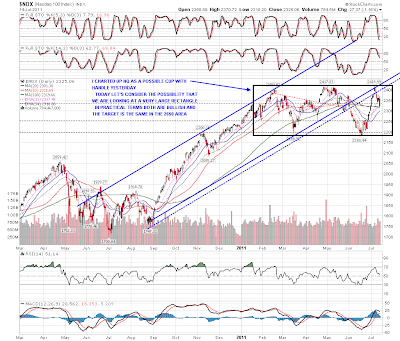
I have nothing short term on NDX really, but having looked at the bigger picture as a forming cup and handle yesterday, I'd like to consider the possibility today that it might be a rectangle. it isn't as nice a setup as a rectangle, but it is still a significant possibility, and if we see a retest of the lows from here, that will become a strong possibility:

I've mentioned before that I tend to read Cobra's blog most mornings as there's often something of interest to read there. He was talking last night about the relative weakness of RSP, the equal-weighted S&P 500 ETF, and I've charted that up against SPY this morning. I've shown both ETFs with the bollinger bands and added a relative RSP:SPY trendline at the top. As you can see SPY is resting on the daily 20 SMA (the middle bollinger band) whereas RSP has already broken it. Cobra was suggesting that this means that the internals on SPY are worse than they appear, with some relatively strong large cap stocks masking greater overall weakness. Interestingly though, as you can see from the relative trendline, relative RSP strength in May preceded the slide to the lows in the first half of June:

Oil's looking interesting today, with a symmetrical triangle forming on the CL (Sept) chart. The next obvious move is to triangle resistance in the 99.5 area, and it has already moved up an encouraging 50 pips since I capped this chart (and went long):

Before I broke my leg I had started to do more individual stock charts and posting these at SharePlanner and I've let that slip since. I'm going to start doing more of these again, and am planning a big project to track hundreds of these through a huge spreadsheet with a chartist friend. That's going to occupy a lot of my time over the next few weeks and though I'll still be doing these posts every day, I may not be around much of the rest of the time as I clear everything else from my desk, and then do and collate the thousand or more charts over various timeframes that this project will need. Just for a taster of the many setups that I am hoping to extract from this project here is the four year chart of JNJ showing why it is looking an attractive short at the current levels:

On the long side I've been watching JPM post-earnings to see whether it can break out of the declining channel from early April. If it can, much as I'm not wild about bank stocks generally, it will look a very strong buy. Here's the declining channel on the 60min chart:

Why would JPM look such a strong buy on a break up? Well for that you need to look at the weekly chart really, where an IHS has been forming since September 2009. Obviously it's a continuation IHS, but you often see those play out and the target is an attractive 61. On the even bigger picture though, and this is obviously very speculative, that IHS is just the right shoulder on a much larger continuation IHS indicating to 81. Can that target be made? Impossible to say, but 48-50 has been such a strong ceiling on this stock for so long that a break up over it could run a long way. At the least it looks worth a punt from 41.5 if JPM breaks the current declining channel:

It's July opex today and those have been down 6 of the last 10 years on the Dow. The stats for the week after July expiration aren't great either with Dow down 7 of the last 12. We've been seeing a strong pattern in the last few days of a strong start to the day, with an early high and then weakness for the rest of the day. We might well see that again today

I have a question for my readers. My brother has asked me for a decent ETF to short banks with over a period of several months to a couple of years. This is intended as a hedge. Are there any recommends of what I would expect should be a 1X short ETF with historically decent inverse tracking over longer periods? Leveraged short ETF suggestions would be welcome too but not if those ETFs tend to degenerate quickly with a high theta burn. Suggestions invited 🙂