

Hey fellow Slopers,
Below is a quick look at the current hedging costs for a few tech companies that went public this year. Before that, though, a quick note about a non-public company Tim blogged about Tuesday, Color ("Update on Color Silliness"). Checking AppShopper's top 200 grossing list for social networking apps, still no Color as of Tuesday night. On to the hedging costs of recent tech IPOs.
High hedging costs for newly public tech stocks
Now that options are traded Groupon Inc. (GRPN), it's possible to hedge it with protective puts — possible, but extremely expensive to do so. And it's even more expensive to hedge Pandora (P) now. Investors in those stocks looking to reduce their risk might be better off just selling their positions and engaging in deep introspection about why they bought them in the first place (Groupon investors may want to also read Goatmug's Slope of Hope about the company, "GROUPON – A Bad Taste In Your Mouth"). The table below shows the costs, as of Tuesday's close, of hedging Groupon, Pandora, and LinkedIn (LNKD) against greater-than-37% declines over the next several months, using optimal puts.
A comparison
For comparison purposes, I've also added the cost of hedging Microsoft (MSFT), Google (GOOG), and the PowerShares QQQ Trust ETF (QQQ) against the same decline. First, a reminder about what optimal puts are, and a note about why I've used 37% as a decline threshold this time; then, a screen capture showing the optimal puts to hedge Pandora.
About Optimal Puts
Optimal puts are the ones that will give you the level of protection you want at the lowest possible cost. Portfolio Armor (available on the web and as an Apple iOS app), uses an algorithm developed by a finance Ph.D to sort through and analyze all of the available puts for your stocks and ETFs, scanning for the optimal ones..
Decline Thresholds
In this context, "threshold" is the maximum decline you are willing to risk. You can enter any percentage you like for a decline threshold when scanning for optimal puts (the higher the percentage though, the greater the chance you will find optimal puts for your position). In the past, when looking at the hedging costs of Internet stocks I've used 25% decline thresholds, but Groupon, Inc. and Pandora Media, Inc. were too expensive to hedge against greater-than-25% declines (i.e., the cost of hedging them against 25% declines was itself more than 25% of position value, so Portfolio Armor indicated there were no optimal contracts available for them). 37% was the smallest decline threshold for which there were optimal contracts for Pandora, so that's the decline threshold I've used for all of the names here, to compare apples to apples.
The optimal puts for P
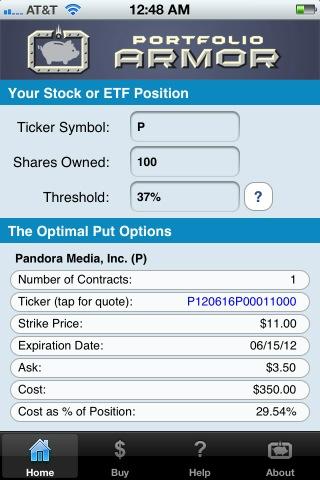
Below is a screen capture showing the optimal put option contract to buy to hedge 100 shares of P against a greater-than-37% drop between now and June 15, 2012. A note about these optimal put options and their cost: to be conservative, Portfolio Armor calculated the cost based on the ask price of the optimal puts. In practice an investor can often purchase puts for a lower price, i.e., some price between the bid and the ask.
Hedging costs as of Tuesday's close
The table below shows the costs of hedging these names against greater-than-37% declines over the next several months. Costs are presented as percentages of position value.
|
Symbol |
Name |
Hedging Cost |
| Recent Tech IPOs | ||
| GRPN | Groupon, Inc. | 15.5%* |
| LNKD | 13.5%** | |
| P | Pandora Media, Inc. | 29.5%*** |
| Comparisons | ||
| GOOG | Google, Inc. | 1.29%*** |
| MSFT | Microsoft Corporation | 0.89%* |
| QQQ | PowerShares QQQ Trust | 1.69%*** |
*Based on optimal puts expiring in April, 2012
**Based on optimal puts expiring in May, 2012
***Based on optimal puts expiring in June, 2012
