

Weekend Getaway (To the Year 2034)
Would you like to take a road trip? Yes? This is a trip to the future, to the year 2034. We’re going to accompany Ryan and Brittany, a couple in Knoxville, on an imaginary trip to Orlando, where they will spend a three day weekend with Ryan’s parents.
Our journey begins on a Friday morning at our lovely couple’s home, with Ryan busily planning their trip. It started a few minutes ago when his parents invited him and his wife down for the holiday. Ryan plans to take their car. Like most cars today, the couple’s car has an autonomous driving mode, making it a fast and easy trip, and allowing them to relax virtually the entire time on the road. Ryan’s parents expect them for dinner on Saturday; since they’ve made the trip before, Ryan knows leaving at 9 AM will get them to his parent’s house in plenty of time.
Ryan will use the home’s main computer to help with the planning. Each room in their house has interactive voice capability, which is also integrated with their mobile devices. Ryan only has to say “We’d like to go to my parent’s house tomorrow for the holidays” and the home’s computer responds “When do you want to leave, how long will you be staying, and how would you like to travel?” Ryan answers “Tomorrow morning around 9, we’ll take our car, and come home on Monday afternoon.” The computer voice replies with a dejected “That’s not much notice. I’ll check but don’t get your hopes up.” A few seconds later “Sorry, unless you can leave at 6 all of the morning time slots for a private vehicle trip to Orlando are already taken. I can show you some other options on the TV.” The computer turns the TV on, and shows Ryan a display of the different ways he and Brittany can get to Orlando. If he takes their car without a highway driving reservation he’ll be forced to get off the main road several times, adding hours to his trip. However, there are still some bus and train spots open that the computer recommends they consider. Ryan sees that there’s a regional bus leaving the Chattanooga travel center at 11:19 AM that gets them to Orlando before 5 PM Saturday afternoon; they can take their car to Chattanooga and the bus to Orlando. The display shows the costs and schedules for each option, and has also confirmed that Ryan’s parents will be able to pick them up at the travel center in Orlando. He tells the computer they’ll take the bus, and the computer makes the arrangements.
On Saturday morning, Ryan and Brittany load their suitcases into the car, and settle in. The car already has the trip scheduled. Ryan says to the car’s computer “We’re ready to leave” to which the computer responds “Please confirm your destination: the regional travel center automobile lot at the intersection of I-75 and I-26.” Ryan says “That’s it” and the computer responds “Thank you. Expected arrival time is 10:59 AM. I am confirming our departure with the Travel Monitor system now, for your reservation made yesterday.” Although Ryan is sitting in the driver’s seat, he lets the car do the driving, as required by their reservations. The car backs out of their driveway, winds through the development and the local streets, and heads towards highway I-40/I-75 which goes to Chattanooga. As they approach the entrance ramp, the computer announces “There will be a 3 minute delay until our assigned travel slot is available.” And then the car warns: “Accelerating to highway speed and merging in 12 seconds.” The highway is nearly packed full, with trucks, busses, and cars; there is hardly a car length open as far as Ryan can see, but traffic is still moving briskly. He and Brittany have learned to close their eyes during a merge onto a highway. The car suddenly zooms forward at full acceleration, up the ramp and onto the short acceleration lane. A truck that had been tailgating another truck next to the acceleration lane magically slows a bit; the opening it leaves to the truck in front is hardly more than a car length, but our couple’s car moves quickly into the space just a few feet behind the lead truck. Ryan guesses the trucks are going at least 75 miles an hour, but that is too slow for their car.
A second later the car leaves the right lane and moves into an opening in the middle lane, accelerating again; the computer simply tells them “Achieving highway speed, arriving at travel center in 82 minutes.” Exactly 82 minutes later the car exits the highway into the immense parking lot of the Chattanooga travel center, while the computer warns “At travel center parking lot, detailed directions required”. Ryan decides to park the car himself and disengages the computer. The lot holds 20,000 cars; while he’s looking for a good parking space the computer says “the bus loading area is 450 feet ahead on your left, if you park in the lot on the right there are spaces open and you can walk to the bus.” Ryan accepts the suggestion, finds a space and pulls in. He and Brittany unload their luggage; a small electric cart to carry it to the bus pulled up behind them just after they arrived and they put their bags on it.
That’s the last time they’ll see their bags until they arrive in Orlando, so the computer on the cart reminds them: “If you need anything from your luggage please remove it now, it will be inaccessible until your arrival in Orlando.” Brittany says “We’re fine” and the cart zips away towards the bus, dodging oncoming traffic. Knowing the food available on the bus is usually tasteless, they pick up a light snack for lunch and walk over to the bus, which is still less than half full even with 60 people already on board. The couple climbs the steps to the second level, as they enjoy watching the scenery. There’s no driver, in fact there isn’t even a seat for a driver anymore. 70 more passengers arrive in the next few minutes, and the bus is nearly full.
The bus’s computer announces “Departing travel plaza, next stop will be Atlanta at 12:26 PM.” It leaves the loading area and has to dodge a pedestrian not watching for traffic, then goes through a maze of lots and shops, eventually pulling onto the entrance ramp to the highway. The bus repeats the merging routine their car performed on a giant scale, with a soft voice announcing the merge and then each lane change. The bus accelerates to cruising speed and joins a convoy of trucks for the trip to Atlanta. Ryan sees the speed icon on his display indicating 110 MPH. The same voice occasionally warns them of bad potholes and bumps, but the ride is otherwise extremely smooth despite the road obviously needing repairs at a number of places.
At one point the computer announces “High winds on bridge ahead, we are requesting additional clearance from local traffic, please be seated.” A truck on their left slows down just enough for the bus to pass in front, and the prediction is correct as the bus lurches two feet into the now empty adjacent lane. The bus gets to Atlanta exactly as scheduled, pulling into another huge travel center. The Atlanta passengers get off, while Orlando passengers get on. Brittany notices a large box holding the luggage of the Atlanta passengers is pulled out from the lower part of the bus and is exchanged with a similar box with the luggage of the newly arrived passengers. The whole process of swapping passengers and luggage takes less than 10 minutes.
With all of the passengers on board, the bus leaves the Atlanta travel center and gets back on I-75. Ryan and Brittany finish their snacks and visit the small recreation area in the front of the bus, where the driver would normally be sitting. Brittany notes they are going even faster than on the Atlanta leg, as the message board shows them hitting speeds of 120 MPH on a few stretches of the highway. The trip takes a bit under four hours, and the bus pulls into the Orlando plaza at 4:38, exactly on time. Ryan’s parents arrived just a minute earlier, with their trip coordinated between Ryan’s home computer and the travel database. Ryan and Brittany wave at them, and they are happy to see their luggage is already at the parent’s car, on the same type of small cart they saw when they got on the bus in Chattanooga.
Some level-headed analysis
What’s it worth to you to save travel time? Would you be willing to share your vacation destination and travel times with Google? How about with the US government? Imagine checking your favorite travel website before going on vacation – OK, now imagine you have no choice and detailed reservations are required before you can even leave your home. Would you be willing to let private companies or the government track you every step of the way as you drive your family to Florida for a week at Disneyworld? Would you be willing to let them tell you what route to take? What if it was mandatory, like flying? (I’m sorry, unscheduled rest stops are not permitted.) What if they knew how much you weighed, how many kids you had, and how many pieces of luggage were in your trunk? And what if you were told that you couldn’t leave until you had the brakes checked and the oil changed? Will you accept this way of life?
Let’s review our imaginary trip and see what developments are in store for us – although imagining what will happen in 20 years is not trivial. Integrated computers and interactive voice systems are available now, although trusting SIRI to make a complex series of reservations is probably not a good idea. But in five years, it will probably be routine.
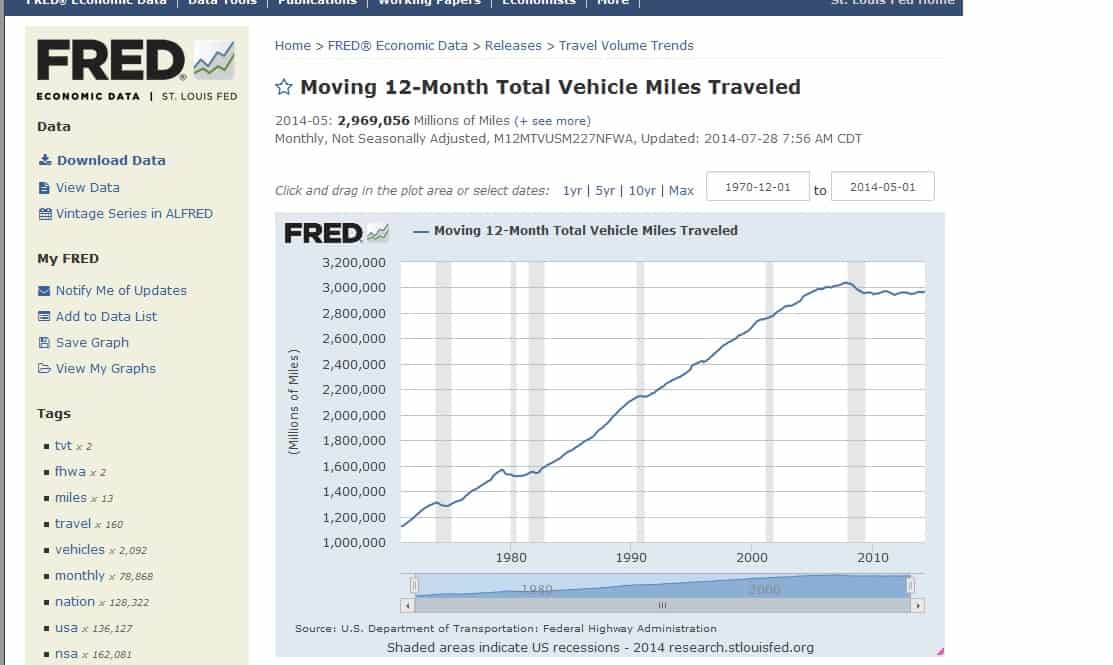
Will highway traffic become even heavier, to the point that reservations are needed before you are even allowed to get on an interstate, or have we hit a limit and traffic is never going to get any worse than it is now? Much has been made of the graph below. Is the lull in traffic temporary or permanent? I suspect it is temporary, but we’ll see in a few years. Not everyone is quite as optimistic, and this analysis is worth noting: http://advisorperspectives.com/dshort/updates/DOT-Miles-Driven.php
Trip planning as a legal requirement before hitting the road will also be driven by increasing pollution along heavily loaded roads – I-95 south of Washington is permanently gridlocked during the day, and every major road in Los Angeles and San Francisco has similar issues.
The speeds quoted in the story are not unusual even now. 80 MPH in Ryan’s car and 120 MPH in the bus don’t sound like much as interstate speeds are already close to these, but recall the traffic volume is much higher than now, and these speeds are sustained from the moment the vehicle enters the highway to the moment it leaves. Vehicles will travel in closely-spaced convoys, minimizing fuel use and making it easier to control traffic. Vehicles continuously report their status to a database, which includes information like maximum speed capability.
Heavily loaded trucks that can’t keep up to the higher speeds are parked on the shoulder until traffic volumes drop, they are then allowed back on the road. Being parked on the shoulder for a few hours, or driving 12 hours continuously, are not an issue when there’s no driver to become fatigued or bored. Over-the-road driver time logs have essentially disappeared, and weight limits, speeds, and bridge load limits are flexible, set by traffic conditions. One big issue with speeds over 90 MPH for trucks and busses, apart from the fear factor of that much mass controlled by computer, is probably tire technology, which is not adequate for 120 MPH, but that will change when highways allow those speeds.
The majority of vehicles by 2034 will probably be autonomous, as developments in this area are occurring quite rapidly. In that case expect major changes in rest stops, truck stops, and driving patterns. Trucks will travel even more at night; rest stops every 50 miles will be eliminated as redundant and the remaining ones will be consolidated into a few larger plazas. The vast areas of truck stops devoted to drivers sleeping will gradually go away. Autonomous trucks will travel on their own schedules, not to ones set by driver or load limitations. Weigh stations will not be needed, since each truck will report to various databases what its manifest is. The system on private cars and local trucks allows a driver to manually control the vehicle when the vehicle is not traveling a programmed route, but the majority of long-haul trucks and busses will eliminate the driver completely. Trucks and busses will appear very different; with no driver they can be optimized for cargo or passengers as needed.
All vehicles are networked via radio into a large national road and vehicle database, which also handled our hypothetical couple’s travel reservations. In addition to the national radio network, each vehicle also has a short-range radio link to all other vehicles in the immediate vicinity. Each car in the short range network is in constant communication with every other vehicle, and can “see” using other vehicle’s camera systems so there are no surprises. Negotiations and handshakes between vehicles occur continuously; there is really no need for stoplights or stop signs in many places. Each vehicle has sensors that detect operating conditions, precise location, speed, vehicle condition, and load, so trucks can safely tailgate each other at high speeds, while cars weave in and out of mile-long truck convoys at will.
The national road databases will be built up with data collected from each vehicle. Possibly this will be a private enterprise, with companies like Google, Garmin, or Expedia competing for your car’s valuable data. Or perhaps government will forcibly collect it from each car. These databases will know everything about roads, vehicles and their occupants, what the safe speeds are, where each pothole and piece of road debris in the country is, and what safe load limits on each bridge are. Much has been made of the US not spending enough on infrastructure.
Autonomous vehicles will permit lower infrastructure spending, as their routes will be programmed to minimize road damage, including avoiding areas needing repair or even specific potholes. Overweight trucks can cross bridges during light traffic conditions, while a bridge experiencing very high traffic volumes will force heavy trucks onto the side of the road until traffic clears, reducing wear on the bridge structure. Since trucks reserve their travel schedule just like Ryan did, these delays are already built into the truck’s schedules. Busses carrying people have priority to use the smoothest parts of the road. There are no speed limits in the usual sense; each vehicle has calculated its maximum safe speed and communicates that information to the database. Speeds on the highway vary depending on traffic types and vehicle characteristics. The same is true of bridges; the load limit varies depending on traffic conditions. Dynamic speed limits, pothole and road surface data, and bridge loading reduce highway maintenance costs and repairs can be scheduled long in advance.
There is no need for a gate, credit card, parking stubs, or an attendant at any of the travel centers; the reservation Ryan made at home had already told the car and the plaza where they’re going and how long they’ll be there; parking charges are automatic. The car told the center how much luggage the couple has; both size and weight, and the bus knew from Ryan’s reservation on Friday how much he and Brittany each weigh. Travel center computers tracked the couple’s driving, and told the car where spaces are open and where the bus will load, so they don’t need to drive around an unfamiliar area with multiple parking lots. RFID tags on their ID cards identify Ryan and Brittany to the bus, so no need for them to check in and they can just climb aboard. As they board they are weighed, to allow the computer control system in the bus to calculate acceleration and braking parameters, and to optimize the ride and fuel economy.
Ryan’s computer knowing enough about him and his wife to contact his parent’s computer and confirm the parent’s schedule is only one step away. If the parents are busy, their car will drive itself to the Orlando plaza to pick up Ryan and Brittany. And the database and computers know enough to direct Ryan and Brittany’s luggage from the bus to the parent’s car as soon as it arrives. Our couple spent a little over seven hours on their journey, traveling 669 miles from door to door, arriving on time and feeling great since they didn’t need to stress over the driving. They averaged 92 miles an hour over the entire trip, including stops at the travel plazas. Not too bad compared to the current time, which is closer to 10 or 11 hours depending on traffic.
Our trip is over now, and welcome back to the present. Hope you had a pleasant journey.
So, is this the future you want? Will you have a choice? Are the tradeoffs worthwhile? The upside is faster, cheaper, more relaxing travel. On the downside, there is even more government and private involvement in people’s personal lives. Hopefully we will make the best choices, or they will be made for us.
Mr. Wizard
