Slope of Hope Blog Posts

Slope initially began as a blog, so this is where most of the website’s content resides. Here we have tens of thousands of posts dating back over a decade. These are listed in reverse chronological order. Click on any category icon below to see posts tagged with that particular subject, or click on a word in the category cloud on the right side of the screen for more specific choices.

Weekly Sector Report: 02/19/10 (by Leisa)

By -

Below is a summary of the major sectors. As you can see, it was a good week with all major sectors in the green.

I've included the chart book with weekly, daily and monthly charts for your viewing in addition to all 164 sectors sorted by weekly performance. You can find that here. There were three negative subsectors for the week:

Home Construction
Gambling
Health Care Equipment and Services

All data furnished in the reports are courtesy of Stockcharts, and the compilation courtesy of me.

How to Ride and not Shoot your Winners (by Leisa)

By -

[Here's another re-tread (edited)post from my blog.  I wrote this post after Market Sniper offered some thoughtful commentary when I was lamenting this blown trade on HPJ. I also received some terrific technical help on a TOS program from both Viscous and Greg.  Offering this 're-tread' is way to highlight the community hear and the cult of shared learning.]


It's not enough to find a stock in which to take a position, but it
is also important to manage the position to optimize results (maximize profits! minimize losses!!!). The literature tells us to
keep our losses small and let our winners run. Sound advice. However,
when faced with a loss, our head often counsels this way: "If you hold onto this stock, it will
come back!" Conversely, when faced with a gain our head has equally pathetic counsel: "Better to
sell it now…you know what they say, 'nobody goes broke pocketing a
gain.' Besides you big dummy look at those losers in your portfolio–be
quick before this turns into one of those."

It's worth
remembering that your mind really doesn't have a mind of its own; and it is quite adept at offering supportive rationalizations for any of your lesser inspired inclinations.  You can go broke by failing to take a gain. How? Simply by hanging onto
your losers while tripping up your winners (selling them) after they've made it
through the first turn on their track to unknown price heights. All of this is a reminder that we must first master our own psychology–and poor disciplines rob us of the psychic energy that we need to trade successfully.

Enough sermonizing…….. Let's
take a look at one of my winning horses, HPJ that I shot dead just after it made its first turn in its personal Kentucky Derby.  I identified it as a volatility squeeze (VS) play.  To find targeted stocks, I'll set Keltner Channel and Bollinger Bands to 10 periods and filter for stocks that have the Bollinger Bands inside the Keltner Channel. I look through hundreds of charts.  I'm looking for volume patterns coupled with attractive basing patterns.  HPJ fit that bill. 

HPJ popped out of this VS.  When my gain was 97% I couldn't stand it any longer, and I sold the whole damned thing. It tripped (read consolidated); and I shot it. Why?  Because my mind (which has no mind) got very chatty and started yammering about how HPJ had lingered a wee bit too long (to my eye) for a
follow through in volume on the initial breakout.  I sold it.  Within 15 minutes, the stock rocketed obscenely higher. I use this VS 'strategy' regularly.  Because I had not codified this strategy , it was merely an idea rattling around in my head.  Businesses don't confuse ideas with strategy, nor should we as traders. Failing to codify that idea into a cogent strategy was expensive.

It is important to differentiate
between hindsight bias and transforming 'coulda, woulda, shoulda's'
into learning vehicles. What would my learning be from this trip down
memory lane? Let's see how I could I could have managed this trade more effectively (as I have managed others like this) with a strategy. Here's the chart (It went on to more than $9.5).

(click to make larger)

  • On first volatility breakout, sell 1/2 position (these are generally large moves > 30%)
  • On subsequent pullback (price and volatility), rebuy 1/2 position–now back to full position.
  • On
    second breakout, I sell 1/2 position again, and looked for
    another entry (pullback to a trendline) if one presents itself. As you can see from the chart, that is what some other
    eyeballs were looking for.
  • I would have sold 2 of 3 tranches into the melt up and kept 1/3 position–managing that against a trailing stop loss percentage. [Note: Market Sniper's counsel was to keep a running position, and that he has many of those.]

Now
plenty of folks keep buying into these melt ups. I'm already in the position at a low risk entry, so I don't do that. My DNA is not wired
that way–not on these speculative stocks which can pop and drop rather
quickly. It's important to be in tune with your own risk tolerances and trading preferences.

The above playbook was soft in that it was rolling around in my head, not solidified by committing it to paper.  Since I've committed it to paper, I've treated it as a core discipline with good results. I hope this post inspires newer traders to commit their learnings to paper and review and revise as necessary. As always all position sizes should be managed prudently within your risk tolerances.

Position: (1) Lamenting HPJ – the one that got away and went up, up and away | (2) Grateful to be part of a community and to have members who willingly teach and serve as sounding boards.


Federal Home Loan Bank System (by Leisa)

By -

(I posted this on my blog in November.  It might be more than Slopers may want to slog through, but it might be worth a cursory view).

I've become recently intrigued with an institution that I rarely
hear anything about: The Federal Home Loan Bank (FHLB). With the
implosion the credit markets involving all things related to home
financing, this agency came under the purview of the FHFA along with
Fannie and Freddie. My objective is not to go into any exhaustive
analysis or even cultivate an opinion. Rather, I'm just reminding you
of this banking system that we does not get much press–and to hit a
few high points. I've no special knowledge on any of this, and
everything that I present here is from 'stuff' easily found on the
internet.

Here's an overview from their website that you can find here. The emphasis added is mine.

The
Federal Housing Finance Agency (FHFA) was created on July 30, 2008,
when the President signed into law the Housing and Economic Recovery
Act of 2008. The Act created a world-class, empowered regulator with
all of the authorities necessary to oversee vital components of our
country’s secondary mortgage markets – Fannie Mae, Freddie Mac, and the
Federal Home Loan Banks. In addition, this law combined the staffs of
the Office of Federal Housing Enterprise Oversight (OFHEO), the Federal
Housing Finance Board (FHFB), and the GSE mission office at the
Department of Housing and Urban Development (HUD). With a very
turbulent market facing our nation, the strengthening of the regulatory
and supervisory oversight of the 14 housing-related GSEs is imperative.
The establishment of FHFA will promote a stronger, safer U.S. housing
finance system. As of June 2008, the
combined debt and obligations of these GSEs totaled $6.6 trillion,
exceeding the total publicly held debt of the USA by $1.3 trillion. The
GSEs also purchased or guaranteed 84% of new mortgages.
Considering
the impact of these GSEs on the U.S. economy and mortgage market, it is
critical that we intensify our focus on oversight of Fannie Mae,
Freddie Mac, and the Federal Home Loan Banks.

I thought the
highlighted text to be an eye-popping fact. There are two other GSE's:
Farmer Mac (AGM) and the Farm Credit Administration–both serving
agriculture. Readers may remember the lonely trade that I did not
take–shorting AGM. Here's the post. Let it serve as a reminder that there are many jewels of ideas for trading that are not in mainstream media.

The FHLB is a collection of 12 banks (with links to their websites):

Boston | New York | Pittsburgh | Atlanta | Cincinnati |Indianapolis | Chicago
Des Moines | Dallas | Topeka | San Franciso | Seattle

Each
of the above are wholesale banks serving as a cooperative within the
geographic areas that they serve. As a cooperative, they have members

FHLBank
members include thrift institutions, commercial banks, credit unions,
and insurance companies. A financial institution joins the FHLBank
district that serves the state where the institution's home office or
principal place of business is located.

From website.

which purchase stock from the FHLB that serves that geographic area of the member.

The
FHLB system allows member banks access to affordable financing for
their lending operations. The member banks, in exchange for these
loans, pledge collateral. Accordingly, the FHLB debt issuances are
supported by collateral. The quality of this collateral is
derivative–meaning that the value is ultimately derived from: (1)
credit quality of the end borrowers and (2) valuation of the
collateral. You see where I'm going with this, right?

The table below is taken from the July 2009 Report on Federal Home Loan Bank Collateral for Advances and Interagency Guidance on Nontraditional Mortgage Products This table shows the concentration of Subprime and Non-traditional Mortgage Collateral.
(Click image to view)

The next table shows the loan to collateral ratio

(Click image to view)
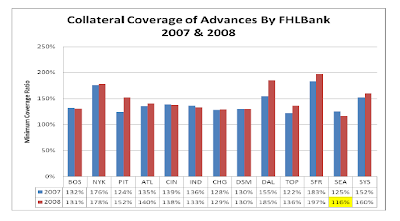
Source: July 2009 Report on Federal Home Loan Bank Collateral for Advances and Interagency Guidance on Nontraditional Mortgage Products

The
highlighted data point is FHLB-Seattle which was recently cited by the
FHFA as being under capitalized. The last column is the system wide
coverage ratio of 160% which increased from 152% in 2007. Also it is
important to note that each FHLB is jointly and severally liable for
the obligations of the others.

The collateral offered may also
include mortgage backed securities that the member banks might hold. It
is a reminder of the cyclical nature of of this 'stuff'. Fannie Mae,
Freddie Mac and Ginnie Mae securities that many conservative
institutions bought due to their perceived safety. It is important to
note that ONLY Ginnie Mae Securities are backed by the full faith and
credit of the United States. Freddie and Fannie are 'wards of the
state' as the are in conservatorship. But the domino effect of an
implosion is evident as these balance sheet holdings served as
collateral and supported capital of the institutions that held them.

For any of you who read financial statements, the next graphic Taken from

First Federal of Northern Michigan Bancorp, Inc.

press release shows where you see the stock purchased from FHLB as well as the advances.

(
Click image to view)


If
any of this whetted your appetite to learn more, I'd encourage you to
seek out the following resources and perhaps appropriate counseling!