

Slope of Hope Blog Posts

Slope initially began as a blog, so this is where most of the website’s content resides. Here we have tens of thousands of posts dating back over a decade. These are listed in reverse chronological order. Click on any category icon below to see posts tagged with that particular subject, or click on a word in the category cloud on the right side of the screen for more specific choices.

Wondering Out Loud: High Short Interests and Market Psychology (Leisa)

By -

The stock market has been lurching forward with surprising force. For armchair economists, one looks about and can only head scratch about the anomalous behavior of the market v. 'reality.' While the market is a discounting mechanism, I will go to my grave believing that it is as perfect at discounting as a teenage boy is at restraint.

Marc Faber's cogent observation that economic reality and the market's perception of economic reality are two different things was an important "AHA" experience for me.

Another important quote that I found in going through my blog archives was one given to me by a fellow blogger from Bill Cara's site. It was attributed to George Soros, though I've never verified that:

“Economic history is a never-ending series of episodes based on falsehoods and lies, not truths. It represents the path to big money. The object is to recognize the trend whose premise is false, ride that trend, and step off before it is discredited."

G. C. Selden writes in his book, Psychology of the Stock Market, the following:

The main point of their argument is that the state of mind of a man short of the market is radically different from the state of mind of one who is long. Their whole study, in such a conversation, is the mental attitude of those interested in the market. If a majority of the volatile class of in-and-out traders are long, many of them will hasten to sell on any sign of weakness and a decline will result. If the majority are short, they will buy on any development of strength and an advance may be expected."

And that leads me to this:
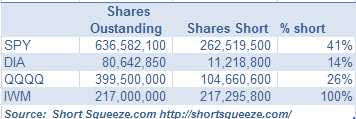
Is it possible that 100% of the IWM is really short? Forty percent of the SPY? If these numbers are true, is it any wonder then that we have these surges of buying on moderate strength? To my amateur eye, these high levels of short interest preclude a major correction until they are reduced. However, I do find these numbers a bit troublesome, as I'm having a difficult time corroborating any by the SPY (FINVIZ reports 44%).  I cannot find numbers for the others.  The numbers (should one be able to find credible numbers) bear watching.

(Editor's Note: I've never used shortsqueeze, but I find these figures in the table above very, very suspicious. I could be wrong, but I think it's impossible the entire float of IWM is short. Looking at this link, which is specific to IWM, this site cites a high price of IWM of $512.70, which is grossly wrong. So it could well be that the site is just packed with absolutely crap data; this is no reflection on Leisa, but I'd appreciate hearing comments about shortsqueeze.com and if it's worthwhile or not – – Tim).

Weekly Sector Report: 03/05/10 (by Leisa)

By -

(Note from Tim: I've got a pretty important post coming up a little later today, where I'd like you to help me think through a very important topic; please be sure to return, as I'm looking to Slopers to help me think through this; thanks).

It was a week of strong, forward movement in all of the 164 DJ US Sectors except for one–Water–which was down 2.1%. Here are the broad sectors, all of which were solidly positive (to the understandable chagrin of the bears).

On the weekly charts, I'm seeing several sectors that are making new highs, but the ultimate oscillator is not confirming. It's a divergence worth keeping an eye on. You can find the full report here. I did not include the Monthly charts.  I will update those at the end of each month.

Data courtesy of Stockcharts; compilation courtesy of me.

Quantum Mechnanics & Trading (by Leisa)

By -

Calabi-Yau manifold

I've many books in my bookshelf that beg reading, none more compelling than
Brian Greene's, The Fabric of the Cosmos:  Space. Time. And the Texture of Reality.  Greene is a theoretical theorist–a mind that dwells in the stratosphere of
conceptual thought.

Greene is that wonderful composite of rocket scientist and gifted writer, making his work accessible to mere mortals.  Rather than reading
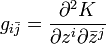
equations, such as this. . . .

g_{i\bar{j}} = \frac{\partial^2 K}{\partial z^i \partial \bar{z}^{j}}

. . . I'm blessedly spared both the headache of trying to hum along with some
lip mumbling–even spurts of drooling –and the shame of having to admit that
I've not understood a thing.  Rather, I simply need to read one of his
beautifully crafted books.

Gmak, made a terrific post on TA, and it engendered a very good discussion. 
I was particularly happy to see it as I had become cross eyed looking at a
number of charts whose ultimate destination seemed unfathomable (like our
drawing above).  "Now what does any of this have to do with trading?" you might ask
impatiently (is that your toe I hear tapping? ).  I ran across two passages in this
book that I wanted to share with Slopers.  The first, I shared already but will
repeat.

Understanding_copy

The second I wanted to commit to a post, because I thought that is was
something worth reading.  I quote from page 11.

But according to the quantum laws, even if you make the most perfect
measurements possible of how things are today, the best you can ever hope to do
is predict the probability that things will be one way or
another at some chosen time in the future, or that things were one way or
another at some chosen time in the past.  The universe, according to quantum
mechanics, is not etched into the present; the universe,
according to quantum mechanics, participates in a game of chance.

. . . most physicists agree that probability is deeply woven in to the fabric
of quantum reality.  Whereas human intuition, and its embodiment in classical
physics, envision a reality in which things are always definitely one way
or another, quantum mechanics describes a reality in which
things sometimes hover in a haze of being partly one way and
partly another.  Things become definite only when a suitable observation forces
them to relinquish quantum possibilities and settle on a specific outcome. The
outcome that's realized, though, cannot be predicted–we can predict only the
odds that things will turn out one way or the other. (p.11)

Running across this passage so quick on the heels of our having a
conversation about TA and its 'predictive' abilities, made it resonate deeply. I
could not help but note that trading/TA is not so far from quantum mechanics. 

When your capital is on the line, probabilities must be considered
carefully–and none more judiciously than the probability of your being
wrong in a trade. As our trading is fraught with our successfully managing (surviving) uncertainty, I thought the passage timely and insightful.

Our technical analysis, for all of its purported faults, is a construct that gives us understanding and cultivates insight.  More importantly, our TA and our trading plan anchors those insights. It is not predictive, but it does reveal to us the promise of certain outcomes. To those promises we must overlay our trading discipline. We are not really trying to managed the outcome of a chart, rather we are managing the outcome of the relationship of our trading capital with the chart.  Accordingly, our trading discipline is the construct of that universe of uncertainty.  Most importantly, we are the final arbiter of those rules those rules dictate the outcomes.  That is great power, is it not? 

We really are masters of our own universe.

Super

Hunting for Volatility Squeezes (by Leisa)

By -

Here's a re-tread post of mine from 11/05/09 that might serve as a useful follow on to my post on how to ride (not shoot) your winners.  Paying to volatility has helped my trading tremendously.  I'll dig out some other posts on this matter to if there is sufficient interest.


While I consider myself a serious student of the market, I don’t
call myself a trader. But I do trade and have done so with reasonable
success. This year, I incorporated a new dimension into my trading:
volatility. Simply put, I’m buying when volatility is low, and I’m
selling when volatility is high—and I’m doing so on charts that appear
to be good candidates for long entries. I’ve not used it for short
positions.

The point of this post is not to go into an in-depth
analysis regarding volatility, but rather to introduce to you this
concept and provide some actual examples. I think that you will have
fun experimenting with it. I'll mention, too, that John Carter uses
this in Mastering the Trade
. But I cobbled it together for myself (after first experimenting with
Donchian Channels) before reading his book. I believe it to be a book
that belongs on most traders bookshelves.

Method: There are two technical indicators deployed: The Keltner Channel and Bollinger Bands.
Like most indicators, both of these are measurements that are
incorporating time and range of price movement that the user defines.
For this method, I am specifically hunting for stocks that have the
Bollinger Band nested INSIDE the Keltner Channel. Carter notes this as
quiet periods…"period of reduced volatility and signals that the
market is taking a significant breather, building up steam for its next
move." For the Bollinger Bands, he uses 20 and 2, and for the Keltner
Channels, 20 and 1.5. I started out using 10, as a parameter for both,
and I've not changed it. But I wanted to share the parameters a
vocational (Carter) rather than an avocational (me) trader utilized.

Now
for four charts. (Click to make larger!) I want to give a brief preamble. While many of you are
technical traders, I mix macro fundamentals and sector fundamentals
into my work. It's my quirk, and it works for me because of my learning
style and my background. It points me in the direction I want to look
and helps me assess risk.

The first three stocks were actual
positions. I've been trading Chinese stocks long before it was
fashionable to do so. The floats and price range may not suit many
here, but the concept can be applied to any stock. It's worth noting
that because this market fell hard, there were lots of attractive
candidates in these long bases. The last is a contemporary example.

Here's
SNEN. I liked them because they were in the compressed natural gas
space in China (engine conversion units and stations). I also knew that
they had a small balance sheet problem–so I took my money and ran.
This stock is an example where I entered, sold on the volatility spike.
Re-entered and re-sold on the volatility spike. No third time charm on
this one because of the risk on the balance sheet. They are being
bought by a shareholder.


Second
is AZC. This stock is again a combination of fundamental (copper–they
will supply 10% of the copper when one of their Rosemont site comes on
board) and TA.

HPJ is another one. This one broke out along with the other lithium-ion battery producers.

Here's the stock screen that I use on StockFetcher (XX's signify variables that suit your trading style–you see I'm no stranger to the boneyards):

Close is above (XX)
AND Volume is greater than (XXXX)
AND Upper Bollinger(10) is less than Upper Keltner Band(10)
AND lower Bollinger(10) is greater than Lower Keltner Band(10)
and add column Bollinger %B(10,2) (I use this to order candidates from lowest band width to highest)

To
put this post together, I didn't have to cherry pick through my stock
entries to provide examples for you. It has proved to be a high
probably trade and a richly rewarded trade. I will tell you that the
hardest thing to do is to sell into the volatility explosion. And we
know that doing the hard thing is often the right thing! Naturally, any method you deploy must fit with your time, money and
risk/reward parameters.