

Slope of Hope Blog Posts

Slope initially began as a blog, so this is where most of the website’s content resides. Here we have tens of thousands of posts dating back over a decade. These are listed in reverse chronological order. Click on any category icon below to see posts tagged with that particular subject, or click on a word in the category cloud on the right side of the screen for more specific choices.

Weekly Sector Report | Expanded View (by Leisa)

By -

Perspective is everything, and we gain perspective by comparing one
thing to another. I wanted to build some sector and market perspective
for you. How? By providing you with the following:

  • time series of when different sectors peaked1
  • current retracement to peak in absolute terms1
  • percentage decline from peak to trough
  • percentage of points
    lost retraced
  • percentage retracement to trough

1
contained in Table 1 below

Table
1
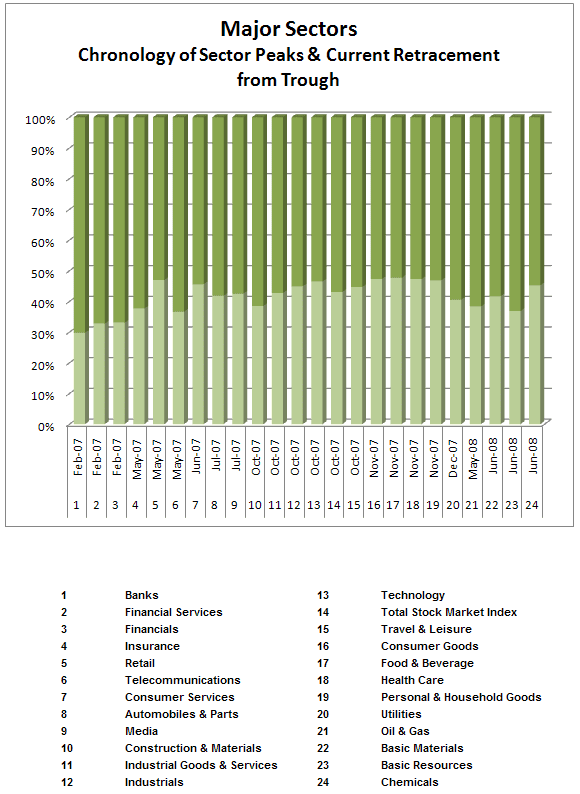

There are a couple of things that are notable from this chart

  • It has been more
    than three years since the financial sector topped
  • There was 16
    months from the topping of the first sector (Financials) to the last
    sector (Commodities)

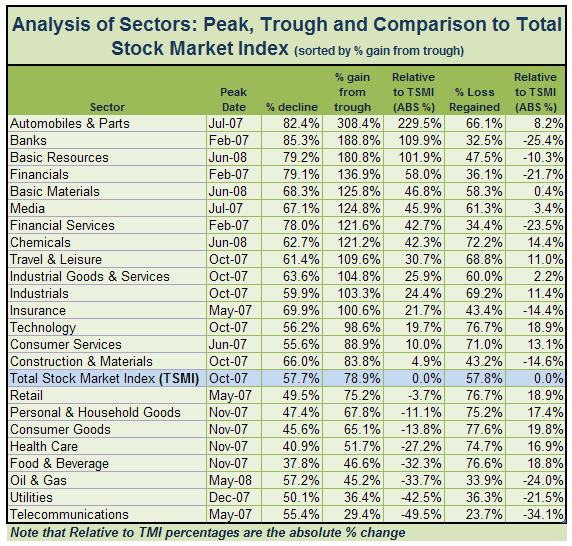
The next table, Analysis of Sectors: Peak, Trough and
Comparison to Total Stock Market Index (sorted by % gain from trough)
,
will give you view of the sectors that have recovered the most since
their trough:

Table 2

Now
that I've provided you with that, we'll return to our previously
schedule program. Below are the 24 Summary Sectors. You can find the
complete report on the 164 DJUS Sectors in addition to weekly + daily
chart books for the sectors below here.
I hope that you found this
expanded report helpful to providing to you some perspective on relative
time and price performance among the 24 sectors that I highlight for
you each week. You can also see the disparate nature of BOTH time and
price performance through a major cyclical decline and recovery. While
this information is unlikely to make interesting cocktail conversation,
it is a useful mosaic of information to inform your investing/trading
thinking.

I will post periodic updates to the peak/trough tables.

All
data courtesy of Stockcharts.com | Compilation and analysis courtesy of
me.
Market Wisdom by Selden (Leisa)

By -

I wanted to share one of Selden's quotes (there are so many of them that resonate). From Psychology of the Stock Market:

To a great extent we train our judgment to lend itself to our selfish interests. . . We cannot work for our own interests as in other lines of business–we can only fit our interests to the facts. . . To make the greatest success it is necessary for the trader to forget entirely his own position in he market, his profits or losses, the relation of present prices to the point where he bought or sold, and to fix his thoughts upon the position of the market. (p.57)

Weekly Sector Report: 03/19/10 (by Leisa)

By -

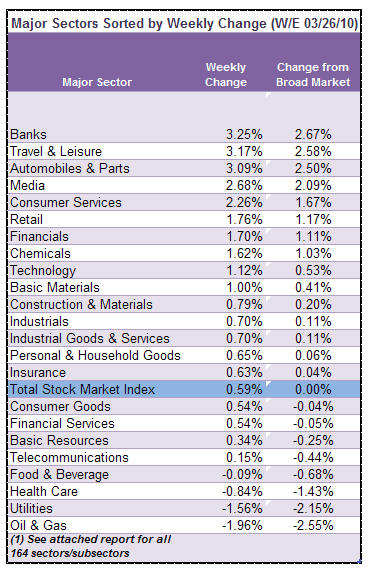
The total stock market index went up .65%. Below are the sectors, sorted based on their weekly change.

I've prepared a full report of all of the DJ US Sectors that you can find here.  Of the 164 sectors

  • 73.8% were positive v. 76.2% last week
  • Average increase was .6% v. 1.10% last week.

I wanted to append to this post a small blurb about why it is even important to look at sectors. I've limited my posting to just delivering the facts.  However, today I wanted to give a little more of the "why" to the "what".

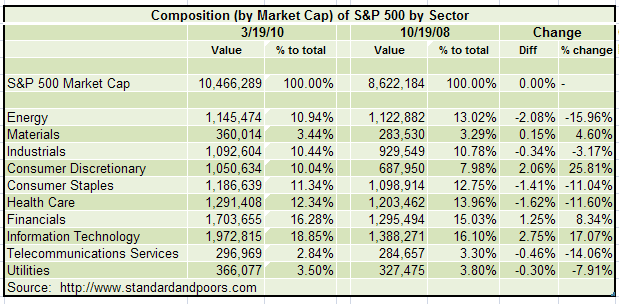
Many people only trade one index or another.  If the S&P is your weapon of choice, then it is important for you to understand its composition. In fact, that understanding should also extend to any ETF as there are a handful of stocks that make up a large part of the weighting. Standard and Poor's has a very good website.  You can find the daily composition of the S&P 500 here.  Their website used to allow you to pick any single day in history and get the composition.  Unfortunately they ceased providing that. 

Nevertheless, I had some old data that I captured.  I want to share with you a "Then v. Now" look.  Below is a table of the S&P as of October 2008 by the market capitalization of its sectors.  I've included a comparison as of EOD 03/19/10. 

You can see clearly that the change in composition among sectors is material.  Money flows in/out of stocks, stocks exist in sector, and the broader indexes are a composite of that underlying movement. The dynamic does not exist in the reverse.  Accordingly, dull index action may belie exciting dynamics of underlying sector rotation. 

While the above breakdown is for the S&P 500 to be illustrative of the material movements underneath the index, the sector information that I provide is for ALL US Stocks using the Dow Jones classification methodology/system (there are different classification systems). Different indices will select these based on market capitalization.

If these sector looks have created an interest on your part, I want to provide you with some resources:

  • WSJ Industry Group Tracker: This source lists the daily performance in addition to other periodicities (e. g. weekly, 1 month, etc).  I'm unsure if this is available to non-subscribers.
  • FINVIZ:  This site (FREE!!!)  provides one of the best way to quickly see charts and other information on stocks in sectors. Unfortunately they do not have broad sector roll ups. You can use their tickers to easily upload sector charts into your software of choice for chart reviews.  The information can also be downloaded into a spreadsheet.
  • Yahoo Finance:  Yahoo has broad sector roll ups, but some of the market capitalizations are incorrect (e.g. the foreign money center banks). 

Your eyes might be crossed at this point, and you may well be wondering why any of this is important. It may not be important to you.  But I believe that the sectors offer a dimension of information that informs whatever work you do on the S&P.  And where opportunities are flat on the index because of underlying sector rotation, opportunities abound (long and short) among the sectors. 

The presentation of my work here is to give you a divining rod for finding the flow of money beneath the surface.  I tend to analyze from the top (broad sector) down (sub-sector, then individual charts).  That is my style.  It may not be yours. There are many ways to skin this cat, and however you do it you need a sharp knife and skill in which to wield it.

Weekly Sector Sort (by Leisa)

By -

Th total stock market index went up 1.11%. Below are the sectors, sorted based on their weekly change. 

I've prepared a full report of all of the DJ US Sectors that you can find here.  Of the 164 sectors

  • 76.2% were positive v. 99.4% last week
  • Average increase was 1.10% v. 4.04% last week.

The full report also includes weekly and daily charts of the broad sectors above.

All date is courtesy of Stockcharts.com |  Compilation is courtesy of me.

The Three Books I Always Recommend

By -

I wanted to share a post on books that I recommend. There are many terrific books on markets and trading.  However,  I recommend these books because I still remember their profound impact on my development as a student of the market–being a student of the market is always the base from which I write. These books provide the context in which everything else I read gets processed.

Long term Slopers have seen me recommend and/or quote from these over the years.  My hope, too, is that this post will engender some discussion from the Slope community to proffer their own suggestions for books that have shaped their development as a market participant.

Importantly, books are like people: some settle better with our personalities than others.  Accordingly, your mileage (enjoyment) might vary from mine.

  • Psychology of the Stock Market,
    G. C. Selden: A 1914 copyright date reminds you as you reading it that
    the more things change, the more they stay the same. Though I recommend
    your buying this slim volume, it can be downloaded from Google books here. While many recommend Reminiscences of a Stock Operator, all of the pith of that book can be found in this slim volume.
  • Secrets to Profiting in Bull and Bear Markets,
    Stan Weinstein. The charts in the book are not of the quality that our
    contemporary eye would hold them to. I wished the book would get
    updated. But this book is the best "must read" for new
    investors/traders. The book does a great job codifying do's and don'ts–basically it helps you to minimize 'stupid stuff'.  My only regret is that I didn't read this book in my first year of trading.
  • The Nature of Risk,
    Justin Mamis. This book will inform your thinking about risk in the
    market and cultivate an understanding of time risk, price risk and
    information risk. I realized from this book that my expectations of risk are counter-intuitive to what I thought.

(Side note: I read Weinstein long before
I discovered Mamis. And in reading Mamis, I was struck that Weinstein's
book spoke about similar principles. I later learned that Weinstein
became the editor of Mamis's The Professional Tape Reader. For fans of
Helen Meisler, she was mentioned in the forward to one of Mamis's
books. He was her mentor–"the very best mentor one could have.")

I'm now going to add a fourth book to the the trio above:

  • Beating the Stock Market,
    R. W. McNeel. Another oldie–1924. It's a slim volume that reminds us
    that while the market seems complicated, it really isn't. I will
    forgive his chapter on Women, Poor Losers.

I particularly
recommend these older books to people prone to thinking about the
market as something rigged against them by ranting against the
proverbial "They". Both McNeel and Selden's books address this sinister
"They". Both authors opine, and I paraphrase, that it is the hobgoblin
of minds that do not understand the speculative process. I believe them
to be correct.

Best to free our minds of such shadows. The greatest force that prevents our being successful in the market is ourselves.

I'll leave you with a fitting phrase from Selden:

Capitalists

(The photo is of Minnah.)