Slope of Hope Blog Posts

Slope initially began as a blog, so this is where most of the website’s content resides. Here we have tens of thousands of posts dating back over a decade. These are listed in reverse chronological order. Click on any category icon below to see posts tagged with that particular subject, or click on a word in the category cloud on the right side of the screen for more specific choices.

AAII Sentiment Survey (by MacroStory.com)

By -

This week's AAII sentiment survey is relatively unchanged.  Those with a bullish outlook over the next six months rose to 36.8% from 36.6% the prior week versus an historic reading of 39%. Those with a bearish outlook over the next six months dropped to 33.1% from 36.1% the prior week versus an historic reading of 30%.  The divergence between these readings and the SPX continues to stay very wide and signals pending SPX weakness.


Submitted by Macro Story.  If interested in reading more, please visit - MacroStory

ISM Manufacturing Feb 2011 (by Ultra Trading)

By -

Today's ISM Manufacturing came in at a very healthy and robust number of  61.4 (above 50 shows expansion, below contraction).  There is no arguing with the headline number and one of the comments from respondents such as, "our plants are working 24/7 to meet production demands." (Fabricated Metal Products)."   There is somewhat of a disconnect though between the many strong manufacturing reports and GDP, employment and other economic data which at a minimum would raise some flags about the true health of the manufacturing sector. One of the respondents did comment as such, "overall demand is off 10 percent." (Plastics & Rubber Products).

Two things have stood out among all of the manufacturing reports, inventories and prices paid and today's ISM is no different.  Inventories have begun contracting signaling an end to the inventory build that helped fuel GDP the past seven quarters.  Additionally customer inventories have contracted at an even quicker pace.  Why would customer inventories contract in the face of growing demand as this report would indicate? Lastly, look at the levels and rate of growth of the prices paid component.


The ISM report had a total of 5 comments from respondents, two of which are mentioned above and the remaining three below.  So the ISM number on the surface was strong as expected but there are a number of warning signs within the report.

"Prices continue to rise, while business limps along at last year's pace." (Nonmetallic Mineral Products)

"A continued weak dollar is increasing the cost of components purchased overseas. It is going to force us to increase our selling prices to our customers." (Transportation Equipment)

"We continue to see significant inflation across nearly every type of chemical raw material we purchase." (Chemical Products)

Submitted by Ultra Trading.  To read more, please visit - MacroStory.com

S&P 500 Historical PE, Dividend, Earnings (by Ultra Trading)

By -

Below are two charts of historical S&P 500 earnings and dividend yield.  The data goes back to 1960 and is based on year end values.

S&P 500 Earnings and Dividend Yield

Historical average for earnings is 6.86% versus year end 2010 value of 6.65%.

Historical average for dividend yield is 3.15% versus year end 2010 value of 1.84%.


S&P 500 Price To Earnings multiple

Historical average is 16.2 versus year end 2010 value of 15.0.


Submitted by Ultra Trading.  To read more, please visit - MacroStory.com

Interesting Commentary on the Chinese RMB (by Ultra Trading)

By -

Part if not all of the goal of quantitative easing is to force China's hand at revaluing the RMB, thus making US exports more competitive and bringing jobs back home.  China has refused to revalue and as a result has faced growing inflation at home.  Bernanke has even hinted at times that if countries do not like the results of "our" monetary policy they should adjust "their" currency.  That's about as direct a central banker can be without writing down a country's monetary policy for them.

The choices for China are rather difficult.  Inflation, especially in the face of the global unrest that has developed recently threatens instability within their country.  Rice has now started to move up in price as well adding further pressure.  Tiananmen Square was partly a result of inflation concerns and the last thing China wants as they try to become a more dominant player in the world are pictures of tanks rolling in the street at protesters. 

Should China decide to raise the value of the RMB they can fight inflation, to some extent but they risk losing jobs.  Is there much of a difference between higher inflation with a job or lower inflation without a job?  Additionally China is trying to slow down its own economy to manage what many see as a bubble in asset prices.  Chinese Premier Wen Jiabao seems somewhat concerned with the precarious situation China finds itself in a recent speech (from Reuters).

"Rapid price rises have affected the public and even social stability," Wen said.

Wen said maintaining social stability was also central to the country's foreign exchange policy, requiring a step-by-step increase in yuan flexibility so that Chinese businesses could adapt to the changes.

"If the yuan saw a one-off large appreciation, that would cause many closures of our processing enterprises and make many export orders shift to other countries and many of our workers will lose jobs."

"Let them think about that: if businesses go bankrupt, workers become unemployed and rural migrant workers go home, then what do we have to expand domestic consumption, where will increased consumption come from?"

"I have in fact said before that if price rises become linked to the problems of graft and corruption, that will be enough to spark public discontent, and even create serious social problems," Wen said.

The war between Bernanke and China is clearly on per Wen's comments.  He seems to take a soft tone and almost concedes that China will revalue the RMB over time but I suspect their timeline is not that of Bernanke who needs jobs in the US immediately, not in two years.  No one ever holds all the cards in a negotiation but clearly Wen is showing a weaker hand, something  that may unfortunately inspire Bernanke to continue QE in June.

Lastly, another comment regarding growth forecasts was rather interesting and clearly shows China is concerned about an overheating economy and managing a goldilocks scenario which many have tried and I don't think any have succeeded.
Wen also said the official GDP target was 7 percent per year for the 2011-2015 developmental plan. That rate is significantly below the average annual 11.2 percent growth during the last five-year period, but growth targets tend to undershoot actual performance.


Submitted by Ultra Trading.  If you would like to read more, please visit - Ultra Trading

This Market Is All Long (by Ultra Trading)

By -

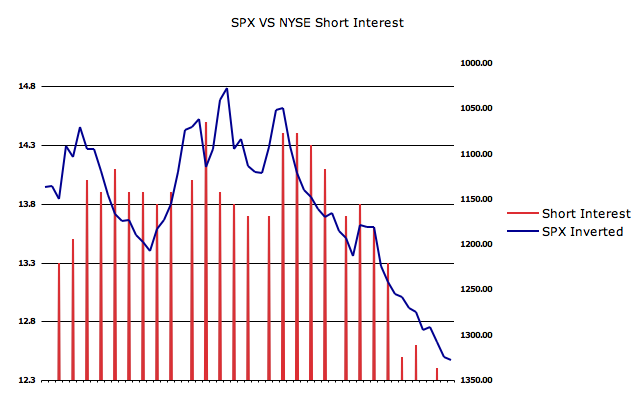
After being beaten for months, shorts have truly capitulated as represented by NYSE short interest.   We've seen endless short covering rallies the past few months but those rallies are running out of fuel.  What happens when the market begins to roll over?  Longs are all invested with cash levels at record lows, while shorts have covered.  Who puts a bid in the market?

When this market corrects and it will happen someday,  there will literally be no one to squeeze.  The bulls will have to rally the market themselves and not the bears for a change.

Submitted by Ultra Trading.  If you would like to read more please visit - Ultra Trading