


Finally, we’re getting back into earnings season, with something besides Powell to move the market! As always, earnings season kicks off with the banks:


Slope initially began as a blog, so this is where most of the website’s content resides. Here we have tens of thousands of posts dating back over a decade. These are listed in reverse chronological order. Click on any category icon below to see posts tagged with that particular subject, or click on a word in the category cloud on the right side of the screen for more specific choices.
Finally, we’re getting back into earnings season, with something besides Powell to move the market! As always, earnings season kicks off with the banks:

I was browsing through a local bookstore last night when I stumbled upon a new book called Rebellion, Rascals, and Revenue. You might not expect a book about the history of taxation over thousands of years to be exactly a page-turner, but it is (at least to me; I really like this kind of thing, particularly since it is combining financial history with political history, both topics of great interest to me). Some of the subjects covered are:
The Fourth Turning is part of the required reading here on Slope, and it is featured on my Recommended Books page.
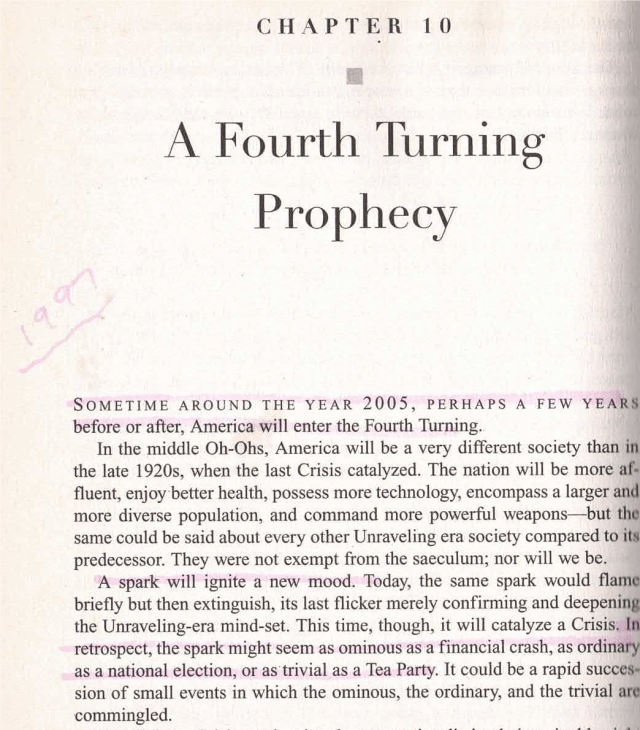
I have read and highlighted the book many times, and I’ve written about it on Slope on a few occasions. I have to trot it out once more, however, since I was surprised at yet another prophecy. As a recap, here is how the important Chapter 10 begins, and keep in mind, this book was published in 1997. Before Covid. Before Trump. Before 9-11. Hell, back then, Zuckerberg was a pimply 13 year old kit. So a lot has happened since then:
The distribution of wealth has long been a fascination of mine (as evidenced by all the posts I’ve written about it). There is a new book I just finished called The Wealth Hoarders by Chuck Collins (a former rich heir himself who eschewed his fortune for the common good). Its subtitle – “How Billionaires Pay Millions to Hide Trillions” – captures the core of what the book is all about.
Even though the book dives into offshore trusts, family offices, perpetual trusts, tax code, and the medieval origins of wealth-preservation laws, it is still an easy, breezy read. There are all kinds of interesting facts, such as:
(more…)