


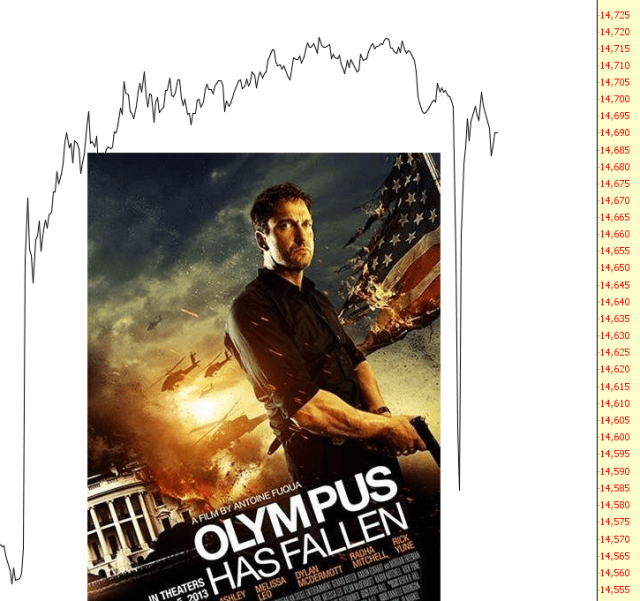
Hacked AP twitter account. Claim of White House bombing and injured President. Entire day’s market gain reversed in moments, then springs right back. We are officially on the other side of the looking glass now. This market has become a bad joke.

Slope initially began as a blog, so this is where most of the website’s content resides. Here we have tens of thousands of posts dating back over a decade. These are listed in reverse chronological order. Click on any category icon below to see posts tagged with that particular subject, or click on a word in the category cloud on the right side of the screen for more specific choices.
Hacked AP twitter account. Claim of White House bombing and injured President. Entire day’s market gain reversed in moments, then springs right back. We are officially on the other side of the looking glass now. This market has become a bad joke.
After this weeks event in Cyprus and in the United Kingdom, I want to pivot and ask a serious question. Are you prepared?
The people in Cyprus are down to a cash society, in a society that is mostly electronic, and I am sure it is causing some great inconvenience with the banks closed. In Great Britain, the cold weather has taken their gas supplies down to emergency levels, and winter storms are stranding people.
In the U.S. we are having our fair share of weather related disruptions, and where I live in California we live in a moments-away calamity with earthquakes and increasing pressure on our power grid.
Can you or your family live a fairly normal life if the power went down for a week, or we have our own self inflicted political wounds and they curtail commerce?
Are you ready?
 In addition to trading I own a solar energy company, and we also provide on site solar tied battery back up systems. I entered this business with a desire to help my family and my customers to become independent of others to provide energy for their homes and businesses. We added the back up systems as solar goes down when the grid goes down, unless you can redirect the solar power into batteries. The next area we are entering is to provide water from air, powered by solar.
I share this with you, not as a commercial (99% of you do not live near me, so not a potential customer) but to let you know there are choices you can make to guard your family, and in the U.S. you can get these financed by the government if you have decent credit. But what if you rent, or live in a condo? There are solutions for that, as well.
Allow me to offer some common sense suggestions that will save you some grief if you find yourself in a unexpected situation.
I tell people to plan for the most likely scenarios, be prepared to be severely disrupted up to five days, and mildly disrupted for up to one month.
The very first thing you need is water, and you should have a gallon of water per person per day for at least two weeks. I have a 60 gallon water heater that I can bleed, but also keep water on hand as bottled spring water in case I am forced to move. I also am going to install a water from air system we are building that ties to my solar system. There are off the shelf systems out there you can buy that do the same thing.
Next is food. This is probably the easiest thing for people to put together, but it is important to buy the right foods. You want easy to open, non perishable, and easy to prepare items. Foods that can be cooked over a Bunsun burner, charcoal grill or a Coleman propane tank. We have a charcoal grill and a portable camping stove with disposable propane tanks. We also have a grab and go bag of food in case of evacuation. You may need to leave your home (We live 12 miles from San Onofre Nuclear Power Plant). Two related suggestions is to keep a couple of bags of charcoal on hand to cook on a grill, and as mentioned above some disposable propane tanks. Keep two weeks of plastic utensils, paper plates, and foil serving trays. You don’t want to clean up
Energy– If you can swing it, get solar,and get a battery back up system installed. If you cannot, get a very good portable battery backup/inverter system that can charge your refrigerator or freezer, and such. Buy some cables that you can charge your system from your car battery if your portable battery runs low. Your refrigerator and freezer are very energy efficient, and you only need to charge them intermittently. Keep your phone and iPad charged, as well. Only go into the fridge and freezer once per day. As you cook food, eat what is defrosted, then work your way through the freezer. Then tap into the canned stuff.
Always try to keep a half of tank of gas in the car. You know your usage, and get in the habit of filling at half of tank, not empty (my wife is rigorous about this, me not so much).
Medicine– Make sure you order a 90 day supply and make sure you reorder at 30 days. Have a cooler handy with ice packs from the freezer for your meds, if they need to stay cool.
Cash and silver – Keeps at least a month’s worth of cash to buy essentials on hand, and a months worth of silver in case it is your currency that is the problem at the moment.
Have a designated rally point at a friend or families home where you can be collectively safe, and mutually support each other. Keep a run away back pack handy for each family member in case you must simply leave. We have those due to our unique location and circumstance, but most would benefit from this.
I don’t want to turn this post into a book, so hopefully, I hit the high notes. I believe our governments ability and desire to help is waning, and shocks are coming out of the blue. We must stand prepared ourselves.
Good trading this week. Bob
It is ironic that right when most Bears where capitulating, a geopolitical event in a small country far away from the US started something that may potentially lead to the next Bear Market and actually trigger a global meltdown that could make the 2008 crisis look like a small correction.
I have recently been mulling over a post financial crisis phenomena. That phenomena is the increasing tendency of business leaders, policy makers and politicians to lie, spin and bullshit on a constant basis and in such an obvious manner that even the most cursory level of analysis and critical thought reveals the lie.
Some recent examples:
1. This past week the G-7 and G-20 group of leaders were meeting and the topic du jour is "currency wars". Japan has recently gone Full Monty in the money printing department where they are not even bothering with the ruse of claiming their "independent" central bank is just managing money supply rather than the more offensive printing to devaluate. Ironically they have become somewhat more honest in their efforts to manipulate their currency lower in order to sell more Toyota at the expense of German Volkswagens.
The other G-7 countries have responded to this by saying "we must do everything possible to avoid currency wars" and then they go on to say that "a country is not engaged in a currency war so long as the reason they are money printing is to improve their domestic economy and not to devalue their currency". If their currency ends up being devalued as a by-product, well that is OK. So as long as you don't say the reason you are printing money is to devalue your currency then you are not in a currency war. It's kind of like firing missiles at your neighbour not being an act of war as long as you don't say it is an act of war.
2. China miraculously always reports economic numbers which show their economy is growing by 8% per year. This week they reported a 25% increase in exports to countries which simultaneously reported a decrease in imports from China. Somebody must be lying…
3. Public companies have raised the practice of excluding "extra-ordinary items" from their earnings reports to an art form. Of course these "ex-out items" are always losses, with the result being that their exclusion increases reported earnings and creates the superficial impression that their stocks are cheap. The practice is so endemic that aggregate reported operating earnings are now 15-20% higher than real earnings…. each and every quarter…. without fail.
4. The US government insists that its debt/GDP is lower than all the other western countries with a reported ratio of 83%. They get to this number by subtracting all the US Treasuries held by their Social Security Fund to pay for public pensions. So they conveniently subtract the assets of the Fund from their debts but don't bother to add the liabilities of the Fund, which would be on the order of a further 75% of GDP. If they just included these bonds held by Social Security (like all the other countries do), their debt/gdp would be 108%, putting them just behind Italy and Greece in the shitty credit category.
5. And the big lie to beat all big lies (with the exception of there not being any anthropologic climate change, of course) is the Federal Reserve buying trillions of dollars in US government bonds in order to artificially suppress interest rates so we will all be forced to pay too much for other assets in order to actually earn some yield. Their logic is that if they artificially boost the price of risky assets we will all be fooled into thinking the world is growing more prosperous by this "wealth effect" and this will raise our confidence and "release the animal spirits".
As a result, they believe, with this renewed confidence we will all go out and spend like a bunch of drunken sailors, and businesses will confidently build new factories so that the myth of prosperity will morph into the reality of prosperity. The deception is that the wealth created by any asset arises from the future income it generates (or the expenses it eliminates) not the price you pay for it. By forcing people to pay too much for assets you are reducing their wealth, not increasing it.
So my open question to all Slope of Hope readers relates to the impact of chronic exposure to saturation lying. I believe that the people which are actually paying attention to world events can easily see through the saturation lying and have a pretty good idea about the true state of the world. I also believe that the "American Idol" masses aren't even listening to the lies, so for them at least it is falling on deaf ears. Furthermore, even though the unwashed masses are poorly informed, they still possess a collective wisdom that tells them that all is not right in Hooterville. So what purpose do the lies serve and what impact do they have on our confidence to invest and spend in the future? Do we willingly go along with the lies because it is consumes less energy than building the proverbial bunker, or do we become more conservative and cautious?
As a side note I think the primary audience for the "everything is OK" meme being spread relentlessly could be the algo machines. The headline this weekend that they will "read" is that "G20 agrees to avoid currency wars" (FT). The algos either don't know or don't care that it is a lie and so their deductive logic will be: "Not being in war is good thing…buy stocks, sell Yen". So the mere fact that machines dominate trading volumes and can't tell a lie from the truth makes the lie effective, no matter how ridiculous we carbon based life forms find it.
