Slope of Hope Blog Posts

Slope initially began as a blog, so this is where most of the website’s content resides. Here we have tens of thousands of posts dating back over a decade. These are listed in reverse chronological order. Click on any category icon below to see posts tagged with that particular subject, or click on a word in the category cloud on the right side of the screen for more specific choices.

The Cost of Cowardice

By -

I have a lot of shorts, and they tend to be heavily concentrated in the small cap and commodities space. Because of gold's and oil's strength this morning, I spent most of the day with a loss, although my portfolio has peeked its head over to profitability.

The frustrating thing was that as GDX and OIH were rising, I had a feeling they would poop out and roll over. However, my fear – – cowardice, to be more direct about it – – to short these markets denied me the opportunity to pad my profits. Conquering fear is a huge part of learning to be a consistently good trader, and with the – shall we say – challenging market of the past several quarters, I have more than my dose of caution.

In any event, the GDX was threatening to break above that green tinted area below, but I felt that was an important level of resistance. Sure enough, GDX flipped right around and started softening. The big question – – a huge question, really – – if whether it'll get soft enough to bust below that magenta area I've also tinted.

0524-GDX1

As I keep saying, the GDX is very important to watch these days. It has made a steady series of higher highs (circled in red), and as I'm typing this, it is simply closing today's gap. What the bears really need to see is a failure on the part of GDX. Should that happen, the coast is totally clear.

0524-GDX2

Fearful and Greedy (by Springheel Jack)

By -

'We simply attempt to be fearful when others are greedy, and to be greedy only when others are fearful' – Warren Buffett

This is a very famous investing quote from Warren Buffett, and the gist is that you tend to get the best buying opportunities after a sharp fall, and the best selling opportunities after a sharp rise. This isn't a rule to be followed blindly of course, but my bullish friend Pug posted a chart yesterday that illustrated this very well and it is the chart of breaks below the SPX daily bollinger bands. I've extended this chart back into 2007 to show that these breaks down, in both bear and bull markets, tend to be a very strong buy signal, with the day of the break frequently marking the short term low. Here it is:
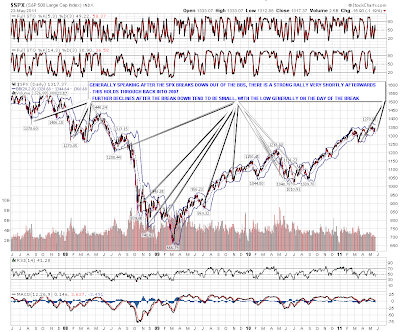
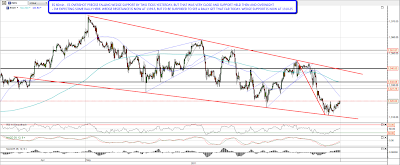
In the short term support held on my ES falling wedge, though it overshot by half a point on the strict thinnest pencil reading. As long as that support holds then the highest probability direction is up to wedge resistance that is currently at 1339.5. Given that the SPX BB chart shows that these breaks down out of the daily BBs are usually followed shortly afterwards by strong rallies, and that falling wedges break up 70% of the time, it would be folly to write off the long side here in my view:
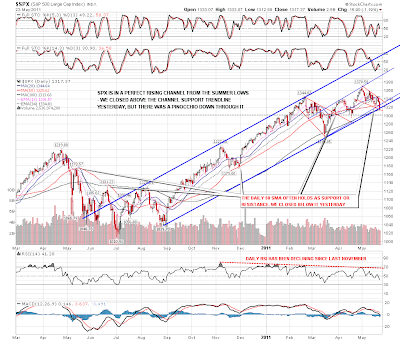
That's not to say that no technical damage has been done by this latest decline though. I said last week that a close below last week's low would cause some technical damage, and I was thinking of the channel support trendline from the Summer 2010 lows on SPX. There was a pinocchio down through that trendline yesterday, though SPX recovered above it by the close. A close below it would be a very dangerous sign of weakness:
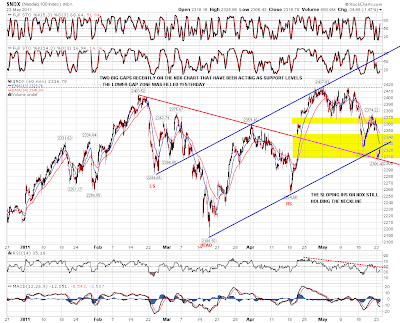
NQ blew through my support trendline for my possible broadening ascending wedge yesterday, so that pattern is trashed. It hasn't broken down of course, as the lower trendline needed a third touch to confirm it in any case. I'm just left with a strong resistance trendline on NQ & I'll have to give that some thought. The picture looks clearer on NDX, where the neckline of the sloping IHS there held at the lows, more or less, while NDX filled the open gap zone that has been acting as support. The SPX open gap in the 1313-1219 area was filled at the same time. Again with NDX, as long as that neckline holds, the default position looks bullish here:
I'm spoilt for choice with charts this morning, so I've bumped the TF chart, which held the support area I indicated yesterday and is still therefore possibly forming a large H&S with a possible RS target in the 845-860 area. You can look at yesterday's TF chart here if you want to refresh your memory of that setup. Copper has formed a little IHS overnight with a target at 409 and that has broken up. The picture is more complex than that though as copper bounced at the 395 support area I highlighted yesterday morning, and may therefore be forming a larger H&S with an RS upside target in the 404-5 area. So far copper has reversed at 405 so that is still very much in play. If 405 breaks then upside targets are 409 and a possible broken wedge support target in the 412-4 area. A break back into that wedge would be very bullish:
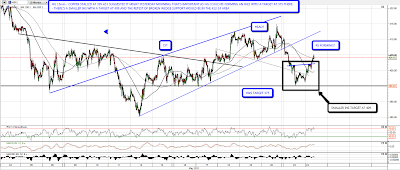
On oil a nice little triangle has formed as it has bounced around for the last few days. Support is at 96.75 today and resistance is at 100 with an upside touch more likely next:

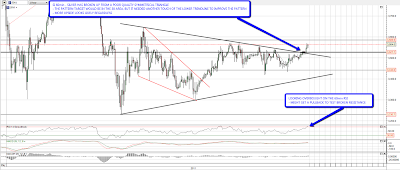
Silver has broken up nicely from the little triangle I've been posting in recent days. It isn't a good quality triangle, as the lower trendline needed a third touch to confirm it, but more upside looks likely from here, and for what it's worth, I'd put the triangle target in the 38 area:
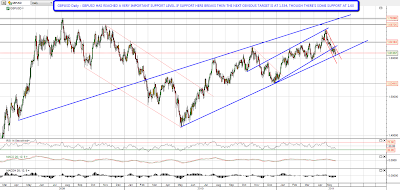
USD/DX hasn't reached the key declining resistance trendline I posted yesterday, and I thought I'd post the GBPUSD chart today to show that it has reached a very key support trendline overnight and bounced there so far. This is the key bull/bear line on GBPUSD in my view and if it breaks down then the obvious target would be the strong support (and possible H&S neckline) at 1.534. This doesn't matter as much for USD as EURUSD, but while USD might make it to declining resistance without GBPUSD breaking this main support, if it is to rise further then that trendline on GBPUSD would really have to be broken. GBPUSD is also in a small declining channel with resistance in the 1.625 area and I'll be watching that for a break up. One to watch:
I'm leaning towards a bounce today, and on the bigger picture I'm sticking with the bullish scenario until that falling wedge on ES breaks down. This isn't a conviction position, as I don't think convictions fit well with technical analysis, where the charts should lead and the analyst should follow. The charts are still telling me that the highest probability trade is up, so as long as that's the case that's good enough for me.


Hedging Update (by Dave Pinsen)

By -

In the table below, I've updated the costs (as of Monday's close) of hedging three major index-tracking ETFs against greater-than-20% declines over the several months, using the optimal puts, along with the costs of similarly hedging a handful of their most widely-traded components, and several precious metals ETFs.

Two new ETF additions this week

In the wake of LinkedIn's IPO last week, I also added two Internet ETFs (I suspect when those two ETFs update their top holdings, LinkedIn will be one of them). First, a reminder about why I've used 20% as a decline threshold, and what "optimal puts" means in this context.

Decline thresholds

As I've mentioned before the threshold I usually use when I hedge is 20% (i.e., I want protection against any decline worse than that). The idea for a 20% threshold came from a comment fund manager (and Stanford finance Ph.D.) John Hussman made in October 2008:

An intolerable loss, in my view, is one that requires a heroic recovery simply to break even… a short-term loss of 20%, particularly after the market has become severely depressed, should not be at all intolerable to long-term investors because such losses are generally reversed in the first few months of an advance (or even a powerful bear market rally).

Optimal puts

Optimal puts are the ones that will give you the level of protection you want at the lowest possible cost. With Portfolio Armor (available as a web app, and an iOS app) you just enter the symbol of the stock or ETF you’re looking to hedge, the number of shares you own, and the maximum decline you’re willing to risk, (your threshold). Then the app uses an algorithm developed by a finance Ph.D. candidate to sort through and analyze all of the available puts for your position, scanning for the optimal ones.

Costs (as of Monday's close) of hedging against >20% declines

Symbol

Name

Cost of Protection (as % of Position value)

Widely-Traded Stocks

INTC

Intel

1.84%*

CSCO

Cisco Systems

2.02%*

MSFT

Microsoft

1.49%*

LVLT

Level 3 Communications, Inc.

17.5%***

BAC

Bank of America

3.50%**

F

Ford

4.53%***

GE

GE

3.82%***

PFE

Pfizer

2.19%***

SIRI

Sirius XM Radio

10.0%***

S

Sprint Nextel

7.00%**

Major Index ETFs

QQQ

PowerShares QQQ Trust

1.95%***

SPY

SPDR S&P 500

1.63%***

DIA

SPDR Dow Jones Industrial Average

1.39%***

Precious Metals ETFs

GLD

SPDR Gold Trust

0.66%***

SLV

iShares Silver Trust

4.52%*

DBP

PowerShares DB Precious Metals

1.71%*

SGOL

ETFS Physical Swiss Gold Shares

3.25%***

SIVR

ETFS Physical Silver Shares

7.59%***

Internet ETFs
FDN First Trust Dow Jones internet 10.0%*
HHH Merrill Lynch Internet HOLDRs 2.91%**

*Based on optimal puts expiring in October, 2011

**Based on optimal puts expiring in November, 2011

***Based on optimal puts expiring in December, 2011

Twitter

I've noticed other posters here mention that they are on Twitter. In the event anyone's interested in my occasional tweets, here's my Twitter ID (or handle, or whatever it's called): @dpinsen

Pattern in Oil (Mike Paulenoff)

By -

Last Wednesday we told subscribers that the day's upmove in WTI crude oil futures from $95 to $101 was not the start of a new upleg. We noted that the pattern exhibited on the daily chart since the May 7 at $94.63 to Wednesday's high at $100.99 resembled a bear flag formation much more than a significant bottom. It had the look of a digestion-consolidation pattern in the lower quadrant of the larger downleg from May 2's $113.97. The analysis remains unchanged, and still argues for another downleg into the $90-$88 area next, which should negatively impact the oil & gas names as well.

OKnF2sQuk
Originally published on MPTrader.com.