



My broker can't find a single share, but just to mention it – here's the triple-bullish-on-real-estate in a gorgeous formation. This will be my last post until late tonight, as I have a very full afternoon. I hope everyone had a great day today!
Slope of Hope Blog Posts
Slope initially began as a blog, so this is where most of the website’s content resides. Here we have tens of thousands of posts dating back over a decade. These are listed in reverse chronological order. Click on any category icon below to see posts tagged with that particular subject, or click on a word in the category cloud on the right side of the screen for more specific choices.
Come to Papa……
VIX Buy Signal (by Springheel Jack)
Vix closed down yesterday, and that has delivered a confirmed Vix buy signal. The performance on these has been impressive since the bear market low in March 2009, and my bias has shifted towards buying the dip on the strength of that, and the other indications that we have seen at least an interim low, if not necessarily a very major low:

As for what sort of a low we have actually seen, it looks ominous to me, suggesting that we'll revisit these levels to make better quality lows or break down later in the summer. Meanwhile though, SPX and RUT have bounced almost precisely at the 200 day SMAs, though NDX went a little below. The broadest measure of US equities is the Wilshire 5000, and that has also made a nice looking low at the daily 200 SMA, and as with all three of the others seems to be bouncing to form the right shoulder on a large H&S pattern:

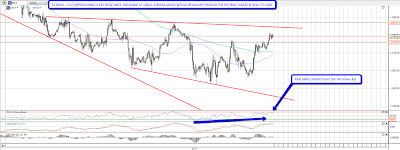
In the very short term however ES and TF are hitting overbought levels on the hourly RSI, and all three of ES, NQ, and TF are approaching important resistance levels that might well deliver significant dips in the next couple of days. First on ES I posted a broadening descending wedge last week that is still very much in play. I've altered the low trendline since somewhat, but the upper trendline with four touches is very significant resistance, and is at 1284.5. If we are to see a pullback today, it will most likely be from there and a break up through it would look very bullish, albeit that the pattern target is only to 1290:
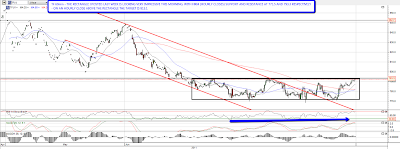
On NQ the declining channel for the wave down to the low has most definitely broken up. NQ isn't yet overbought on the 60min RSI, but it is approaching a very significant resistance level at 2215. A break up through would clear the path to the next significant resistance level in the 2250 area:

Of the three, it's TF that looks the most interesting to me this morning, as the possible rectangle that I posted last week on TF has continued to develop very nicely and has a very nice target at 815.1 on a break up. I like rectangles as I've found these to be reliable performers on the indices in the past so I'm watching this rectangle very carefully:
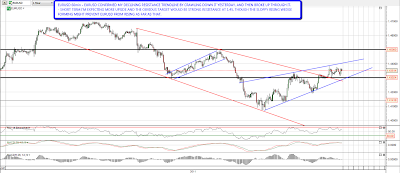
I was talking about the need for declining resistance on EURUSD to be confirmed and it was confirmed yesterday, with EURUSD crawling down the trendline for several hours. That's a characteristic of an imminent breakout generally, and sure enough EURUSD broke up through it overnight. The target of the broken broadening descending wedge is 1.465. The immediate target that springs immediately to the eye however is the strong resistance level and potential IHS neckline at 1.45. There is a bearish aspect to this breakout however and it is that EURUSD is forming a sloppy rising wedge with next resistance in the 1.44 area and with strong support now in the 1.43 area. I'll be watching both levels with interest for direction:
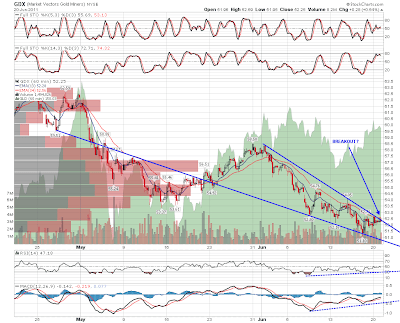
The last chart of the day is GDX, which has received an impressive battering recently. However a bullish falling wedge has formed and GDX is trying to break up from it. If it breaks up then the pattern target is 58.50, which is also a potential IHS neckline:
All in all I'm now leaning bullish on the view that we have now seen at least a multi-week low. As I mentioned though, short term the indices are looking overbought and are approaching some key resistance levels where we may well see a reversal today and tomorrow. I'll be buying that dip if we see it.
Hedging Update — Stocks
On Bloomberg TV Monday afternoon, markets reporter Adam Johnson noted that put protection had gotten more expensive since a week ago. That has been the case, as the the Chicago Board Options Exchange Market Volatility Index (VIX) has been above 20 since late last week. You can see examples of put protection getting more expensive in the table below, shows the costs, as of Monday afternoon, of hedging 20 of the most actively-traded stocks against greater-than-20% declines over the next several months, using the optimal puts for that.
Comparisons
For comparison purposes, I've also added the costs of hedging the SPDR S&P 500 Trust ETF (SPY), the SPDR Dow Jones Industrial Average ETF (DIA) and the Nasdaq 100-tracking ETF PowerShares QQQ Trust ETF (QQQ) against the similar declines. First, a reminder about what optimal puts mean in this context and why I've used 20% as a decline threshold.
Optimal Puts
Optimal puts are the ones that will give you the level of protection you want at the lowest possible cost. As University of Maine finance professor Dr. Robert Strong, CFA has noted, picking the most economical puts can be a complicated task. With Portfolio Armor (available on the web and as an Apple iOS app), you just enter the symbol of the stock or ETF you're looking to hedge, the number of shares you own and the maximum decline you're willing to risk (your threshold). Then the app uses an algorithm developed by a finance academic to sort through and analyze all of the available puts for your position, scanning for the optimal ones.
Decline Thresholds
You can enter any percentage you like for a threshold when using Portfolio Armor (the higher the percentage though, the greater the chance you will find optimal puts for your position). The idea for a 20% threshold comes, as I've mentioned before, from a comment fund manager John Hussman made in a market commentary in October 2008:
An intolerable loss, in my view, is one that requires a heroic recovery simply to break even … a short-term loss of 20%, particularly after the market has become severely depressed, should not be at all intolerable to long-term investors because such losses are generally reversed in the first few months of an advance (or even a powerful bear market rally).
Essentially, 20% is a large enough threshold that it reduces the cost of hedging but not so large that it precludes a recovery. When hedging, cost is always a concern, which is where optimal puts come in.
How Costs Are Calculated
To be conservative, Portfolio Armor calculated the costs below based on the ask prices of the optimal put options. In practice, though, an investor may be able to buy some of these put options for less (i.e., at a price between the bid and the ask).
Hedging Costs as of Intraday Monday
The data in the table below is as of Monday afternoon.
|
Symbol |
Name |
Cost of Protection (as % of position value) |
|
SPY |
SPDR S&P 500 |
1.49%* |
| DIA | SPDR Dow Jones Industrial Avg | 1.26%* |
| QQQ | PowerShares QQQ Trust | 1.90%** |
| NYSE Stocks | ||
| BAC | Bank of America Corporation | 8.18%** |
| F | Ford | 3.77%* |
| AMD | Advanced Micro Devices, Inc. | 19.4%** |
| GE | General Electric Company | 3.19%* |
| WFC | Wells Fargo & Co. | 6.03%** |
| NOK | Nokia Corporation | 16.3%** |
| C | Citigroup Inc. | 4.47%* |
| PFE | Pfizer Inc. | 2.37%* |
| S | Sprint Nextel Corporation | 11.2%** |
| ALU | Alcatel-Lucent | 11.5%* |
| Nasdaq Stocks | ||
| RIMM | Research in Motion, Ltd | 12.7%* |
| CSCO | Cisco Systems, Inc. | 6.01%** |
| MSFT | Microsoft Corporation | 3.14%** |
| LVLT | Level 3 Communications, Inc. | 11.6%* |
| INTC | Intel Corporation | 4.74%** |
| YHOO | Yahoo! Inc. | 8.34%** |
| MU | Micron Technology Inc. | 12.6%** |
| AAPL | Apple, Inc. | 3.90%** |
| ORCL | Oracle Corporation | 3.35%* |
| NVDA | NVIDIA Corporation | 8.56%* |
*Based on optimal puts expiring in December, 2011.
**Based on optimal puts expiring in January, 2012.
