Slope initially began as a blog, so this is where most of the website’s content resides. Here we have tens of thousands of posts dating back over a decade. These are listed in reverse chronological order. Click on any category icon below to see posts tagged with that particular subject, or click on a word in the category cloud on the right side of the screen for more specific choices.
When I worked at Apple from 1987 to 1990, the Macintosh was the only product they had. My, how times have changed!
Oh, and sorry for the comment-cleaner post. I’ve got a couple of fish to fry during this early morning hour, so I don’t have time for anything more substantive.
As I mentioned in my last post, I have been absolutely gobbling up A Fiscal Cliff. I haven’t enjoyed reading a book this much since fellow Sloper David Stockman’s Great Deformation. As for “Cliff”, I am only five chapters of this rather lengthy twenty chapter book, but I wanted to share some of my notes with you from what I’ve read so far:
About a week ago, someone here pointed my attention to a new book called A Fiscal Cliff. I am absolutely loving it – – can hardly put it down – – and I’m sure to write a long review/summary of it once I’m finished with its 400+ pages. As a side note, even though the book is pretty much hot off the presses, its data is made out-of-date thanks to Covid. For one thing, it mentions how in ten years we might pass the record Debt-to-GDP level of 107% set back in 1946. Well, folks, put down your pencils. We have roared right past that level massively………….we’re up to where the CBO projected we’d be in the year 2060 already.
As the market struggles with whether we are heading to 4,600 on the S&P (as the good people at Goldman Sachs assert) or instead lose of the recent mega-rally, I would suggest keeping a close eye on KBE, the bank sector ETF. We are at an important resistance level, just beneath a substantial cluster of overhead supply.
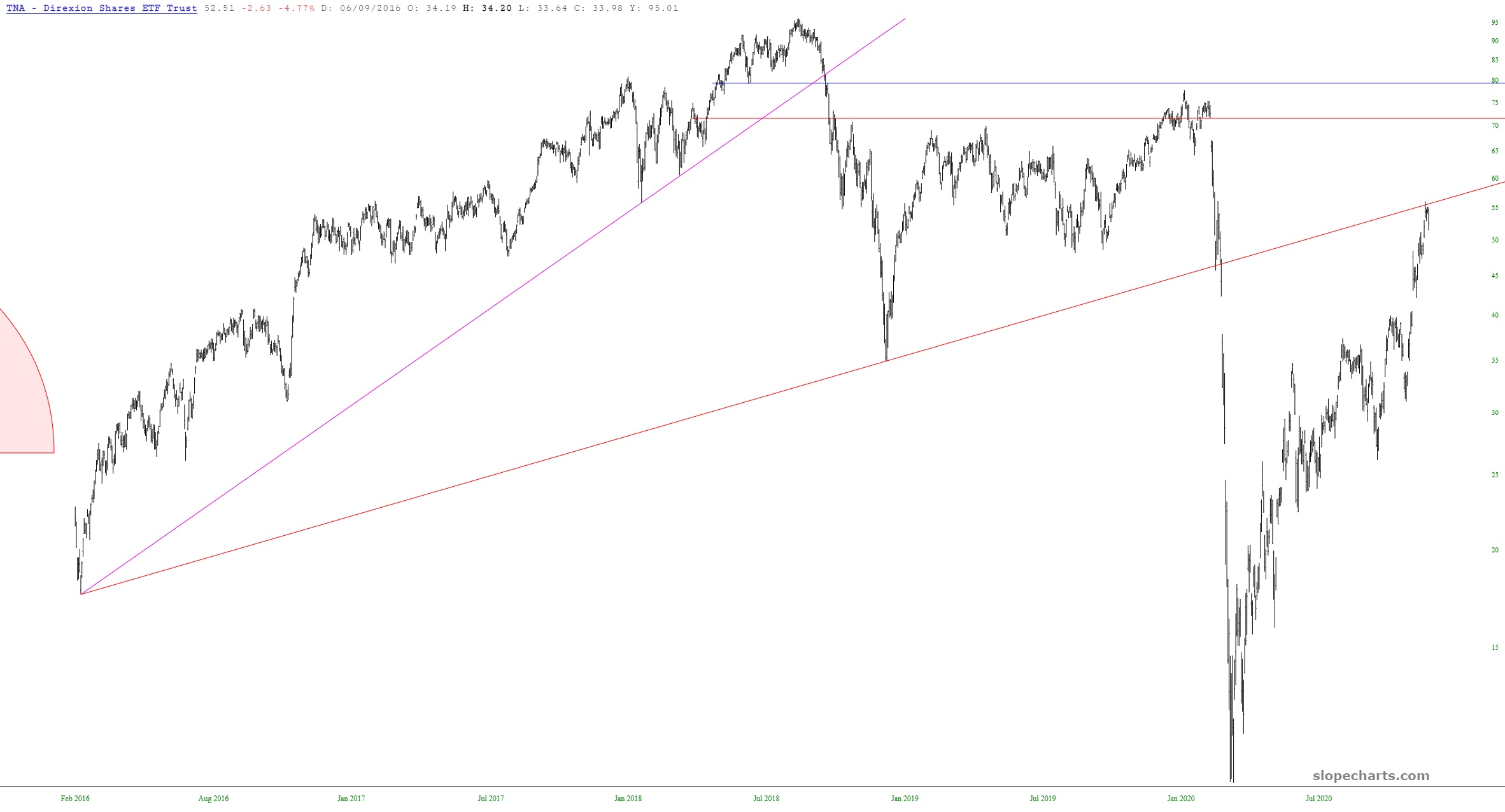
Below is the chart of TNA, the triple-bullish-fund based on small caps. It seems to me we have run into a wall of resistance, indicated by both a horizontal line and a shorter diagonal.