

Preface: due to the intense interest in silver these days, I have decided to share a chapter from my Panic Prosperity and Progress book which focuses on the Hunt Brothers and their attempt to corner the silver market in the late 1970s. I hope you enjoy it.
Putting an End to It
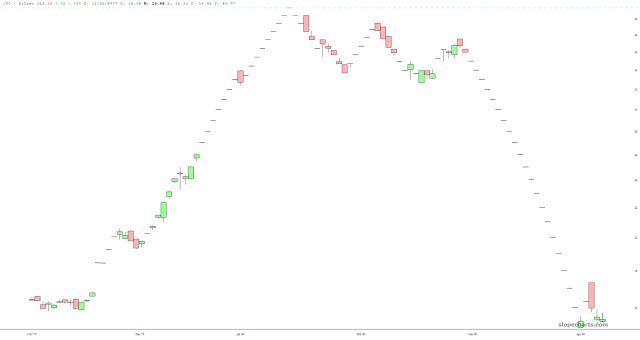
At this point, the exchanges did something extraordinary: simply stated, they outlawed buying. More specifically, on January 21, 1980, the COMEX said that the only orders they would accept would be liquidation orders. No one could buy. They could only sell.
The market was past the point of shrugging off news like this. With no buyers permitted, the price went into a free-fall. The day after the announcement, silver plunged to $34. To add to the selling pressure, the everyday people of the American middle class finally woke up to silver’s sensationally high price and began selling everything they might possess with silver content, from heirloom silverware to coins jingling in canvas bags.
In the first couple of months of 1980, it was reported that 16,000,000 ounces of silver coins and 6,000,000 ounces of scrap silver (including more than a few silver tea sets from little old ladies across the nation) were poured into the silver market, causing prices to shrink that much faster.
In spite of seeing his profits vanishing by hundreds of millions of dollars on a daily basis, Bunker kept a stiff upper lip and stated, “Why would anyone want to sell silver to get [paper] dollars? I guess they got tired of polishing it.” As nonchalant as he may have appeared in the press, his billions of dollars of silver were suddenly lurching limit-down in price, day after day.
Bunker Hunt kept behaving in the same fashion as he had before, confident that the recent downturn was just a blip in silver’s inevitable rise higher. He continued taking delivery of bullion, buying up more contracts, and taking up a multi-million dollar stake in another silver mine. He even announced that his employees would be given their bonuses in silver or gold, instead of cash, if the metals were more valuable when the bonuses were due. Bunker was, in sum, trying to give silver whatever positive press it could garner, given the unfortunate circumstances.
Silver Thursday
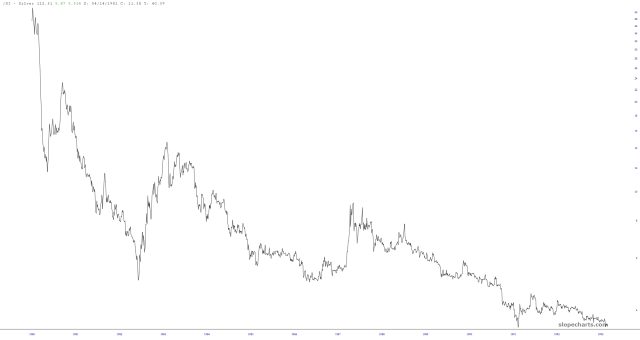
By March 3rd, silver had slipped to $35.20 per ounce, a drop of about 30% from just two months before. Although the overall Hunt position was still profitable, a meaningful amount of the gains had disappeared. The bull market was clearly over, and the price kept getting hammered on a daily basis, reaching $21 by March 14th. Paul Volcker, the Chairman of the Federal Reserve, had declared open war on inflation, and he was pushing interest rates to levels the nation had never seen before. The fantastically-high interest rates were mopping up cash from around the world and drawing it away from such alternatives as silver.
The Hunts had many expenses related to their silver holdings, such as the storage costs. But the biggest cash drain of all was the making of margin payments, because as the price of the metal continued to drop, the exchanges demanded larger and larger cash payments so that the International Metals partnership could avoid a margin call, which would compel the selling of their futures contracts.
Although the margin calls had been paid obediently during the collapse, that all changed on March 25, 1980. The Hunts’ silver broker, Bache, contacted the partnership with a $135 million margin call. The Hunts stoically informed Bache that they couldn’t make the payment. The game was at an end.
Bache started dumping the Hunt silver, and they likewise notified the CFTC about the margin call and its consequences. B ache warned the CFTC that the Hunts would be facing more calls, given the ongoing plunge in silver’s price, and that they would likely have an account with a significant negative balance. Word of the dire situation quickly leaked out, and full-scale panic took hold of the precious metals markets.
In a last-ditch effort, Bunker made an announcement from Paris that he and four Arab partners had completed the acquisition of more than 200 million ounces of silver and that they would be issuing silver bonds to investors, both small and large, that were backed by the metal. In a way, Bunker was going to distribute his own metal-backed currency, returning to the tradition that national governments had long-ago abandoned.
One aspect of the announcement that was visibly lacking was the name of any large banks that would be participating in such a venture. The public swiftly concluded that Hunt was just announcing a hoped-for plan, not an actual public offering of silver-backed bonds, and that he hadn’t even found any credible banks to partner with him.
Although Bunker hoped to shore up silver’s price with such a bold announcement, it had precisely the opposite effect. On March 27, 1980, the day after Bunker’s announcement, the silver market went into an unmitigated free-fall. It opened at $15.80, and frantic trading flooded the pits. Unfounded rumors begin to circulate, such as that the Hunts were facing a billion-dollar margin call they couldn’t meet, and that their broker was about to shutter its doors.
Silver’s plunge had not gone unnoticed by the equity markets. The Dow Jones Industrial Average had been above 900 early in the year, but the pummeling that both gold and silver had been taken had a wasting effect on equity prices, particularly since there were rumors that the Hunts would need to dumped vast quantities of their own public holdings in order to meet their silver market requirements. The Dow was trading at about 760, a 15% drop, during what would be known as “Silver Thursday.”
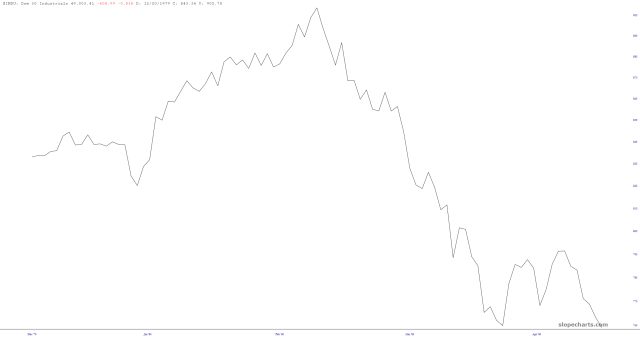
As the trading day wore on, the damage was becoming extraordinary. Silver was trading at $10.80 an ounce, nearly 80% lower than it had been just a couple of months before. The Dow was showing a loss of 25.43 points, a fall of over 3% in a single day and the lowest price it had seen in five years.
The investing public was beginning to perceive the Hunts as having created a financial debacle that reached far beyond their beloved silver. Before the closing bell rang, bargain-hunters bucked up equity prices and reversed almost all the losses for the day, although silver was still hammered down to its $10.80 bid.
On January 17, the Hunts had $4.5 billion silver, $3.5 billion of which was profit. By the closing bell of Silver Thursday, the picture had changed dramatically: now the Hunts silver misadventure had $1.5 billion in assets (the bullion itself) and $2.5 billion in liabilities. The Hunts were presented with just about the last thing they wanted to see: another margin call, this one for $100 million.
Just about the only people happy with the events of Silver Thursday were those fortunate enough to have sold silver short at higher prices. Armand Hammer – the same man who infuriated the Hunts by being the first to bend to the will of Gadaffi – locked in a gain of $119 million with silver’s collapse, since he had the foresight to see that silver’s parabolic rise would soon come to an end.
The Bailout
Because the Hunts had started purchasing silver when it was much cheaper, the cost basis of their bullion was only about $10, which meant that even with the complete devastation that has been leveled against silver prices in the first couple months of 1980, they still had a small profit on their holdings. Their trouble wasn’t with the bullion, but with the massive amount of futures contracts they had secured with a price of about $35 per ounce.
The debts they owed on these obligations were enormous and so complex that no one was sure what the exact figure was, but the damage was in the neighborhood of $1.5 billion. On top of this, they already had an obligation to take delivery of silver to the tune of $665,000,000 to add to their already staggering pile of bullion. The Hunts had acquired much of their silver with leverage, which worked fabulously during silver’s unrelenting ascent, but had a devastating effect now that prices had fallen so hard.
On the Sunday following Silver Thursday, Bunker met in Dallas with some principals of his organization as well as the Engelhard organization to which they owed $665 million for a looming silver delivery. The Hunts notified Engelhard that they didn’t have the cash to take the delivery and that their tremendous holdings of silver stored abroad had already been pledged as collateral for other loans. Bunker Hunt, when contemplating their monstrous losses, uttered a phrase that would achieve some lasting notoriety: “A billion dollars isn’t what it used to be.”
The tremors that the Hunts had caused on the nation’s financial markets required the most senior attention, so that afternoon they flew to Boca Raton to meet with the leaders of the largest banks in the U.S. as well as the Chairman of the Federal Reserve, Paul Volcker. Volcker normally frowned on providing any assistance to speculative ventures, but in this instance he happened to be in town to give a speech, and he decided to get involved in the negotiations that the Hunts and Engelhard were having with the banks.
The negotiations dragged on through the night and into the early morning, with a rumpled and weary Volcker occasionally showing up in his night clothes with a dress shirt haphazardly thrown over his pajama top. The negotiations were complex and difficult, but by Monday morning, an arrangement had been made: the Hunts would hand over 8.5 million ounces of silver to Engelhard as well as a 20% interest in several oil properties. The oil interests were untapped, and the Hunts didn’t know if they were giving away an ungodly sum to get out of the mess they were in, but given the circumstances, they had little room to negotiate.
Since the Hunts and Engelhard had reached an arrangement about their own financial relationship, the Hunts now turned to the gathered bankers to get a loan that could cover all the existing debt obligations. Led by First National Bank of Dallas and Morgan Guaranty of New York, a group of banks assembled $1.1 billion in loans to the Hunt interests so that they could honor their debt obligations.
Among the terms of the deal was a pledge that the Hunts not speculate in the silver market until everything had been paid off – given the circumstance, it seems unlikely that the Hunts would need to be restricted from having anything to do with silver again in their entire lives.
What was shocking to the rest of Hunt clan was how much of the family’s assets had to be pledged as collateral for the bailout. The rest of the Hunt children, most of whom had absolutely nothing to do with the silver debacle, found their coins, jewelry, cars, oil interests, paintings, furs, racehorses, and other valuable assets suddenly collateralized. Although the other Hunts didn’t partake of the splendid (albeit fleeting) gains that had been enjoyed by the participating Hunt brothers, they did find themselves having to help pay for these financial risks across almost all their asset classes.
Gold Riding Shotgun
Throughout all the Hunts’ silver drama, gold likewise participated in its own highly-correlated bull market. Unlike silver, gold was not the beneficiary of a very focused buying spree by the richest men in the world, but it had its own reasons for moving higher.
In May of 1973, gold was pegged at $42.22 per ounce by the government, but by January 1980 – the same month silver peaked – gold hit a lifetime record of $850 per ounce, a twenty-fold increase. Besides the surging inflation of the late 1970s, political unrest in Afghanistan (specifically, the Soviet invasion) as well as the turmoil in Iran with the taking of American hostages fueled the flames of international worry. Such fears often drive money into historically safe assets, and in this case, the safest asset of all was perceived as gold.
Although gold had enjoyed a speculator run during the final years of the 1970s, once the price peaked in January 1980, gold would enter a grueling, seemingly interminable bear market of its own for nearly twenty years. It would finally bottom at $251.70 in August 1999, near the height of Internet stock mania. In inflation-adjusted terms, the peak price of gold in early 1980 was well over $2,000 per ounce, a price that, as of this writing, has never been matched.
The Double Eagle Returns
The double eagle gold coins from 1933, described earlier in this tale, should have been completely lost to history, with the exception of the two specimens saved by the U.S. government, having been melted down by government order. It turns out, however, that a small number of the coins found their way out of the U.S. Mint, and one of them eventually become the most expensive coin sold in history.
The circuitous, multi-decade route of the “escaped” coins is an interesting tale in itself. It seems that someone at the U.S. Mint with access to the gold coins – perhaps the Mint Cashier, although no one will ever know for sure – pilfered at least twenty coins and got them into the hands of Israel Swift, a jeweler in Philadelphia. This went unnoticed for years, until one of the coins appeared at a coin auction.
A reporter was intrigued by the appearance of this coin which wasn’t supposed to exist, so he contacted the U.S. Mint as part of his research. In turn, the Mint notified the Secret Service, which opened up a case to investigate the matter.
One would not normally think that a single coin from over a decade ago would have been a matter of national interest, but the Secret Service took the matter very seriously and wound up tracking down seven different coins, each of which were doomed to be melted at the Mint, as they should have been ten years earlier. Because of the age of the crime, Israel Swift had the statute of limitations to thank, since he could not be prosecuted.
Unknown to the Secret Service, there was another 1933 Double Eagle sitting in Egypt, owned by none other than King Farouk, who was an enthusiastic collector of all kinds of objects and treasures. He had, in 1944, purchased the coin and had actually taken great care to follow the letter of the law and fill out all the export paperwork so that the purchase and shipment of the coin was legal and proper. This all took place just a few days before the Israel Swift matter came to light, and the export license was granted.
Although the Treasury Department tried to get the coin back through diplomatic channels, the King saw no reason to hand over his legally-acquired property. In 1952, he was deposed from his throne, with his many treasures seized and put up for public auction. The Treasury Department asked the new Egyptian government to hand over the coin, and the government agreed that it would. Strangely, however, the coin once again vanished.
Decades later, at the Waldorf-Astoria Hotel in New York City, the U.S. Secret Service arrested British coin dealer Stephen Fenton, and among his holdings was the very Double Eagle that King Farouk had possessed so long before. A court battle ensued, and it was decided that the coin belonged to the government of the United States and that it could be sold at auction. In an interesting settlement, it was also decided that, unlike all the other Double Eagles, this one would be made into legal tender (that is, monetized), as originally intended in 1933.

The story of this small, single coin becomes more interesting still: when deciding where to store this singularly valuable coin, the Treasury officials settled on the vaults of the World Trade Center. In July 2001, only a few months before terrorist attacks would destroy the building complex, the coin was moved to Fort Knox.
Finally, on July 30, 2002, the coin was put up for auction at Sotheby’s and sold for $6,600,000. A 15% surcharge was tacked on by Sotheby’s plus – almost comically – a $20 fee in exchange for the intrinsic $20 “monetized” value of the coin as legal tender (although it can safely be said the coin would never be spent in exchange for $20 in goods or services).
Thus, the final bill of $7,590,020 was the final bill for the coin, with half the cash (plus the intrinsic value of $20) going to the U.S. Treasury and the other half going to coin dealer Stephen Fenton. After over 70 years of making its way all over the world, the coin finally found a permanent home to an anonymous buyer after only nine minutes of bidding.
Finally, it should be noted that ten more Double Eagles have been uncovered – again, emanating from the actions of Israel Swift – but that lengthy litigation has determined that these too are the property of the U.S. Government. They remain securely stored at Fort Knox and, as of this writing, their fate has not been determined.
Bankrupt Billionaires
The inflationary 1970s had been very kind to the Hunts and their businesses. Surging prices in soybeans, crude oil, silver, Texas real estate, and many other commodities augmented the family fortune by billions.
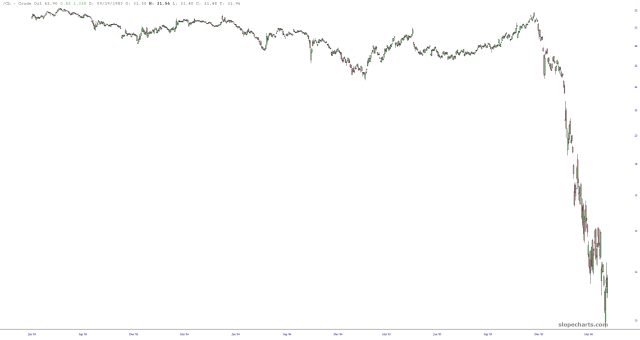
The 1980s were a mirror image for the family’s assets. Texas real estate fell in value precipitously, and crude oil collapsed from about $32/barrel in late 1985 to about $10 in early 1986. The Hunts found themselves with $1.48 billion in assets and debts of $2.43 billion. The Hunts had grown from the richest people in the world to some of the world’s most indebted.
In 1987, the Hunts had as many lawyers working on their financial legal battles – 15 in all –as there were children in the family. The banks fighting the Hunts on the other side of the table hired fifty times that many attorneys to wage war against them, and by 1988, the war was over, and the banks had won.
Adding to the financial pain being brought by their creditors, the Hunts also faced another unexpected nemesis: a mineral company from Peru. During the run-up in silver prices, a rogue trader inside the company sold short the metal, ultimately suffering terrible losses for the firm. In 1988, a court awarded $134 million damages to the Peruvian firm, payable by the Hunt brothers.
Bunker Hunt filed for personal bankruptcy in 1988, and he emerged from the formalities with several million dollars in assets but a bill to the IRS for $90 million that had to be repaid over the ensuing fifteen years. It was the largest personal bankruptcy in Texas history, and a coda that would have seem preposterous had one predicted it a few years earlier.
The remarkable tale of the Hunt saga can, at its simplest, illustrate vividly that leverage can be a powerful ally or a deadly enemy to the fortunes of even the most storied family dynasties.
