

The Foundation of Options Trading
First things first—don’t let the term “Greeks” intimidate you. They aren’t ancient riddles, nor do they require decoding with mystical insight. The Greeks are simply tools—powerful ones—that help you understand how options behave. For anyone serious about trading options, the Greeks are not barriers but bridges to better decision-making.
Today, we’ll focus on one of the most fundamental Greeks: Delta. This isn’t a comprehensive dive, just a starting point. Think of it as laying the first brick in a strong foundation. In the coming weeks, I’ll expand on each of the Greeks with detailed discussions.
What Is Delta?
Delta is often considered the backbone of options trading because of its versatility. At its core, delta tells you two critical things:
- Probability Indicator: Delta represents the likelihood that an option will finish in the money at expiration.
- Price Sensitivity Gauge: It also shows how much an option’s price will change if the underlying stock moves $1.
Think of delta like a weather forecast:
- The probability indicator is like the forecast saying, “There’s a 70% chance of rain tomorrow.” It doesn’t guarantee rain, but it gives you strong odds to plan your day—maybe pack an umbrella.
- The price sensitivity gauge is like predicting how much it will rain. Is it a light drizzle or a downpour? In options, this tells you how much the option’s price will rise or fall with a change in the stock’s price.
Delta as a Probability Tool
Delta isn’t just a number; it’s a probability compass, guiding you through the uncertain terrain of the markets.
Imagine you’re flipping a coin. There’s a 50% chance it lands heads up. In the world of options, buying an at-the-money (ATM) call or put option has a similar probability of success—right around 50%. This is because the strike price is exactly at the current market price, making the odds of it finishing in-the-money a statistical coin flip.
Example 1:
Consider the S&P 500 ETF (SPY) currently trading at 597.10. The at-the-money strike would be 597, and the delta for the 597 call option is roughly 0.50. This translates to a 50% chance that the option will expire in-the-money. It’s the options equivalent of flipping a coin—simple, unbiased odds based on current market conditions.
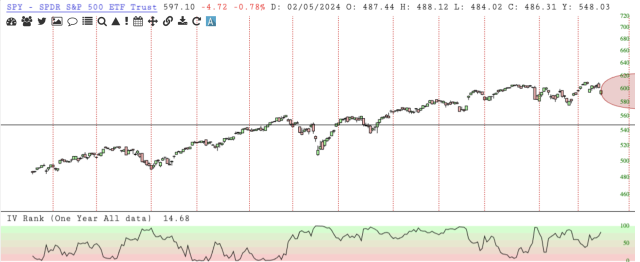
Now, if you prefer higher probabilities of success—like most premium sellers—you’d target options with a lower delta. This approach shifts the odds in your favor.
Example 2:
Selling an option with a 0.20 delta gives you roughly an 80% probability that the option will expire worthless, allowing you to keep the premium. For instance, the SPY 622 call has a delta of 0.20, indicating an 80.73% chance of success if you sell it, especially when using strategies like a bear call spread.

A Simple Metaphor:
Think of delta as playing a game of darts:
- High Delta (0.70): You’re aiming at the bullseye from far away. You might hit it, but it’s a tough shot, at only 30% chance of success.
- Low Delta (0.20): Now imagine the bullseye is much larger, or you’ve stepped closer. It’s easier to hit, giving you better odds (80% success), but the reward isn’t as big (smaller premium).
Key Takeaways:
- Higher Delta (Closer to 0.70): Higher premium potential, but lower probability of success.
- Lower Delta (Around 0.20): Lower premium, but a much higher probability of success—ideal for option sellers.
Understanding delta as a probability tool empowers you to structure trades that align with your risk tolerance and strategy objectives.
Delta as a Price Sensitivity Measure
Delta doesn’t stop at probabilities. It also measures how much an option’s price will change with a $1 move in the underlying asset. Think of delta as the volume knob on your stereo—when you adjust it slightly, the sound increases or decreases. Similarly, delta tells you how sensitive an option’s price is to changes in the underlying stock.
- Example 1: If you own a SPY call option priced at $1.00 with a delta of 0.60, and SPY rises by $1, the option’s price will increase to $1.60, assuming other factors remain constant. Here, the 0.60 delta means the option “absorbs” 60% of the underlying stock’s price movement.
- Example 2: For the SPY 622 call with a delta of 0.20, currently priced at around $2.98, a $1 increase in SPY would raise its value to approximately $3.18, again, with all other things being equal. This smaller delta reflects less sensitivity to price movement.
A Simple Metaphor:
Imagine you’re pushing two sleds on snow:
- Sled A (high delta, 0.60) is light. A gentle push (a $1 stock move) sends it sliding far (a big change in option price).
- Sled B (low delta, 0.20) is heavier. The same push moves it, but not nearly as far (a smaller price change).
In trading, this means that higher-delta options react more dramatically to changes in the underlying stock, while lower-delta options move more gradually.
Why This Matters:
Understanding delta’s sensitivity function helps you anticipate how much your options will gain or lose as the market moves. This knowledge is crucial for:
- Managing risk: Knowing how volatile your position might become.
- Position sizing: Deciding how much exposure you really have.
- Strategic adjustments: Making timely decisions if the market moves against you.
The Hidden Power of Delta: Real-Time Market Sentiment
Delta isn’t just about numbers—it reflects real-time market sentiment. Think of it as the pulse of the market, capturing how traders collectively feel about the future direction of a stock or index. It’s not based on forecasts or opinions; it’s based on real money changing hands in real time.
Imagine walking into a bustling marketplace. The noise, the crowd’s movements, the frantic pace—all give you a sense of what’s hot and what’s not without anyone having to say a word. Delta functions the same way. It silently translates the market’s collective actions into a clear, measurable probability.
No Guesswork Needed:
Delta doesn’t care about geopolitical events, interest rate decisions, tariffs or economic forecasts. While the financial media buzzes with speculation about “what might happen,” delta deals with what’s happening right now. All the known information—earnings reports, economic data, and investor sentiment—is already baked into the option’s price through supply and demand dynamics.
- Example: When traders rush to buy call options because they expect a stock to rise, the increased demand pushes both the price and the delta higher. Conversely, if fear dominates and puts are in high demand, delta shifts accordingly. No need for crystal balls or complex predictions—delta shows you where the money is flowing.
A Simple Metaphor:
Think of delta like a thermometer:
- It doesn’t predict tomorrow’s weather, but it tells you exactly how hot or cold it is right now.
- You don’t need to speculate; the reading reflects the current environment, based on real, observable data.
Why This Matters for Traders:
For quantitative traders, this is the beauty of delta. It’s not swayed by emotions or news headlines. It’s rooted in hard data—real trades, real prices, real probabilities. By focusing on delta, you can:
- Make data-driven decisions
- Avoid emotional trading traps
- React to the market’s actual behavior, not just its noise
Why Delta Should Anchor Your Options Strategy
Delta isn’t just another number on an options chain. It’s the cornerstone of effective risk management and trade construction, especially for premium sellers. Understanding delta helps you:
- Choose strike prices with precision
- Manage directional risk
- Adjust positions proactively
In the coming weeks, I’ll release a series of posts diving deeper into delta and the other Greeks. For now, this overview should give you a solid foundation. Remember, in options trading, knowledge isn’t just power—it’s profit.
If you’re ready to start trading smarter, with high-probability strategies, and a focus on consistent income over long-term speculation, I invite you to join me at The Option Premium.
📩 Sign up for my free newsletter here → [The Option Premium]
I want to encourage all of you interested in trading options to sign-up for my free weekly newsletter. No, I’m not going to send you more than the one email a week and no, I’m not running a service. I’m a trader. This is completely free from all marketing. You will find educational topics, research, actionable trade ideas, weekly indicators and more each week. I’ve been on Slope for a long, long time and would appreciate all of your support. As always, thanks for your time!
Kindest,
Andy Crowder
