

A Pragmatic Approach to Hedging: Navigating an Extended Bull Market
“The markets can remain irrational longer than you can remain solvent.” — John Maynard Keynes
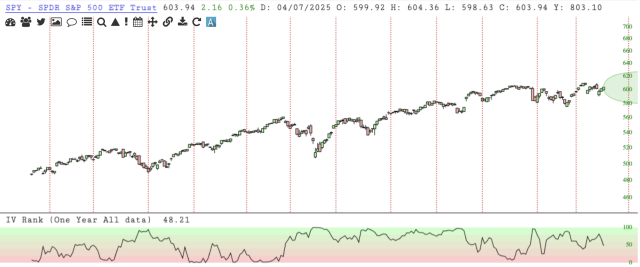
It’s a sobering reminder that even the most seasoned investors aren’t immune to the fickle nature of the financial markets. Today’s S&P 500 seems to be on an endless upward trajectory, defying gravity with each new high, tempting traders to believe in an unbreakable rally. But history whispers a different tale—bull markets, no matter how robust, are often punctuated by sharp, unexpected corrections. While no one can predict with absolute certainty when the tide will turn, prudence suggests preparing for the inevitable. Strategic hedging isn’t about forecasting the future; it’s about fortifying your portfolio against it. This is where the bear call spread becomes more than just a strategy—it becomes your safety net when the euphoria fades.
While no one can predict with absolute certainty when the tide might turn, prudence suggests preparing for the inevitable. After all, bull markets are often punctuated by sharp, albeit temporary, corrections. This is where strategic hedging comes into play—not to predict the market’s next move, but to prepare for it.
The Case for a Bear Call Spread
When markets surge relentlessly, it’s easy to get swept up in the euphoria—chasing gains, stretching positions, and convincing ourselves that “this time is different.” But seasoned traders know better. They understand that what goes up, doesn’t always come down immediately—but it rarely rises forever. That’s where the bear call spread comes in. It’s not about betting against the market; it’s about positioning wisely when prices start to look a little too perfect. This strategy allows you to lean into caution without abandoning opportunity—a way to profit from stability, complacency, or even the faintest signs of market fatigue.
Why a Bear Call Spread?
Imagine having a strategy that rewards you even when you’re not exactly right. That’s the beauty of the bear call spread. You don’t need the market to crash—you just need it to not explode higher. By defining both your potential profit and your risk upfront, the bear call spread offers clarity in a market often clouded by uncertainty. It’s tailor-made for traders who value structure over speculation, who prefer probabilities over hope, and who know that the smartest moves aren’t always the flashiest.
Setting Up the Trade
With the SPDR S&P 500 ETF (SPY) trading around 603.94, let’s construct an example of a bear call spread with a short-term horizon—44 days until expiration. The goal: a trade with an 80% to 85% probability of success.
Step 1: Choosing the Strike Prices
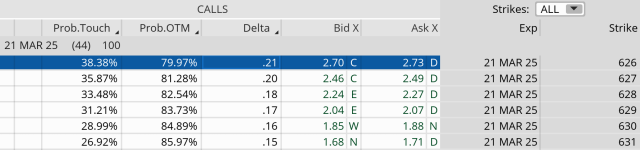
- Short Call: Target a call option with a delta below 0.21, correlating to an 80%+ probability of success. In this case, the 626 strike fits the bill.
- Long Call: To cap potential losses, buy the 631 strike, creating a 5-point-wide spread.
Step 2: Understanding the Expected Move
The market anticipates SPY could reach as high as 632 by expiration. Placing the short call inside the expected move provides a buffer within this expected range, balancing risk and reward. Our probability of success stands at 79.97%.
Step 3: Executing the Trade
- Sell to Open: SPY March 21, 626 Call
- Buy to Open: SPY March 21, 631 Call
- Net Credit: $1.00 (or $100 per spread)
- Max Risk: $4.00 (or $400 per spread)
- Max Return: 25.0% if SPY remains below 626 at expiration
Managing the Trade
Risk management doesn’t end at execution. Time decay (theta) works in our favor, accelerating as expiration nears. The plan is to close the position early, ideally when 50-75% of the premium has been captured. This translates to buying back the spread when it falls to $0.50-$0.25, possibly doing this in tranches.
However, should SPY rally unexpectedly, a stop-loss is essential. Personally, I like to exit if the spread value doubles or triples (i.e., $2.00 to $3.00).
The Importance of Position Sizing
Risk is defined not just by the strategy but by how much capital you allocate. A disciplined approach limits exposure to 1-5% of your portfolio per trade, allowing the law of large numbers to work in your favor. This methodical framework not only safeguards capital but also ensures peace of mind.
Final Thoughts
Final Thoughts
In the relentless ebb and flow of the markets, it’s easy to be swept away by optimism—or paralyzed by fear. But successful trading isn’t about chasing every rally or dodging every dip; it’s about discipline. The bear call spread embodies this discipline, offering a structured approach to navigating uncertainty. It allows you to hedge against market exuberance while still leaving room for calculated gains. Whether you’re new to options or a seasoned trader, the fundamentals remain unchanged: define your risk, trust in probabilities, and let strategy—not emotion—drive your decisions.
If this resonated with you or sparked new questions, I’d love to hear your thoughts. After all, the most valuable insights often come from the conversations we share.
If you’re ready to start trading smarter, with high-probability strategies, and a focus on consistent income over long-term speculation, I invite you to join me at The Option Premium.
📩 Sign up for my free newsletter here → [The Option Premium]
I want to encourage all of you interested in trading options to sign-up for my free weekly newsletter. No, I’m not going to send you more than the one email a week and no, I’m not running a service. I’m a trader. This is completely free from all marketing. You will find educational topics, research, actionable trade ideas, weekly indicators and more each week. I’ve been on Slope for a long, long time and would appreciate all of your support. As always, thanks for your time!
Kindest,
Andy Crowder
