Slope of Hope Blog Posts

Slope initially began as a blog, so this is where most of the website’s content resides. Here we have tens of thousands of posts dating back over a decade. These are listed in reverse chronological order. Click on any category icon below to see posts tagged with that particular subject, or click on a word in the category cloud on the right side of the screen for more specific choices.

AAII Sentiment Survey – Week Ending 2/15 (by Ultra Trading)

By -

This week's AAII Investor Sentiment (asks of one's market view over the next six months) is out and still in the bullish camp.  Those answering bullish dropped 2.8% this week to a still above average 46.6%. Those answering bearish dropped 1.3% this week to a still below average of 25.6%.


The SPX continues to ignore prior correlations and the AAII sentiment data is yet another.  The charts below speak for themselves as the divergence over the past few months continues to grow new levels.


Submitted by Ultra Trading.  If you would like to read more, please visit - Ultra Trading

Understanding The Big Picture (by Ultra Trading)

By -

A few weeks back after the banks reported earnings, I compared the reserve rates for the top four banks. Clearly, WFC stood out as having a lower reserve as a percent of total loans and leases. 

With the recent and sudden departure of the WFC CFO rumors began circulating as to why Howard Atkins left a high paying job, very suddenly and at a relatively young age. Well today one of the best bank analysts is shedding light as he questions the validity of WFC's disclosure process.

"The departure of Atkins, we are led to believe, was not merely the result of personal issues, but reflects an ongoing internal dispute within [Wells Fargo's] executive suite regarding the bank's disclosure," 

There is a lot of noise in the market right now. Bank stocks seem to catch and endless bid but the problems have not gone away. Understanding and staying focused on the bigger picture, beyond the day to day noise is critical. You are better prepared to understand how to respond to the WFC news today and determine if the sell off is an overreaction or in fact true pricing of real risk at WFC.

Submitted by Ultra Trading.  If you would like to read more, please visit - Ultra Trading

Interest Rate Derivatives (by Ultra Trading)

By -

Remember back in 2008 each Sunday night seemed to be a new class on the latest financial product that failed.  Guess what?  They are still out there and the risk in many cases is even greater.  So as we watch a market chop up anyone trying to price in reality, time is better served for longer term and or macro traders to study and be prepared for those falling shoes still being levitated by the Fed, FASB and Treasury.

Over the next few days I'll discuss various derivatives.  Derivatives are important financial products but like anything in moderation.  Derivatives have outgrown their intended use and as a result represent major systemic risk to the global economy that still have yet to be addressed.

Below is an example of an interest rate derivative product.  In its most basic definition, all this product does is convert a floating rate to a fixed rate and vice versa. 

GM needs capital and wants to sell debt to GEICO.  They offer to sell $100 million in debt to GEICO for five years at an adjustable rate of 6 month Libor plus 200 bp (2%).  GEICO loves the deal but wants a fixed rate. The interest rate derivative is the product that allows this deal to get done.

Transaction 1 – The selling of debt between GM and GEICO

Screen shot 2011-02-15 at 3.57.57 PM 

Transaction 2 – GEICO converts their adjustable rate to a fixed rate
GEICO needs to find someone who will convert their adjustable rate for a fixed rate.
They call JPM who agrees to buy GEICO's 6 month Libor and will pay GEICO 4%.


Screen shot 2011-02-15 at 3.58.05 PM

The Result

  • GM sold $100 million in debt to GEICO and pays an adjustable rate
  • GEICO invested $100 million in GM at a fixed rate of 6%
  • JPM purchased 6 month Libor for 4% for a period of five years


Submitted by Ultra Trading.  If you would like to read more, please visit - Ultra Trading

Derivatives Overview Part 1 – (By Ultra Trading)

By -

This is a multi-part series that looks at the derivatives market to help understand the systemic risk these products represent to the global economy.  Unfortunately this problem was never resolved after the 2008 financial crisis.  One day it will have to be addressed. 


Wikipedia defines a derivative as:

"A financial instrument (or, more simply, an agreement between two parties) that has a value, based on the expected future price movements of the asset to which it is linked, called the underlying asset."


The most basic of derivatives would be the equity option such as a call.  Using the definition above, the derivative, the call option, is an agreement between the buyer and seller of the option, whose value is based on the future price of the underlying asset in this case, equity.  A 300 call option on AAPL is an agreement between a buyer and a seller and the value of the option is based on the price of the underlying asset, AAPL stock. 

Although scary in name, such as an Interest Rate Derivative, the product itself is relatively straightforward as will be discussed in future posts.  Derivatives are used for various reasons from speculation, increased leverage to arbitrage, but primarily as a hedge against risk.  They serve an important role in the world of finance but like anything moderation is key.


Derivatives can be broken down into two categories: 

  • Over The Counter (OTC)
  • Exchange-Traded


OTC is where we will focus as this represents the greatest risk to the global economy.  In the 2008 financial crisis, derivatives took center stage and became part of everyone's vocabulary. Unfortunately though, the 2008 financial crisis did very little to resolve inherent risks to the financial system.  As you will see the size of this market is truly beyond comprehension.


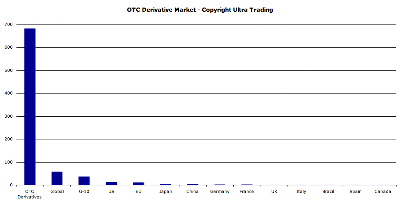
Global GDP in 2008 was roughly $58 trillion USD.

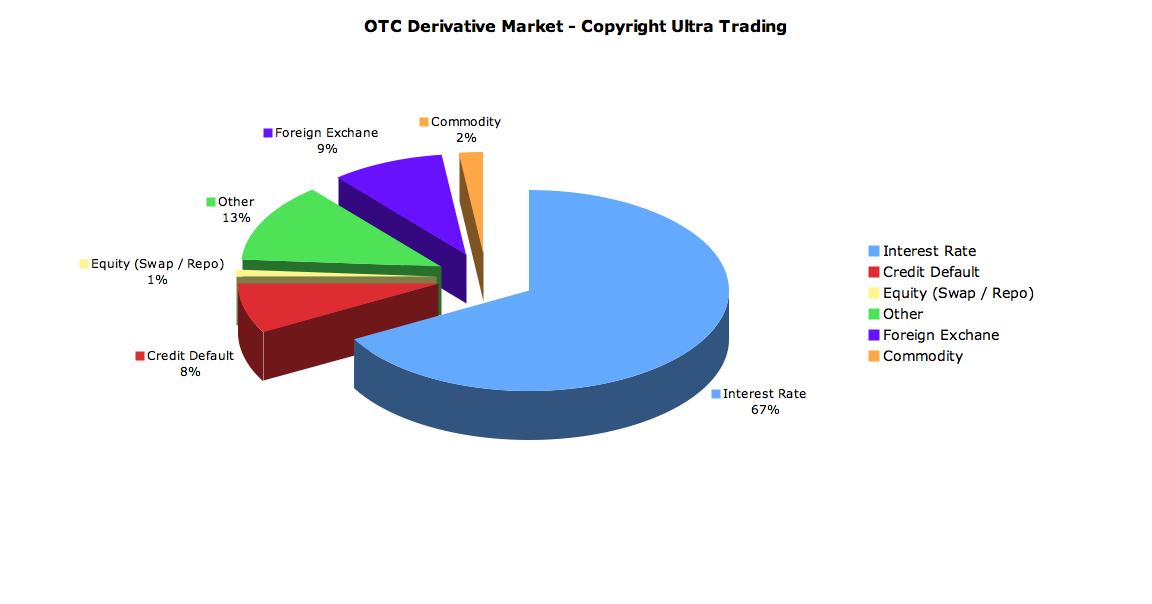
The notional value of OTC derivatives is 12 times greater at $684 trillion USD


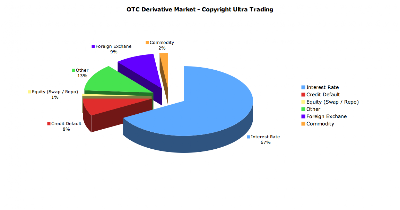
Interest Rate Derivatives are by far the largest of the OTC derivatives market


Imagine an unregulated product that is 12 times greater than the GDP of the world.  Does that make any sense?  Anyone who thinks we have moved past the problems of the 2008 financial meltdown is kidding themselves.  This is a serious problem that must be understood, especially in a financial world where central banks have a heavy hand and whose actions often produce different results than intended. 

In future posts we will discuss various derivative products in depth and the risk of each to the global economy.


Submitted by Ultra Trading.  If you would like to read more, please visit - Ultra Trading

The Latest On The Irish Elections – Fine Gael Close To Majority (by Ultra Trading)

By -

With the Irish Parliamentary elections less than two weeks away (February 25, 2011) things are getting interesting.  The IMF, ECB, EU, German and French banks and pretty much anyone trying to protect senior debt holders must be squirming.  The most recent polls show the two opposition groups Labour and Fine Gael with a pretty decisive lead. They could join forces but Fine Gael currently at 38% could also win the 40% needed for a majority without Labour.


What is interesting about this and something bulls should fear are the following quotes from the Irish Times regarding the views of each party towards future bank bailouts.


From the Irish Times 

"THE LEADERS of the two main Opposition parties have ruled out any immediate recapitalisation of the banks if they are elected to form the next government."

"Under that renegotiation, Labour would insist on “burden sharing” with bondholders as part of bank restructuring, he said."

This would be a wonderful development should senior bond holders be forced to accept risk for a change.  

 Submitted by Ultra Trading.  If you would like to read more, please visit - Ultra Trading