Slope of Hope Blog Posts

Slope initially began as a blog, so this is where most of the website’s content resides. Here we have tens of thousands of posts dating back over a decade. These are listed in reverse chronological order. Click on any category icon below to see posts tagged with that particular subject, or click on a word in the category cloud on the right side of the screen for more specific choices.

Loan Loss Reserves – A Comparison (by Runedge)

By -

Rather interesting when you compare the Loan Loss Reserves as a % of Total Loans and Leases for C, BAC, JPM, WFC.

For the most part C, BAC, JPM are reserving roughly the same amount (4-5% for BAC and JPM and 6% for C). Wells on the other hand leads us to believe they have far higher quality credits on their balance sheet with reserves in the 3% range.  Not sure why that is.  For WFC to reserve relative to BAC and JPM they would need to add about 15 billion or in other words, they are more prone to balance sheet risk assuming their credit quality is similar to their competitors.

Based on some recent litigation regarding put back requests, it is arguable that BAC and JPM are under reserved as well and should be reserved more in the range of C.  Taking it one step further, does anyone honestly believe any of these reserves are based on the reality of a double dip in housing prices that has been ongoing for about four months now?  What about second tier credit quality?  What about the risk of mortgage cram downs?  What about the risk of increased strategic defaults in the face of the longest duration of unemployment ever?  

Balance sheet risk could very well be the theme of 2011 bank earnings. 

Submitted by Runedge.  If you would like to follow my blog please visit - Ultra Trading

BAC Earnings vs. Balance Sheet Risk (by Runedge)

By -

I spent the weekend going back to Q1 2007 through the most current quarter and pulled financial data from BAC financial statements (yeah, I know, I need a life).  What I want to understand is very simple. Does BAC have the earning potential to absorb a further drop in home prices.  

I'm sharing this data as part of a group think exercise and asking for any feedback that can help all of us. Before I show the two simple charts, let me shed some light on the terminology for those who actually did something more social this weekend versus study bank financials.

Total Net Revenue is broken into two groups: 

1 – Net Interest Income (interest income minus interest expense)

2 – Non Interest Income

Combing the two gives you total revenue.   That revenue then needs to cover three main expenses:

1 - Non Interest Expense (staff, legal, pretty much all operating expenses)

2 - Provisions for credit losses

3 – Income to shareholders.

The first chart I show is Total Net Revenue minus Non Interest Expense (in other words income left to cover provisions for credit losses and income to shareholders) VS Provisions for Credit Losses.  This one is simple and not good looking.  Since Q1 2009 income available to service provisions has dropped dramatically and shown no recovery.  At the same time provisions have also dropped.  Sure there is some tweaking of provisions to prevent / minimize losses but the question that needs to be answered is will the red line (provisions for credit losses) be forced to trend up again.   To answer this question, I then looked at total loans and leases on the balance sheet and allowance for credit losses (the amount reserved for future credit losses).  


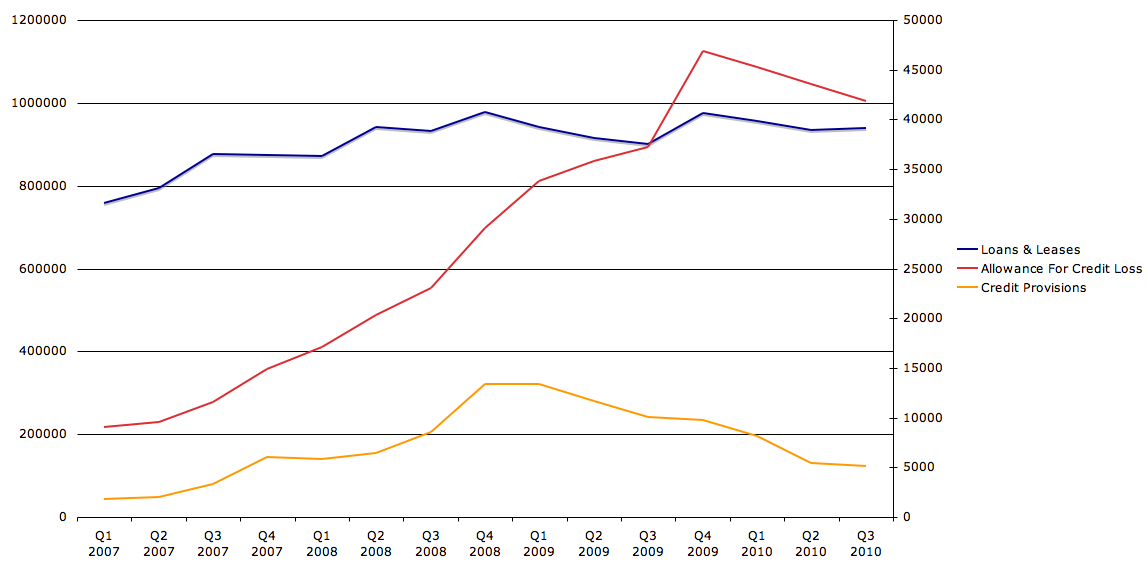
This chart shows Loans & Leases  VS Allowance For Credit Losses VS Provisions for Credit Losses. Some observations, loans and leases for the most part have stayed flat and through Q4 2009 allowance for credit losses did move up rather significantly.  Since that time they have begun moving back down. As of right now BAC has reserved for a 4.45% losses to total loans and leases.  Assuming all loans and leases are held at par then in other words the balance sheet is priced at 95.55% of par.  

The question I am struggling to understand is does this data alone and the realization that shadow inventory has grown the past year show that provisions (the orange line) will be forced to move up again regardless of the future of home prices.  Provisions are made up of two components:

1 – Changes to allowance for credit losses (balance sheet adjustment)

2 – Actual loss incurred during a given quarter

Provisions have been moving down since Q4 2008, a year ahead of the move down in allowance for credit losses.  In other words BAC through 2008 was realizing lower losses yet reserving at a higher rate.   Why would you reserve for future losses unless you were all but certain of those losses.  If anything you would reserve as little as possible in the face of diminishing earnings (chart 1 above). 

Banks have reported a time line in excess of 14 months from default to REO so there is a lag time between the actual loss incurred and the balance sheet adjustment.  


Submitted by Runedge.  If you would like to visit my blog please go to - Ultra Trading

The Health Of The Consumer (By Runedge)

By -

There is a lot of talk in the financial media about the strength of the consumer.  Pundits will tell us to never count the consumer out.  The holiday season was strong, iPad sales are strong, the high end consumer is spending.  In a word, nonsense.   

The number of people in some form of default on their mortgage continues to rise.  The average time from the first missed payment to REO is in excess of fourteen months and higher depending on who is reporting.  Imagine not making a mortgage payment for fourteen months.  What do you do with that money?  You don't save it all.  You spend it on things you are "entitled" to because the sad truth right now is our society for the most part feels entitled.

Consumers guard their credit card and HELOCs because it is their only form of credit and yet the banks spin this as a positive about their assets, their credit quality.  Again, I say nonsense.  I came across two charts that really support this view.  

For the first time in over sixty years, Americans had a net withdrawal of financial assets, whether it be savings, 401K plans, etc.  Americans are suffering hard right now.  One in five are employed part time. Part time work is necessary and there is nothing wrong with that form of employment but the reality is you cannot grow an economy with limited wages and reduced benefits.


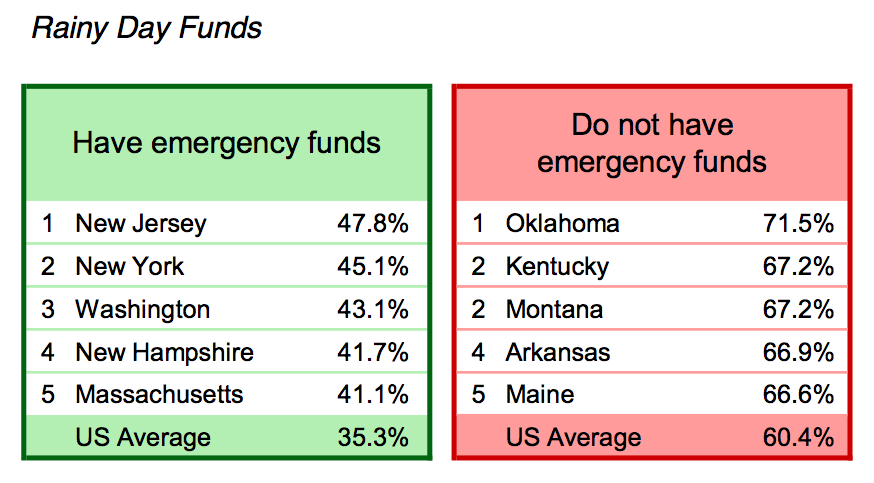
Now this one was the scary report from FINRA.  The simple question, how many Americans have available funds to cover three months of normal expenses.  35.3% do while 60.4% do not.  GOD forbid someone loses a job, for every three that lose work today, two need immediate government aid.  One in seven Americans are on food stamps.  There are many people hurting right now and for the media and financial system to spin it as all is well is very sad.  


Submitted by Runedge.  If you would like to follow my blog please visit - Ultra Trading

Dwindling Loan Loss Reserves (by Runedge)

By -

The major banks have reported this week and have exceeded on the bottom line (top line for the most part was down Q4 2010 versus Q4 2009).  The reason for the bottom line beat is they reduced their provision for credit losses.  In fact each quarter since at least Q4 2009 they have continually dropped the total allowance for loan losses as a percent of total loans outstanding.

Chris Whalen said it best referring to JPM's earnings "Jamie Dimon is making a bullish bet on housing." What happens if asset prices do not rebound but rather fall?  What happens if the foreclosure process extends further with all that is going on in the industry?  What happens if mortgage cram downs occur? What happens to second tier liens?   

At some point should asset prices fall the banks are not prepared from an earnings standpoint to take the hit to their balance sheet.  Rather than lower the provision for credit losses they will need to ramp them back up and take a major hit to bank earnings.  Banks are also talking about raising their dividend (good luck finding the cash for that) in the coming year.  

The data below supports the theory that their "bullish bet on housing" is the wrong side of the trade. Perhaps there is a strategic reason for them to kick the can down the road right now from a reporting standpoint to build confidence in their equity.  In some sense why do the right thing now when there is a chance (albeit slim) that asset prices will rise and total allowances are at adequate levels.   

As traders we know prices ALWAYS over correct.  Whether it be to the downside or upside, the market never gets it right initially.  Looking at this chart below which looks at historic home values the argument can be made that home prices will depreciate possibly as much as 30% more.


The Case-Shiller Price Index below is also showing a double dip in home prices.  Many argue that since this index does not measure the entire market that it in fact lags and still it is showing a drop in home prices.

The chart below shows sales activity in 25 major metropolitan areas.  There are no "bids" in this market. How can prices rise when supply outweighs demand?


Lastly Lender Processing Services recently reported the following 

"Foreclosure inventories also continued to rise for the fifth straight month as delinquent accounts are referred for foreclosure, but the sale of foreclosure properties declined. When compared to January 2008 levels, the foreclosure inventory of jumbo prime loans is nearly seven times higher; the inventory of agency prime loans is nearly six times higher; and the foreclosure inventory of option adjustable-rate mortgage loans is approaching five times the inventory in January 2008."

The banks may argue that falling asset prices does not mean increased balance sheet risk as they hold to maturity or higher delinquency rates.  Perhaps that is their bullish bet.  There is plenty of data that counters that argument and clearly shows the less financial interest a homeowner has in their asset the far greater chance they will strategically default.  

Submitted by Runedge.  If you would like to follow my blog please visit - Ultra Trading

Inflation (by Runedge)

By -

I don't claim to be an expert on inflation nor will I give an opinion if we will experience inflation, deflation or both.  Prices on essential items are rising.  Prices on non-essential items are falling (home prices, flat screens, etc).  The chart below of the CRB Index shows the rise in input costs contrary to the CPI (ex food and energy) which the Fed constantly talks about as showing no inflation in our economy. Name one person who doesn't eat or drive.  Just one please.


If you manufacture anything your input costs are rising.  Whether it be oil to run a machine or flour to make bread, your input costs have risen significantly.  You have three choices.  You can raise your prices, lower your margins or reduce expenses.

Raising Prices:

The US economy is on fumes right now (government sponsored or shall I say debt sponsored). There is no velocity, no demand.  Sure you can raise prices on some items such as gas at the pump.  It's a commodity and we all need it, like it or not.  We will pay higher prices.  Other items it is hard to raise prices. Bread prices at the grocery store seem to be rising but not at the rate of grains.  Flat screen prices are falling and there is no chance of passing along higher costs.  

Lower Margins:

If you can't raise prices then your margins are instantly lower.  If you are a public company you need to manage the bottom line.  I used to own a small business.  If I was in a position where my margins were being squeezed, I would live with it for a while but once it started hurting my own pay check I would have to begin making tough choices.

Reduce Expenses:

Public companies have to hit the bottom line and will lay off staff, cut back overtime, lower wages, etc. Sure they can cut back other fixed expenses but after two years of slow growth, those expenses must already be scaled back somewhat.

Considering those three options, I see two outcomes playing out in our future.

Outcome 1:

The economy improves, allowing input costs to be passed along to the consumer.  The result will force employers to raise wages.  The scary side of this scenario is there is so much money in the economy right now that any velocity will truly make us a Weimmar republic.  Prices will skyrocket  and the Fed is in no position to stop it.  They cannot reduce their balance sheet for the simple fact the capital losses would be massive.  They would need a bailout from the Treasury.  Imagine that concept.  

Outcome 2:

The economy continues to stagnate as it has the past two years.  Considering that 20% of those lucky enough to be employed are working part time this scenario seems pretty reasonable.  Under this scenario rising prices cannot be passed along.  Sure some will such as gas as we are seeing now and basic needs such as groceries.  Under this possible outcome, companies will be forced to reduce staff and or wages, further reducing overall demand.  Those prices that do get passed along will literally choke off any remaining demand and push the economy back into recession.

Food riots are breaking out across the globe.  China is faced with a very real and serious inflation problem within their country.  I suspect this issue is going to come to a head far faster than June when QE2 ends and QE3 possibly begins.  When the cost of milk doubles in price and wages stagnate, Bernanke will have far more to answer to than a 60 Minutes interview.  

I still can't believe he said he can raise rates in 15 minutes.  How naive does he think we are? Apparently very.  

Submitted by Runedge.  If you would like to read more please visit my blog - Ultra Trading