Slope of Hope Blog Posts

Slope initially began as a blog, so this is where most of the website’s content resides. Here we have tens of thousands of posts dating back over a decade. These are listed in reverse chronological order. Click on any category icon below to see posts tagged with that particular subject, or click on a word in the category cloud on the right side of the screen for more specific choices.

Sideways to Down (by Springheel Jack)

By -

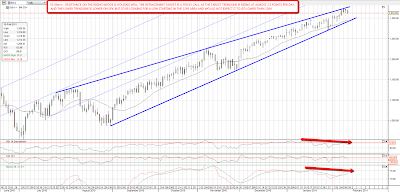
It's looking like we may not see the sharp retracement I was looking for here, as nothing has triggered a swift decline on ES yet. The target lower rising wedge trendline is move upwards at 2.5 points or so per day, so there's a chance that we'll just kick around in the 1300 – 1320 area until it is hit sometime next week. I've been considering retracement targets in the event that we can reach the trendline this week and I'd be ideally looking for a hit on the lower trendline of the wedge on ES in the 1295 area. The trendline looks lower on SPX though, so it might be that we'd go as low as 1284 support:

The retracement on EURUSD is proceeding well, and has formed a falling wedge, though it's early days and we need another hit on both trendlines to confirm the wedge. Short term EURUSD is forming an H&S that looks good to take EURUSD through support at 1.35. My retracement targets are the strong support levels below at either 1.34 or 1.326:

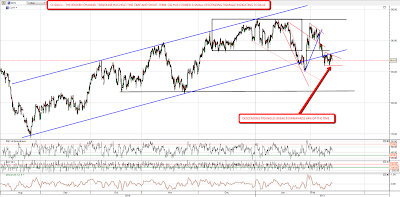
GBPUSD also looks weak here, and has formed a descending triangle, a pattern that breaks down 64% of the time, and the target is in the 1.585 area:

Flicking through the charts this morning long treasuries are looking due for a short term bounce here. They haven't reached the pattern target in the 115'24 area yet, so I'm expecting more downside when the bounce is finished:

Silver looks as though it may break down from the recent rising channel here, though we need an hourly close below the channel to confirm. Looking at RSI I'd expect a bounce after a break, perhaps to retest the broken trendline but possibly higher. If the channel breaks it will look an attractive short again. On the longer term picture I'm still expecting a deeper retracement than the one we have seen so far:

I've covered the short term bearish picture on copper very thoroughly this week, and it's still looking weak. I'll post an updated chart tomorrow when the shape of the decline has clarified somewhat. I'll do a chart on oil today as I've not covered the sharp decline this week. Oil was in a nice looking decline with the obvious target at 81.75 before Egypt blew up and now that Egypt is old news oil has resumed that downtrend. The broken rising channel has broken again and been retested. If we see a bounce at 81.75 then there's a possibility that we will be forming a large H&S with a target at 70:

I like using the hourly RSI as an indicator for significant highs and lows on many charts, and I've marked up some of the negative and positive divergences on some of the charts above. It doesn't catch them all, but it's always worth watching for these.

I'm expecting that we may well see an early bounce today and perhaps gap fill  but I'm leaning sideways to short until we see a lower trendline hit on the main ES/SPX rising wedge. USD looks short term bullish, copper, oil and possibly silver short term bearish.

Wedge Hits (by Springheel Jack)

By -

There's fair amount of art as well as science to drawing trendlines. Sometimes it's easy enough with a series of well lined up points, but sometimes, particularly with candlesticks, there are judgement calls that need to be made, and the trendlines are somewhat mushy as a result. I'd drawn the upper trendline of the SPX rising wedge a little lower as I thought the first high under 1300 might be a marginal hit, but the high yesterday was a perfect hit, so I've restored it to its original angle. As well as the wedge trendline hit SPX is also showing strong negative divergence on the daily chart, so I'm expecting a retracement today and tomorrow. I still have two alternative lower trendlines though and I'm expecting the next low to clarify the lower trendline too:

On ES the action for recent days has crystallised into a triangle, which overthrew slightly at the high yesterday and has not yet broken downwards. Triangle support is at 1312, and the target for the triangle is 1262, but we're not going to make that unless the wedge breaks down, which would surprise me. I'll be looking for the low in the 1274-1290 area with the probabilities weighted towards the higher end of that range, and there is strong support in the 1300 area that has to be broken first:

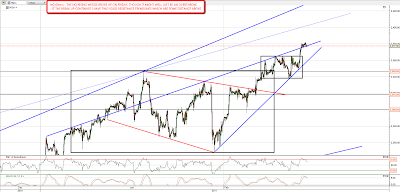
NQ looks less ambitious. The short term rising wedge broke down into a rising channel overnight, and as I suggested was probable on the chart, the channel has now in turn broken down. The wedge target is in the 2295 area and we have some decent support in the 2318 area to get through first:

I've been giving the copper chart a lot of thought. As I mentioned copper broke through my long term resistance trendline but it isn't quite as clear as that. Very long term resistance is definitely broken, and copper might well now go higher, but in the short term it has reversed at one longer term trendline and also at a previously unproved medium term rising channel upper trendline. There's also negative divergence on the weekly RSI and MACD, so the odds of a multi-week retracement look good here.

The copper weekly chart is arguing for a deep retracement here to somewhere between 355 and 380 depending on the time taken to retrace, and I don't know whether we'll see that, but on the hourly the short-term support trendline is broken and a small H&S has formed with a target at 443:

Overall the short side is looking very good today, with a dip more than likely coming our way. I'll be expecting to buy that dip, though I'll be watching in case the rising wedge breaks down. We're coming close in time and price however to my upside target near 1381 SPX in late March or early April, and I'm becoming doubtful that we'll see a deep retracement before then so unless we see that break I'll JBTFD.

Trading The End Of Day (EOD) Ramp by Market Sniper

By -

Here on The Slope, we are constantly railing about the phenomena known as the "the end of day (EOD) ramp." Yes, it seems to be manipulative. Yes, it appears to be contrived and yes, it is even deplorable. In price action, this is the proclivity of the stock market to go up (often large) starting at around 3:30 pm EST. Instead of complaining about it, make some money off it! THAT is our JOB as traders, after all.

Trading edges are found when patterns repeat. Since TARP, this has been almost a constant pattern. It was a minor pattern before TARP but it has become much more pronounced since TARP. Here is how I identify the trade, how I enter the trade and how I manage the trade. Since I am predominately an ES (emini S&P futures) day trader, I will use the ES here. You can possibly trade it with other instruments but back test this with your instrument of choice. This trade is to be done with a minimum of two contracts. If you are a one lot trader, do not trade this setup.

Identifying The Trade: Your window of opportunity is between 3:30 and 3:40 pm (EST). Price at entry must be at least 3 points (12 ticks) below the session high. By session high I mean the open out cry (pit session) high which starts at 9:30 am (EST) NOT the GLOBEX high (GLOBEX trading session starts the previous day at 4:30 pm (EST).

Trade Entry: Do not enter this trade prior to 3:30 pm or after 3:39 pm. You will attempt to identify the lowest price action within this time frame. I have notice over the past three months or so that the low is coming a bit later. Around 3:35 pm. Use whatever methodology your currently using to identify breakout price and break down price action, bottoming formations on your one minute chart, etc. to identify the low during this time window. You can scale into the position IF that is allowed by your trading plan and your trading with size (more than 2 contracts) if price moves against your entry. I would not suggest this. I do not do it but it is a viable entry plan.

Managing the Trade: Upon entry, place your stop loss at two full points (8 ticks=$100 per contract) beneath your entry price. Place a 1.25 point (5 ticks=$62.50 per contract) price target above entry for one half your position size. Then, kick back and relax. IF  your 1.25 target is hit, immediately move your stop up to your entry price. Do NOT forget that you have reduced your trade size by half. Reduce your contract size on the stop accordingly. Example: your trading 4 contracts. Your stop loss is for four contracts. If you have scaled out half (2 contracts). Your stop should now be only for two contracts. Now, as price moves in favor of the trade, do NOT start trailing a stop! You want to be in this trade through cash close which is at 4:00 pm! Still in the trade? Now the real fun begins. After cash close, you have two kinds of stops. A trailing stop and a mental time stop. At 4:05 pm, move your stop up to 1.25 points below price and trail it. Still in the trade at 4:13 pm? Exit the trade at the market. Do NOT stay in the trade during the last two minutes of the pit session which closes at 4:15 pm.

And there you have it. A complete setup and trading plan for the EOD ramp. You may find that this setup will often make your trading day. Last week, it was worth over 10 points ($500 per contract) to me. Even on Friday, when the ramp did not develop, I made money with it. Target price hit for 1.25 points on half, stopped out at entry on the other half of the position. Hope this helps.

Yours in the eternal quest of The Trading Edge-Market Sniper

A Promising Start (by Springheel Jack)

By -

Support finally broke on Friday and there were impressive falls on SPX and Nasdaq while oil spiked up on riots suggesting that the Egyptian dictator Mubarak may be replaced soon.Why's that important for oil? Because Egypt's Suez Canal is a potential choke point for shipping world oil supplies and because the toppling of Mubarak might lead to an aggressive islamist government in this key western ally in the Middle East.

We'll see how that goes but rioting in Egypt looks set to run for a second week this week and Middle Eastern stockmarkets, which are open on Sundays, were down a further 3% to 5% yesterday. Things look promising for more downside on equities in the west too as ES failed to hold the support levels at 1276 and 1273 on Friday and traded as low as 1262.5 overnight. The next target support level that I have on ES is the potential H&S neckline at 1258 and I'm expecting that we'll see that hit this week, though we might well see a bounce first. That matches exactly with the lower trendline of the rising wedge on the SPX daily chart:

NQ failed to hold the key 2267 level on Friday, and is now rising in a short-term channel that looks like a bear flag. If it breaks downward the obvious target is the lower trendline of the broadening top in the 2220-5 area:

Encouragingly for equity shorts, the technical picure on EURUSD now also looks increasingly bearish with a significant break downwards on Friday. For two weeks now EURUSD has been breaking through a succession of three progressiverly shallower trendlines and is now bouncing from a potential H&S neckline. If that plays out the pattern target is at 1.338:

Copper was looking divergently bullish on Friday morning, made my 439 target, reversed to channel support at 433.6, and is now moving up towards declining support in the 444.5 area. I'm expecting that target to be made, and (slightly less confidently) am expecting a reversal there towards the larger channel support in the 425 area. A break above 444.5 would look very bullish and the next short term top will be signalled by the break of the short term channel:

Silver is continuing to look extremely bearish, and reversed at the top of the current declining channel yesterday. I'm expecting a move down within that channel to the key support level and potential H&S neckline at 25. It is possible that silver's H&S has already formed higher with a target at 22, and if 25 fails to hold, that is where I would expect silver to go. A break up through the declining channel would look very bullish and would put the immediate short scenario into serious question:

Oil is the star of the current geopolitical show at the moment of course, and has broken up convincingly from the declining channel that had seemed likely to take it to the potential H&S neckline at 82. Added to that potential H&S pattern we now have a potential (continuation) IHS forming with the neckline at 93.5 and the target in the 102 area. If the crisis in Egypt deepens this week, that will be one to watch:

We may be watching a very significant reversal forming here, and if the SPX rising wedge breaks downwards then I'll be looking for a retracement into the 1200 SPX area, which I'd expect to hold unless Atilla at Xtrends is right about equities having already made a very major top.

Egypt – Into the Looking Glass (by BKudla)

By -

For this post I will only focus on the food problem for Egypt, and why it is a window on the demons released by our insane monetary printing, and the unwillingness of command and control countries to de-link from a parity dollar policy.  The FED is pumping dollars to force China, et al to revalue, allowing for us to export,  raise tax funds, and velocity through inflation.  Unsustainable food and oil prices will force the hands of these governments to do just that, is the thinking.  The game of chicken is on, but an unintended domino in a volatile part of the world fell this week, and has the potential to engulf us all.

Look at the slides and narrative from http://209.157.64.200/focus/f-news/2665495/posts?page=3.  You can plug in nearly every North African/Middle Eastern country into this picture, but China, Russia, and India are also in the same boat.  Add to this tight supply and the real likelihood that Russia, Canada, and Australia produce less than normal, and we have some big problems coming.

"Egypt is reported to be the world’s largest importer of wheat. In 2010, the oil minister stated that Egypt imports 40% of its food, and 60% of its wheat. The problem this year is that world wheat production is down (at least in part due to weather problems in Russia) so world exports are down:


Figure 4. World wheat production and world wheat exports from USDA

A longer term problem, though, is that world wheat production has not been growing to keep up with growing world population. Part of this lack of growth may be competition from biofuels. Part of the lack of growth also relates to the fact that the “green revolution” improvements (adding irrigation and fertilizer) are mostly behind us. While irrigation and fertilizer greatly improved production at the time of the change, gains in production since 1990 have been much smaller.

The cost of imported food, particularly wheat, has risen, partly because of the relatively smaller harvest, and partly because the cost of production and transport is rising because of rising oil prices. Figure 5 shows the close relationship food prices and oil prices. The Food Price Index used in this graph is the FAO’s Food Price Indexrelated to food for export; Brent oil prices are spot prices from the EIA.

Figure 5. World food price trend is similar to Brent oil price trend.

With oil prices higher now (because world production is close to flat, and as countries come out of recession, they want more), food prices of all types are higher as well. Oil is used directly in the production of grain and indirectly in storage and transit, so its cost becomes important.

The higher food prices contribute to the overall inflation problem that Egypt already had. In 2010, the CIA Factbook estimated the inflation rate to be 12.8%. Since wages don’t always rise to match inflation rates, inflationary pressures have no doubt put more pressure on the government to increase subsidies, at a time it cannot really afford to do so.

Impact on the Rest of the World

Why does everyone else respond so strongly to Egypt’s problems?

One reason is that other Arab countries are also feeling some of the same pressures. Food prices are rising everywhere. Many low income people spend in excess of 50% of their income for food, so a rise in food costs becomes a real issue. People have come to depend on oil and food subsidies. If they are taken away, or not raised sufficiently to compensate for the higher costs of imports, it is a real problem.

Oil prices seem to be affected as well. If the Suez Canal should be closed because of disruptions, it could affect oil transit, particularly to Europe. According to the EIA:

An estimated 1.0 million bbl/d of crude oil and refined petroleum products flowed northbound through the Suez Canal to the Mediterranean Sea in 2009, while 0.8 million bbl/d travelled southbound into the Red Sea.

The amounts being transported through the Suez canal are now likely down a little from these amounts in 2011, because of reduced imports/exports worldwide, but they are still substantial. Europe’s oil imports are about 10 million barrels a day of oil, according to Energy Export Data Browser (using BP’s data). If all of the amounts that flowed northbound went to Europe, they would amount to about 10% of Europe’s imports, or about 7% of Europe’s consumption. In fact, some of these exports go farther–in particular to the US, or to Canada, so the amount in question is probably lower than this relative to Europe’s consumption, say 4% or 5%. But even a small shortfall is a problem, in a world that needs oil for transport, food production, heating, and many other uses.

The inability to send products southbound through the Suez Canal is likely to also be a problem. Part of what Europe does is refine oil, keep the products it needs, and send other products to customers elsewhere. The whole system is set up assuming close to “just-in-time” production and delivery. While there is some storage capability, after a few days or weeks the system is likely to start running into problems. Those in need of the refined products being sent southward through the Suez Canal will be facing a shortage, and Europe will have excess supply. Of course, it is possible to use longer shipping routes, but this uses more oil for shipping and takes longer, so is more expensive. There is also a time-delay when the new system is put in place.

All of these problems (relating to both north and south-bound oil traveling through the Suez) can be worked around, but there could be a period of disruption for a while, as supplies begin traveling a longer route."

If you have not already, I suggest buying MOO, RJA, JJG, and DBA on any weakness.  The revolutions may end, but not the food crisis.