Slope of Hope Blog Posts

Slope initially began as a blog, so this is where most of the website’s content resides. Here we have tens of thousands of posts dating back over a decade. These are listed in reverse chronological order. Click on any category icon below to see posts tagged with that particular subject, or click on a word in the category cloud on the right side of the screen for more specific choices.

Important Symmetry Video (By eMiniSchool)

By -


When we look at the market we are always seeing if we are inside or outside of symmetry. It is important to know if the symmetry support is above the .618 the market can break symmetry to fall down into the bigger support and still be bullish. It is also important to see if we are still inside of symmetry before trying to pick the top of the market. You will see in the video how calculated the markets have been since the 09’ low.

Some traders think that what we do is too “Voodoo” and it has no meaning. The thing is as traders we do not have to be 100% fundamental or 100% technical. In my view the market is 90% technical and 10% fundamental but that is just my opinion.  

I have seen the market turn too many times at symmetry support and resistance to ignore it. I have found that the people who do not believe just are not informed on the subject, just like anything in life.  I hope the time we put in on the blog can inform you so you can look for yourself and the stocks you own to make the best decision you can before pulling the trigger on emotions.

Earlier today we did a post on the corrective symmetry and so far that has been the low of today. This does not mean it is the absolute low but it is an important low going forward a few days.  

Corrective Symmetry Video from earlier today: http://wwweminischool.wordpress.com/2011/08/01/corrective-symmetry/ 

Happy Trading,

eMiniSchool.com

NQ Symmetry (by eMiniSchool)

By -

7.31Slope 

There is something to keep in mind going into next week and that is the symmetry of the market. Symmetry is the true support and resistance of the market. We get the symmetry buy using Fibs on each leg of each pattern.

From the March 09' low the symmetry of the NQ and TF has been only .382 which is on the faster side of the equation. You can see this by looking at a weekly NQ chart and you will see the pullbacks have been shallow in price and time.

The chart in this post is the 60 minute and you can see the .382 is still in play two times within the last wave up (Still Bullish)

We know there is a lot of news flow right now but it is important to look at the charts to see if the pattern is broken and so far the pattern is not broken to the upside. Of course patterns can fail but we stay with the pattern and direction until we are proven wrong and so far we have been rewarded in buying the dips and that condition is still in play.

There are two degrees of the pattern the major and the minor. On the NQ the major .382 support is 2325.59 and the minor .382 is 2337.14. When you look at the chart now they will seem like obvious support levels the key is to know the symmetry support before the level is hit so you we can get back in the long trade.

To see the weekly and daily levels we posted a video on July 5th here:

http://wwweminischool.wordpress.com/2011/07/14/nq-symmetry-382/ 

In that post there is a link to a video explaining what we were looking at and that condition is still true right now.

Happy Trading,

Sean

PS. This is pattern and patterns can fail but as of right now the pattern is still true and we are looking for targets of 2476 to 2500 on this next leg.

Secular Bear Markets 101 (by Springheel Jack)

By -

Some people regard private enterprise as a predatory tiger to be shot. Others look on it as a cow they can milk. Not enough people see it as a healthy horse, pulling a sturdy wagon. 

Winston Churchill

I'm sleeping badly this week and I'll probably skip trading today though I have some equity longs I'll leave on as I'm leaning bullish. I'll keep the post relatively short too as I've started late and the market prospects today can easily be summed up in a couple of charts. First though I've been meaning to talk about a popular myth that I often see referred to, and that is the myth that stock market performance is unrelated to economic performance. 

Over shorter timeframes, as with some other popular myths, this can be true, but the apparent lack of correlation vanishes over longer timeframes, as you would expect logically of course. Those longer timeframes are of course the generally 15 to 20 year periods of the secular bull and bear markets.

There's a reasonable (and concise) view of these periods since 1906 in an article here, and it's well worth a look to give the overall context of the current period that we are trading through now. Looking at the last 60 years though, the secular bull market period 1950-1966 was a very strong period for equities at the same time as a period of strong economic growth. During the secular bear market 1966-82 economic performance was weak and equities lost value in real terms. In the secular bull market 1982-2000 we saw another very strong period for equities at the same time as a strong period for economic growth. That growth was slower than earlier bull cycles but it is a fact that economic growth slows down in more mature economies, possibly because of the higher proportion of government spending and consequent crowding out of the private sector. In the ongoing secular bear market from 2000 growth has been weak and fitful and equities have again lost value in real terms. The chances are that will continue until this secular bear market ends, most likely in the 2015-2020 period. 

What's also interesting are the reasons that economies and equities have peaked and then corrected. My favorite book on this subject is Galbraith's The Great Crash 1929, which also has a very illuminating foreword written near the peak of the 1950-66 secular bull market. Galbraith talks there about the role of leverage in the great bubble of the 20s, and then talks about the rediscovery of the power of leverage in the late 50s, a key factor in the bubble that culminated in the mid-60s, and the painful deleveraging period that followed during the next secular bear market. You could reasonably assume reading this book that not only do these cycles look fairly similar, but the causes of the booms and bust look rather similar as well.

Those who cannot remember the past are condemned to repeat it. – George Santanaya

What we have learned that is new in this current cycle though, is that even with famous scholars of previous cycles (Ben Bernanke), in key policymaking positions, all policymakers are managing to do is find new ways to make the same old mistakes. A slightly dispiriting refutation of the implication of George Santanaya's quote above, which is that if you study your history, you have less chance of repeating previous mistakes. Perhaps by the time the next secular bull cycle is peaking in the 2130s policymakers will have managed to learn something useful.

So how does this apply to us today? Well the first thing to note is that of the three secular bear market periods since 1906, the shortest lasted 16 years and the longest lasted 20 years. Realistically therefore, there is no good reason to think that this current secular bear market will be any shorter, not least because we can easily see around us that the policy response to overleveraging has been denial and a 'pretend and extend' policy based on the idea that if the problem can be brushed under the carpet long enough, it will somehow resolve itself. That seems unlikely, current policies look likely to end in a major sovereign debt crisis, which will lead to austerity and/or inflation, which should end the secular bear market cycle after another major downswing in equities. 

Anyway, that's economic cycles history 101 concluded for today so let's see how the markets are looking in the short term.

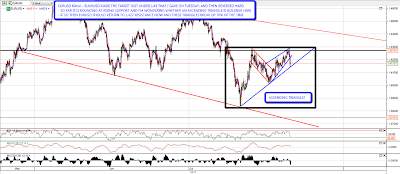
A very key chart for today and the next few days is the EURUSD chart. Overnight EURUSD made the target just under 1.43 that I gave on Tuesday morning and reversed hard there. A significant inflection point then came an hour ago when EURUSD hit the rising support trendline from the recent low. EURUSD bounced hard there and my suspicion that an ascending triangle might be forming on EURUSD was confirmed. Looking at the chart the next target is triangle resistance at 1.427 – 1.4285, but the important thing to note about these triangles is that they break up 70% of the time. If and when this triangle breaks up that should give equities a decent boost and carry ES up with it to the next resistance level in the mid-1340s. Here's how that looks on the 60min chart and you can read more about ascending triangles at Bulkowski's site here:
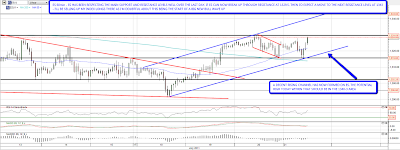
ES has respected the established support / resistance levels well. I marked in the current key levels at 1329.5 and 1315.5 a couple of days ago and was happy to see the high at the upper level yesterday and a double test of the lower level overnight. If 1329.5 can be broken today then I'm looking for a move to the next level up at 1343. If support fails at 1315.5, I'd be looking for a retest of support at 1302.25:
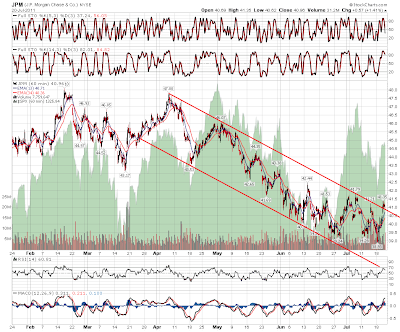
I haven't posted the XLF chart much lately, and that's because apart from a worrying support break and some positive divergence on the daily chart, it isn't really saying much to me. I did post the JPM charts the other day showing the potentially stellar long setup there on a break up from the declining channel on the 60min chart, and yesterday JPM broke up from that channel. I've taken a spec long at 41 and it was trading under that at the close yesterday for anyone thinking of joining me:
That's it for today, apart from adding that I'm doubtful about this current move being the start of a big bull wave up like the one we saw last summer. I think there's a good chance of ES recovering the 1343 area, but after that I'll be watching support trendlines and patterns to signal a reversal which I suspect may not be long in coming. Meanwhile I'm enjoying the bull side here.


S&P Cycle Points Lower (by Mike Paulenoff)

By -

Today is day # 59 within my 70-75 day S&P 500 cycle. This means that the cycle is 79%-84% complete (from its prior low on March 16), and also means that it is in its final 15%-20% (down hard) period ahead of its anticipated low/bottoming timefame in and around the end of June-early July (June 27-July 6).

Also due to bottom at that time is the 20-25 day cycle, forming a "dual cycle low."

Rallies usually fail and surprises tend to trigger negative price reactions within this "down hard" portion of the dual cycle period. My next optimal target zone points towards a test of critical support around 1255-1249, which represents both the rising 200 DMA and the prior significant (dual cycle) low at 1249.05 from March 16.

WuguZsNYd
Originally published on MPTrader.com.

Bear Capitulation? by Market Sniper

By -

Change in bearish sentiment in the air? Perma-bears starting to give up the ghost? The signs are everywhere. From this blog to the few remainind bear blogs, the bears are giving it up. Lot fewer "top callers" out there and I suspect the few that continue to call tops either do not trade  or have  little "skin" in the game. This is one if not THE most magnificient bear market rallys of all time. It continues to be my view that this is a cyclical bull market within a long term secular bear market. I will need to see the popular indexes all eclipse all time highs to change my opinion. Can that happen? Yes, of course, anything is possible but as a probabalistic thinker, this is still of a lower probability. I have often stated that the job of the secular bear market is not to reward bears and punish bulls, it seeks to wipeout both. So far, it is doing a very decent job of getting that done. There is one thing I know with absolute certainty: the higher price climbs through time, the closer we approach that inevitable top,  both in price and time. How does one attempt to identify a top? Here are my views and observations.

Anatomy Of A Bull Market And The  Top: The first thing to consider is that market cycles and economic cycles are two distinctly different cycles and they are rarely in sync. A bear market low is the incubator for the next bull market. At the bear market low, economic news is nearly uniformly bad. As the last exhausted bull finally throws in the towel and sells, more bad economic news no long causes price to fall. Margin buyers are gone, wiped out for the most part and there are no more sellers. Now as economic news continues to worsen, price starts to rise. At first there is widespread disbelief. This disbelief is fueled by a number of factors. Humans are social animals with herd instinct. We like to fit in. To go against "group think" invites exclusion from the group. Due to continuing bad economic news, group think is of the opinion that price will continue to decline. This goes to the heart of Recency Bias which states that what has happened in the most recent past will continue to happen. This is normal, indeed, hard wired and probably has its roots in our specie survival tool set. As price starts its ascent or no longer is falling, some short sellers begin to take profit. This starts to move price  higher. Early trend traders, usually trading in shorter time frames, detect the trend and start to buy. It should be noted that during the first phase of the new bull market, like we witnessed after the March 2009 low, there are numerous pullbacks in price. This is due to the remaining herd mentality selling into rising price as well as weak early bulls taking profits as they, too, do not believe in sustained higher prices. These pulbacks allows more buyers to enter the market.  While this is happening, fundamental analysis becomes more positive, enticing fundamental traders/investors to begin to enter the market on the buy side. A trend has started to be recognized by some in the herd who also start to buy. At this point, opinion is split as to IF rising price is sustainable or not as economic news is also mixed. Continued rising price now becomes a readily recognizable trend and momentum /trend traders continue to buy. Rising prices continue to bring in more buyers as the news drumbeat becomes even more positive and/or is "interpreted" in a positve light. Now the "herd" is almost universally bullish. Market bears now start asking such questions as "is technical analysis dead?" as tried and true techincal indicators and chart patterns more often than not, lead to a failure of the "next technical expectation." The failed head and shoulders formation of early July 2009 is the best example of that. There is a saying "out of failed moves come rapid and sharp moves in the opposite direction." The rally into late September of 2009 off the failed formation did NOT allow pullback buying bulls into the market as there was NO pullback. This marked the second phase of this cyclical bull market. Price then consolidates such a large rapid move in basically a sidways or "channeling" market. The channel normally has an upward bias, however. This marked the third phase. The fourth and final phase is now what I believe we have just entered possibly as early as September of 2010. The final phase of the cyclical bull can be marked by a number of observations. Remaining bears continue to short into rising buying pressure and exit more swiftly (adding to buying pressure) with losses. Some, capital depleted, are out of the market. More decide to just sit it out. Overall short interest starts to drop.  Mutual fund cash flows now reverse. Mutual fund money (the dumb money) flows into the market fueling further breakouts to higher recovery highs. Fund money now is much closer to being fully long. Fund managers are the epitomy of herd animals as they chase each other's returns. The concept begins to gain  wide circulation that this cyclical bull is NOT just a cyclical bull but rather a NEW secular bull market and that the all time highs will be soon eclipsed. Throw this into the mix as well: historical seasonal negative influences also seem to be no longer valid.  How does it top? When the last buyer has bought. This can come in two forms. Either a rounding top formation showing distribution or a "blow off" top. I favor the second scenario as to what we most probably will see. This is a very sharp spike upwards. The last of the shorts cover (no more captive buyers) and the very last of the dumbest of the dumb money comes in not wishing to "miss the move to infinity." What you will see at this point is that more positive news no longer propels the market higher. In fact, price may start to "retrace" on good news. The secular bear market now re-asserts itself as price starts to plunge.

As NOBODY knows what happens next, I have no time frame for when this occurs or from what price level the market puts in its top. Tops, like bottoms are a process. They are events only in hindsight. I have attempted to give you some guide posts to that event. As an additional observation, one that could be huge, the very nature of the markets we trade have changed. Analogues to past bear market rallies can fail for the following reasons. Recent changes are the replacement of fractional price with priced in pennies. The advent of the electronic market place changed markets as well. Now, add to the witch's brew the following: the massive intervention in the markets by the central banks and governments, the advent of dark pool trading (beware those of you looking for price/volume divergences!) and HFT (high frequency trading by machines). But the largest change could be the fact that approximately 75% of all trading is now institutional trading. The retail trader has an ever shrinking portion of market impact.

This is all well and good but how is this information actionable? That will depend, as always, on the time frame you choose to trade.

Day Traders: a day trader should have no directional bias when trading. Most important is to try to discover what kind of day it will be as soon as possible as therein lies a very large edge. There are five different types of days. 1) Nontrend day. The market shows little or no extension in price beyond the first hour's range. 2)  Normal day. Shows a directional bias of about 50% of the first hour's range. 3) Normal variation day. The range is expanded by around twice the opening first hour range. 4) Trend day. Price moves dramatically out of the day's opening range and closes close to the extreme direction of the move and 5) Neutral day. Price extends in both directions from the opening range but nets out little to no price change at close. Tip: Trend days normally are around 1 out of 8 trading days. As market get closer to tops/bottoms, trend days become more frequent. Tactics and setups will shift according to what type of day you are trading.

Swing Traders: your swing trades should be in alignment with the intermediate trend. Do not attempt to pick tops in your swing trades. You are trading against the trend and immediately have one strike against your trade. As an example, I sell option credit spreads. I prefer broad market ETF's and broad market futures options when doing this. Each time I have attempted to counter trend trade these (selling bear call credit spreads) by being "cute" and "thinking" a very short term top is in, trade result has been less than stellar. Here is another tip: On page B2 of IBD (Investor's Business Daily) for the NASDAQ and the S&P 500, there are charts. In that chart (close to the top) is a letter grade. A through E. This is accumulation/Distribution. A-B is accumulation. C is neutral and D-E is distribution. When the letter grade changes, through time, two full letters, might want to reassess your market stance.

Position Traders: I am of the firm opinion that position trades, held for long periods of time, should be based strictly on fundamentals. Technicals can and should be used for entry and exits only. Make certain your trade size in this type of trade is in alignment with your risk tolerance and business plan for such risk. Over time, price can fluctuate radically, often not in the direction of your trade. The last thing you would like to see is getting stopped out of a long term trade only to see your long term fundamental assessment later confirmed by price.

I hope this is of some help and benefit.

Yours in the never ending search for the trading edge-Market Sniper