

Slope of Hope Blog Posts

Slope initially began as a blog, so this is where most of the website’s content resides. Here we have tens of thousands of posts dating back over a decade. These are listed in reverse chronological order. Click on any category icon below to see posts tagged with that particular subject, or click on a word in the category cloud on the right side of the screen for more specific choices.

Picking Off the Sissies, Again

By -

NFTRH 'charter' subscriber and 'Gold This Morning' blog contributor, Jonathan relayed the beautiful title phrase to me in Q4 of 2008 as we both became bullish during Armageddon '08. NFTRH9 noted…

"Yes Gary, I spoke last night with one of the legendary street traders from the old days (pre 1990). He wants to leave Miami and work free at our shop because he has never seen a time when there is more money to be made the old fashioned way… picking off the sissies."

The best traders know when it is time to get opposite the herd. This is not easy to do because the act of being contrary by definition comes with much more negative reinforcement than anything else. Trend followers are awfully right for long stretches of time, until they are suddenly wrong, and go into hiding… or revision mode. Become known as a bull, bear, stock, precious metals or commodity guru, stake out your territory, and then blame the manipulators when the violent turn comes. This is a tried and true tradition in market analysis.

Being a successful contrary player is different, however. If I am doing my job correctly, I am pissing off bulls, bears, gold bugs, commodity gurus and deflationists at varying times, and as their respective favored trends mature. It is imperative not to join any of these teams.

Sure, I have been big picture bullish the gold sector for nearly a decade now, but as noted several times in the past, I would rather not have to be. If I were not bullish on gold, it would mean that I lived in a society and participated in an economy that was in the sweet spot of a secular cycle yet to come, like in 1980, as Paul Volcker got serious about regaining austere control through monetary policy aimed at regaining real confidence in the system.

Volcker did not just talk the talk; he walked the walk and took interest rates as high as they needed to go to show he was serious. It can be argued that he created a wellspring of goodwill that subsequent Fed officials have opened up as a trough for herds of pigs to drink, wallow in and ultimately, pollute.

Timecover

In November of 2008, the 'sissies' theme was put forth in reference to getting bullish on many asset classes, markets and in my case at least, getting bearish on the Deflation argument, which the public had quickly gotten up to speed on, as evidenced by the Time cover that was also included in NFTRH9.

As noted last week, I cannot apologize for the bullish contrarian signals currently popping up in gold, nor the fundamental ones. Does NFTRH have a preordained right to be well, right? If it had that key, I would not be spending two thirds of my weekend writing and editing the newsletter.

But bear in mind that the writer claiming risk is sharply reduced in gold today is the same one who got certain gold boosters' pants in a bunch with some downside targets just weeks ago. There are times to be appropriately bullish, and times to be guarded. It is okay, and it is all part of a bull market. Cheering and bashing are just noise.

What I currently see in gold is a cocksure arrogance creeping in among the usual trend follower suspects that the monetary metal has made an important top. One might assume this is due to the gold bear not having been on board the secular run (the bull market has thrived on these people all the way up), or possibly due to his having been burned badly, compliments of the actions of Mr. Volcker, in 1980.

From 1980 on, gold was a four letter word to my parents after being 'put in' by a stockbroker at the very freaking top. Today, with a little help from their hard working boy, they are doing much better (with the modest funds they were able to bring themselves to allocate) where gold is concerned. And I do not intend to have them sitting there like bag holders when the bull market peaks, either.

As stated in NFTRH120, 'Nominal gold is bullish on a risk vs. reward basis; in fact, it is compellingly so.' This week we will again review many of the fundamental and technical reasons why, and also importantly, review gold's relation to other assets to see if its 'real' price is any closer to indicating whether the 'gold stocks above all others' stance remains on track [edit: after completing NFTRH121 on Jan. 30th, the gold stock investment (as opposed to trading) case has not improved, as explained later in the report]. This in turn, may help indicate coming events in the broad markets, commodities and economies as well.
http://www.biiwii.blogspot.com

http://www.biiwii.com

Inflation & Popular Strife

By -

Click graphic below and check out the inflation 'heat map' at the WSJ, which I first came across @ Zero Hedge).  

Inflation heatmapt_0

First off, a qualification.  This is not a map of inflation, it is a map of the global effects of inflation, including places like Egypt, like Pakistan, like Venezuela, like Nigeria, where the effects (chronically high prices) have saturated and become deeply embedded. 

Egypt is a country in which around 40% of the people live below the poverty line.  Add the effects of inflation, rising and battering day after day, month after month, year after year… and you have a cauldron more than ready to boil over.  Not that the people in the street are economists or even financial students like us, but consider that the global economic revival currently in progress is aimed at asset owners and the most powerful financial entities – at the expense of people the world over just trying to make their already stretched Pound (Egypt's currency), Rupee, Rial or what have you – buy the necessary things in life.

Check out the sedate looking 'inflation effects' status of the US, which the Fed Chairman either pretends is real or worse yet, is stupid enough to actually believe, and you can clearly see why he has an implied carte blanche to keep on the current inflationary process of monetizing debt and printing money.  Deflation is the handy dandy threat used to support this.  The question is, when will the US saturation point be attained?  When will the same happen for other developed nations?

In NFTRH, this is the overriding long term theme as we move further along the continuum of conventional slumber we currently enjoy.  Things change, and sometimes they change radically and seemingly out of nowhere.  But we know better.  We watched the 2008 mess put a punctuation on years of degradation.  We do the same now for what comes next.

Money supply will eventually be followed by supply/demand dynamics, with prices getting out of control to a degree that even the official, massaged numbers will look bad.  Asset owners are being rewarded and speculators are being encouraged the world over.

Our ultimate trigger, the monthly EMA 100 on the long bond, along with several other indicators, is at an inflection point but not yet activated.  So, there remains an opportunity for the guys who EVERYBODY KNOWS are wrong – the deflationists – to get very right in the interim.  Think about it, from a contrarian perspective, EVERYBODY is (rightly) concerned about inflation.   

It's a crowded trade, to say the least.  And now whole countries are starting to boil over.  Like I said, 2011 is going to be one supremely interesting year and you just gotta love this or get the hell away from it.  Pretend it doesn't exist and let your financial professional handle the murky details.  Because the Devil is in the details.

http://www.biiwii.blogspot.com
http://www.biiwii.com

Egypt – Into the Looking Glass (by BKudla)

By -

For this post I will only focus on the food problem for Egypt, and why it is a window on the demons released by our insane monetary printing, and the unwillingness of command and control countries to de-link from a parity dollar policy.  The FED is pumping dollars to force China, et al to revalue, allowing for us to export,  raise tax funds, and velocity through inflation.  Unsustainable food and oil prices will force the hands of these governments to do just that, is the thinking.  The game of chicken is on, but an unintended domino in a volatile part of the world fell this week, and has the potential to engulf us all.

Look at the slides and narrative from http://209.157.64.200/focus/f-news/2665495/posts?page=3.  You can plug in nearly every North African/Middle Eastern country into this picture, but China, Russia, and India are also in the same boat.  Add to this tight supply and the real likelihood that Russia, Canada, and Australia produce less than normal, and we have some big problems coming.

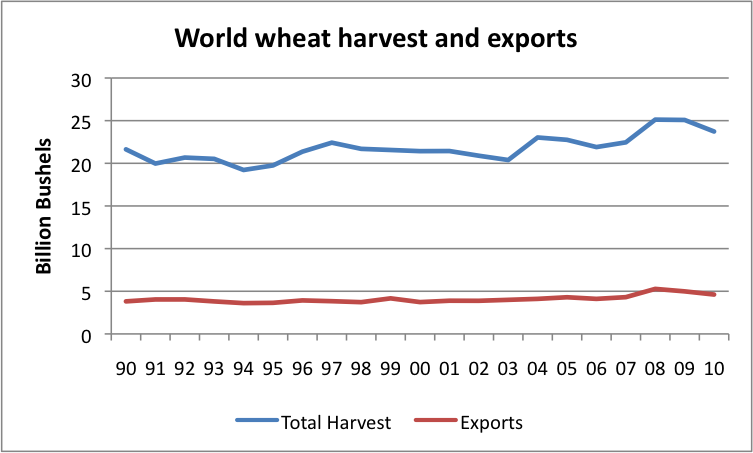
"Egypt is reported to be the world’s largest importer of wheat. In 2010, the oil minister stated that Egypt imports 40% of its food, and 60% of its wheat. The problem this year is that world wheat production is down (at least in part due to weather problems in Russia) so world exports are down:


Figure 4. World wheat production and world wheat exports from USDA

A longer term problem, though, is that world wheat production has not been growing to keep up with growing world population. Part of this lack of growth may be competition from biofuels. Part of the lack of growth also relates to the fact that the “green revolution” improvements (adding irrigation and fertilizer) are mostly behind us. While irrigation and fertilizer greatly improved production at the time of the change, gains in production since 1990 have been much smaller.

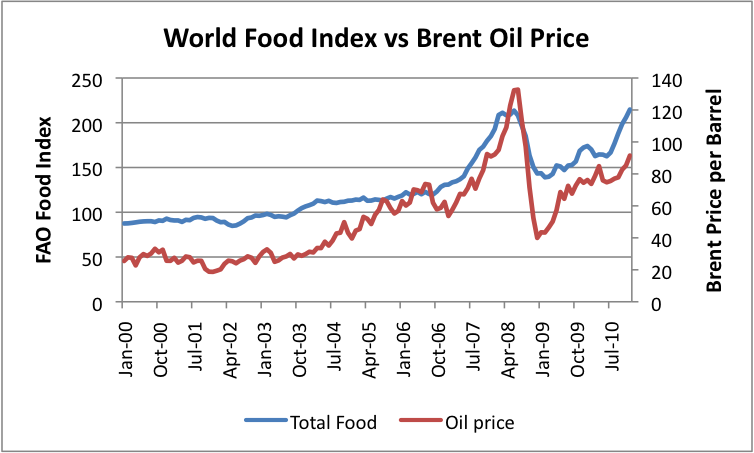
The cost of imported food, particularly wheat, has risen, partly because of the relatively smaller harvest, and partly because the cost of production and transport is rising because of rising oil prices. Figure 5 shows the close relationship food prices and oil prices. The Food Price Index used in this graph is the FAO’s Food Price Indexrelated to food for export; Brent oil prices are spot prices from the EIA.

Figure 5. World food price trend is similar to Brent oil price trend.

With oil prices higher now (because world production is close to flat, and as countries come out of recession, they want more), food prices of all types are higher as well. Oil is used directly in the production of grain and indirectly in storage and transit, so its cost becomes important.

The higher food prices contribute to the overall inflation problem that Egypt already had. In 2010, the CIA Factbook estimated the inflation rate to be 12.8%. Since wages don’t always rise to match inflation rates, inflationary pressures have no doubt put more pressure on the government to increase subsidies, at a time it cannot really afford to do so.

Impact on the Rest of the World

Why does everyone else respond so strongly to Egypt’s problems?

One reason is that other Arab countries are also feeling some of the same pressures. Food prices are rising everywhere. Many low income people spend in excess of 50% of their income for food, so a rise in food costs becomes a real issue. People have come to depend on oil and food subsidies. If they are taken away, or not raised sufficiently to compensate for the higher costs of imports, it is a real problem.

Oil prices seem to be affected as well. If the Suez Canal should be closed because of disruptions, it could affect oil transit, particularly to Europe. According to the EIA:

An estimated 1.0 million bbl/d of crude oil and refined petroleum products flowed northbound through the Suez Canal to the Mediterranean Sea in 2009, while 0.8 million bbl/d travelled southbound into the Red Sea.

The amounts being transported through the Suez canal are now likely down a little from these amounts in 2011, because of reduced imports/exports worldwide, but they are still substantial. Europe’s oil imports are about 10 million barrels a day of oil, according to Energy Export Data Browser (using BP’s data). If all of the amounts that flowed northbound went to Europe, they would amount to about 10% of Europe’s imports, or about 7% of Europe’s consumption. In fact, some of these exports go farther–in particular to the US, or to Canada, so the amount in question is probably lower than this relative to Europe’s consumption, say 4% or 5%. But even a small shortfall is a problem, in a world that needs oil for transport, food production, heating, and many other uses.

The inability to send products southbound through the Suez Canal is likely to also be a problem. Part of what Europe does is refine oil, keep the products it needs, and send other products to customers elsewhere. The whole system is set up assuming close to “just-in-time” production and delivery. While there is some storage capability, after a few days or weeks the system is likely to start running into problems. Those in need of the refined products being sent southward through the Suez Canal will be facing a shortage, and Europe will have excess supply. Of course, it is possible to use longer shipping routes, but this uses more oil for shipping and takes longer, so is more expensive. There is also a time-delay when the new system is put in place.

All of these problems (relating to both north and south-bound oil traveling through the Suez) can be worked around, but there could be a period of disruption for a while, as supplies begin traveling a longer route."

If you have not already, I suggest buying MOO, RJA, JJG, and DBA on any weakness.  The revolutions may end, but not the food crisis.

Just Another Post on Gold (by Gary Tanashian)

By -

The signs come in fast and furious now.  The gold analyst talking in December about a February upside explosion to above 2000/oz., now talks about money being made on the short side for at least the next 6 months.  Large speculators have been reeled in significantly on the CoT, the public opinion of gold – sorry, I pay for this service and cannot reproduce the data here for free – is good to go, and then there are the technical downside targets, which NFTRH has had loaded for weeks now, coming into view.

Trend followers are doing what they always do and for some reason, when people read things on the internet with titles like 'Gold Loses Critical Support', they get their pants all bunched up.  A topping pattern appeared in gold back in December.  From this pattern, there were several downside potentials, none of which – including the remote prospect of a test of the massive support at 1000 – should be causing heartburn right now.

In the precious metals sector, you operate on a risk vs. reward basis, strap in for volatility and as I have long said, let FEAR RIDE SHOTGUN.  Embrace it.  Don't be a sissy, as Jonathan would say.  This is the only way to make long term gains and out perform the herd.  Be brave when they are sucking their thumbs. 

You have no idea how often I am negatively reinforced, like when the intelligent deflationist took a well spoken exception to my bullish stance on oil in early 2009.  When I was told by a financial professional and former subscriber, why treasury bond yields were going down and my 'rates rising' stance was incorrect in Q4 of 2010.  And now with gold, we have the ultimate contrarian opportunity in the asset that is contrary the vast, inflated mess of global assets.

Year after year it's the same market, same players, same dynamics, same herd.  The wash, rinse, repeat cycle whirring away.  Winners and loser to be sorted out soon enough… again.  http://www.biiwii.blogspot.com

A Prediction Fulfilling (by BKudla)

By -

Last March I wrote my first post for Tim and discussed what can stop the Fed.  At the time we were going through our second bout of uninterrupteded ramping in the market, and I speculated on what will kill the economy.  Please read here for the post

http://slopeofhope.com/2010/03/index.html

At the time the price of oil was $81, the price of gold $1130, and the interest rates were 3.7%.  In one short year, all of the levers that will kill the Fed's ability to strengthen the economy through more debt are now pushing hard against them, and are at breaking points for the economy. 


In addition, our inconvenience in these areas of price increases are turning into calamities overseas.  China and India are experiencing food inflation that, in my view cause world changing social unrest. South Korea is releasing emergency food stockpiles to ease pricing pressures, North Africa is experiencing regime change, and the other two BRIC countries, Brazil and Russia are suffering from these same hot money flows.  Oh, and don't forget Europe.  We are one bad harvest away from a worldwide upheaval (a post for another day)

All of this calamity because the TPTB are protecting the bank and other fixed income bondholders.  All of the extra money created worldwide is being used to buy hard assets (and being hoarded) with the fake money, and the money is being politically directed.  So in the end, the imbalances continue until the masses here in the U.S. can't absorb the costs anymore.  That time has come; as I always contend, the price of energy is the silver nail into the Fed.  Food and transport companies are getting crushed via margin pressure, and they will release that pressure onto us.  As that happens (already begun) the political heat ends the games and the long awaited debt destruction spiral can and will begin.

My bias is that we profit correct out of this quarter, the politicians panic regarding the Muni crisis, and we move into our last bout of the bubble, then it gets ugly.

Enjoy your weekend  :-), and go Steelers.