Slope of Hope Blog Posts

Slope initially began as a blog, so this is where most of the website’s content resides. Here we have tens of thousands of posts dating back over a decade. These are listed in reverse chronological order. Click on any category icon below to see posts tagged with that particular subject, or click on a word in the category cloud on the right side of the screen for more specific choices.

Are We at Deflations Gate? (by BKudlaQA)

By -

In December my indicators told me to move into a short position regarding the miners, especially gold, and I did so.  Then during the Christmas break, the strength of the move forced me to dehedge and go longer, which I did.  So far so good on that, made some nice money and was feeling good going into the new year.

This week I spent the better part of it very sick and scrambling to sell things and rehedge, as I think I was hoodwinked by greed, and not paying enough attention to the low volume week, and its implications.

As part of my reflection, I started to look at charts from December 09 to see how the miners, and commodities in general have done in this so called stimulated environment.  Some interesting finds.

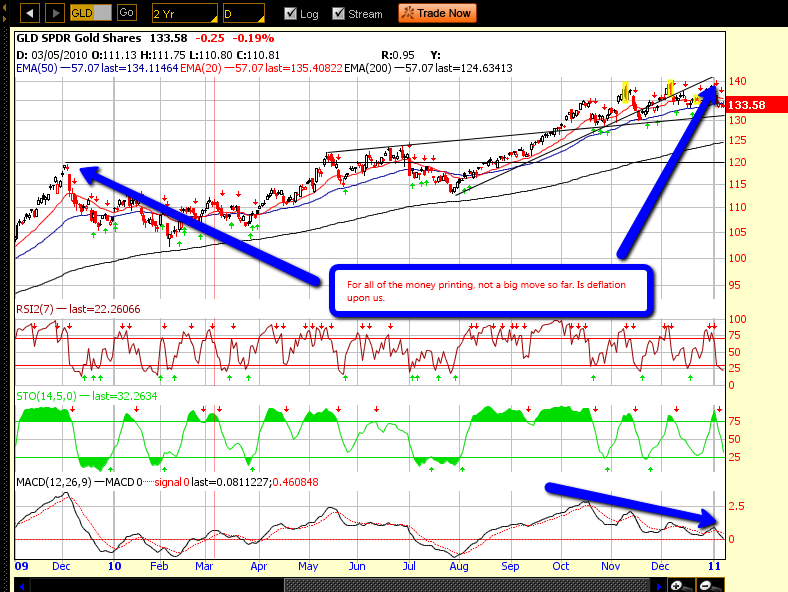
The large cap miners have done nothing, while gold is up 11%, this can't be good news for them if they break this horizontal support.

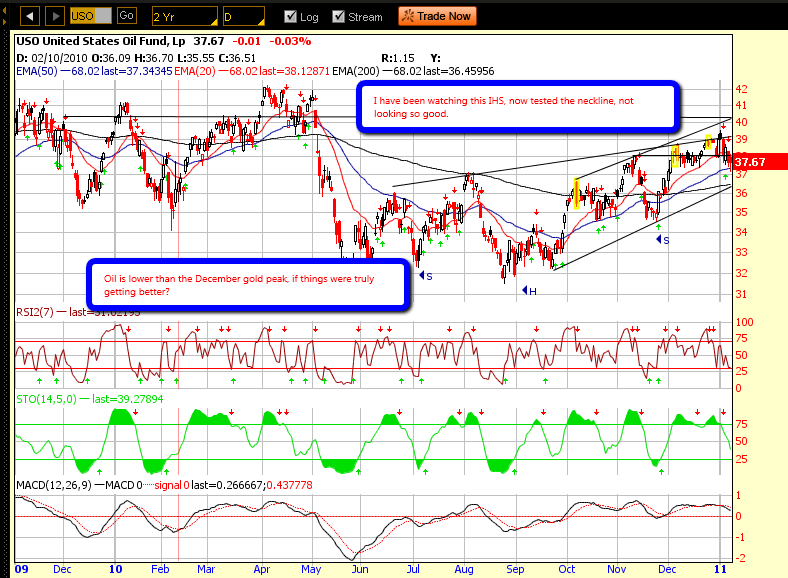
Oil has, really, done nothing, and looking at USO, it was forming IHS, and has turned back on the neckline.  I am watching this closely.

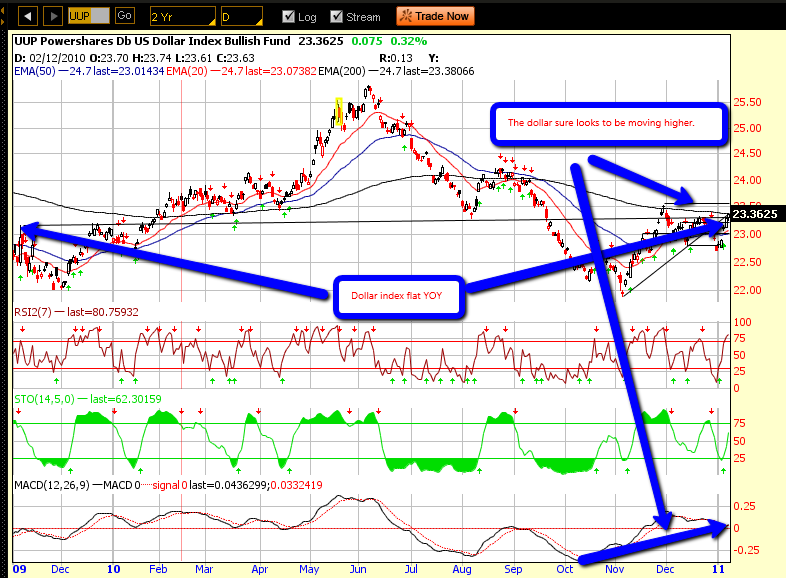
The dollar has gone nowhere, as well. Based on all that we are hearing about stimulus, you'd think the dollar is in the tank, nope.

The Euro, is down, and looks ready for the next leg down right now.  This cannot be good for the stock market.

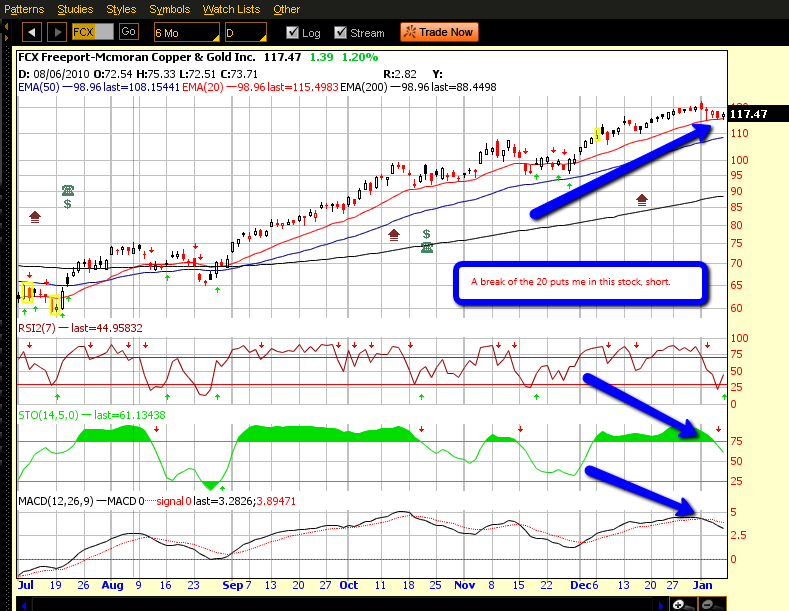
What is up is food and copper. Food I can understand, poor harvests, small commodity markets that can be overwhelmed with hot mney, etc.  Copper though is interesting, best I can guess, it is all about China, or is it.  I also hear that JP Morgan is controlling 80% of the metal in Comex, and has it warehoused, maybe a hedge against their silver exposure short.  If silver relents lower here, watch copper, also the China growth story is long in the tooth.  I am shorting FCX below its 20EMA.

We may be in a position for our next whiff of deflation, what say you?


Bank Loans Gently Bottoming? (by Gary Tanashian)

By -

Happy New Year SOH!

http://www.biiwii.blogspot.com

NFTRH117 opened the new year with a review of a successful 2010 and a look ahead to 2011.  We reviewed the precious metals, commodities and broad markets.  Risk is quite high in the broad markets now, even as they pump higher this morning, as I write this intro.  

Stock market sponsorship is represented by the absolute dumbest money on the planet as measured by several metrics (AAII out front).  This is money that wants in on the party and wants to repair the indignities of first being fleeced in 2008, and then sitting in Treasury bonds watching the party from the outside.  

While I expect a significant correction before too long, the analysis in the 'Wrap Up' segment of #117 left me feeling a bit less bearish for the entirety of 2011.  Let's see how things develop.  Manage risk (which means manage bear instincts as well as bull ones), keep perspective, and you will do fine in 2011.

NFTRH117 Wrap Up (Bank Loans Bottoming?)

NFTRH117 intended to be brief, with bullet highlights or something to that effect. But
somehow it got to page 9, so we will wrap up here.

Upon finishing the report, I find myself feeling a bit more bullish on the immediate term
than I was before I started writing. If I had to take a guess, I would lean toward
continued bullish activity in most everything outside of the USD, which sports a chart
that does not look very good. But at some point there should be a strong reversal and
with any luck at all, we will be able to find some negative divergence somewhere to
indicate its impending arrival.

Of course, a strong candidate will be the Gold-Silver Ratio, which remains pinned in a
nose dive despite some positive MACD and RSI divergence. Junk bond to relative
quality bond ratios may provide a clue. Gold in relation to industrial metals maybe. Or
perhaps the thing will just reverse one day when most people least expect it.
Well, NFTRH will expect it no matter how high our gains go in the interim, because
NFTRH is in high risk mode and will remain so until the risk parameters clear.
Meanwhile, I guess it’s party on Wayne, party on Garth.

If Wayne and Garth are going to party well into or through 2011 however, the
inflationary policy must translate to the economy. Below is a graph from the St. Louis
Fed (updated 12/30/10) showing what could well be a bottoming out in bank loans to
businesses.

Deflationists promote the ‘velocity of money’ argument as they predict economic
implosion. While current events indicate speculative momentum and froth subject to
reversal, bank loans look to be gently bottoming into a pattern I would normally buy. We
must consider that this could be one of the diminishing returns (in relation to huge
commodity and precious metals upside) of intense inflationary policy, post-2007.

This would argue for inflation effects (price increases) to become more prominent in
2011 and for treasury yields to continue to rise, which would of course put major pressure
on the economy. An unwinding of non-governmental credit brought on the most recent
deflationary crash in 2008. The next crash might well be brought on by revulsion toward
Treasury credit.

But if the graph below is indeed bottoming, an argument could be made that any coming
near term correction of frothy markets could be a healthy resetting of excess on the way
to a more extended – albeit inflationary – recovery. As with the cycle from 2003-2007, I
would expect the real gains in said recovery to be in the most productive economies and
valuable resources.

Then again, maybe I am reading too much into a fledgling bottoming pattern on a graph.
Best to let events unfold and monitor weekly, and not impose bias on the proceedings.

Bankloansfed
Here is a long-term view of business loans. Deflationists argue that they are right in the
big picture, but as we have noted previously, they will only be right in the final deflation.
All others, since the last monetary system ties to gold were severed have just been
deflation ‘events’ along an inflationary continuum. The trend as they say, is up. So will
the tiny hitch below turn into a real bottom, signaling that money is indeed getting out
into the economy now that banks have fed at the trough of pigs for two years? If so, do
not be a deflationist.


BUSLOANS_Max_630_378

Macroeconomics and the US Dollar (by David Kern)

By -

I have two charts for your perusal, dear readers – focused on the broader indexes.  Tonight my thoughts go to my TSP allocation, specifically: my over weighting of the international index (the EFA).  This international index will tend to have a bit more volatility than the S&P 500, similar to the Wilshire 4500 (EMW) – but decorrelated at times.  Lately, the EFA and EMW have been rather decorrelated.  Much of this is due to the economic worries in Europe, as the PIIGS national economies (Portugal, Ireland, Italy, Greece, and Spain) have really shown how shaky this debt/leverage house of cards can be.

Exchange rates also have much to do with the relative performance of the EFA and US indexes.  As the value of US currency goes down (and o-how-it-has since 2000), the EFA will get a corresponding tail wind due to the greater currency valuations it represents.  Now lest you think this whole post is just a bunch of hand waving and pie in the sky economic mumbo-jumbo, I offer my first chart: hard core technical analysis of the EFA point and figure chart.  What I’m showing here is an equity clearly being owned by increasing demand that overpowers supply.  Prices can not increase without more buying interest than selling interest – and this chart demonstrates that in spades.  Fair enough, we should expect higher prices on the EFA and I’m happy to hold my investment there.

The natural follow up question is, “will the EFA outperform domestic indexes?”  That question I hope to answer by means of my second chart, showing the value of the US dollar on a weekly candlestick chart.  This proves by observation my earlier premise – that declining value in US currency boosts the performance of the EFA vs the EMW or SPX.  Notice especially the blue outlined timespans: when the US greenback falls, the EFA was killing versus the domestics. Now granted, my chart note about a possible top forming is speculative – but it does fall in line with a descending channel.

I think the more compelling argument for decreasing value in the US dollar is in the headlines.  You may have heard of quantitative easing, which is how my government has chosen to try to stimulate the economy (it really just means printing more money that didn’t exist before – I wish I could do that).  Contrast that with the austerity measures being imposed overseas, and I think it’s a safe bet that there is room for the value of the dollar to fall further.  Bottom line – although the EFA has underperformed the domestic indexes lately, I expect that those roles will reverse.

Thanks for reading, I blog at AbjectAvarice.com where you can watch my stock portfolio in real time.

David Kern (@AbjectAvarice)

Risk On/Risk Off (by BKudla)

By -

People ask me all the time if the U.S. is in such bad shape and things get worse, why will the dollar and gold do well.  I then whip out this chart and explain to them that as things get bad people need to sell things that are electronically invented and / or are leveraged and buy something that has less debt or leverage associated with it, or in the case of gold no debt associated with it.Inverted_pyramid_2010-12-26_1542 

To illustrate how much debt worldwide is out there against real capital, look at the following chart.


Credit_bubble_2010-12-14_1657 

The annotations are mine from government websites.  There is approximately $5 trillion in cash and gold supporting $290 Trillion in assets.  That is some nasty leverage.  The world governments are trying to add $2 trillion in capital to the foundation.  This is grossly inadequate.  The world's asset base simply declines by 3% and we are insolvent again.

As anyone who owns a business or truly invests in capital assets, you value these assets on the discounted income they generate, and as government spending takes over private spending to increase this capital base, it is inefficient and slows velocity that can generate income, and increasing taxation does the same.  So bottom line, the income supporting these assets are suspect and after a next flirt with high inflation we collapse into a debt destruction spiral.  Happy New Year.

www.arum-geld-gold.blogspot.com