Slope of Hope Blog Posts

Slope initially began as a blog, so this is where most of the website’s content resides. Here we have tens of thousands of posts dating back over a decade. These are listed in reverse chronological order. Click on any category icon below to see posts tagged with that particular subject, or click on a word in the category cloud on the right side of the screen for more specific choices.

A Little Long – EPP

By -

How’d that quote go? – “Don’t fight the Fed…”  As of Friday, I am still net short, but have more longs (as a %) than I have had since 2007.

QE 

To be clear, I fundamentally believe most Western economies are circling the bowl; and the Fed is dumping water in, praying it can keep the turd from going down…  it’s just a matter of time.

Since mid-late October sometime, I’ve been taking small bites of EPP (iShares MSCI Pacific ex-Japan) on any drop.  From the iShares site: http://us.ishares.com/product_info/fund/overview/EPP.htm


Pros: Given the 20% inflation Ben & Co. just dumped into the bowl, I like the geographic breakdown:

Australia              65.46%

Hong Kong           19.29%

Singapore            12.67%

New Zealand         0.79%

Macau                  0.64%

China                   0.27% (<– and specifically that this is not a large % of the mix)

Additionally, as the world hunger for materials grows, 10% of EPP is BHP Billiton.


Cons: I’ve been cautious with the accumulation, as over 46% of this ETF is in Financials.  Sure, as a %, most of the Financials are ANZ banks, but I have such a limited trust of this sector – I can easily imagine some panic-inducing event turning this into a loser faster than the HFT machines can dump it.


TA: The price data is strong above the cloud:

EPPcloud 

EPP appears to be at a confluence of support.  I'm holding at this point, and will add another chunk if it can manage to hold the blue line.  If it breaks the overhead green, I’m adding more for what I believe should be another nice leg up:

EPPpara 

Behind the Scenes (by BKudla)

By -

As we watch the Federal Reserve launch QEII, and other programs to "support" growth in our economy, many of us are saying this will ruin us, we will have a run on the dollar, etc. and these guys can't be that stupid, can they.  Then there are those of us that try to pierce the veil to determine what is really the strategic end game here.  Here is my take, and before I share it, I don't necessarily endorse it or morally judge it.  That is when I lose money.  I am simply trying to see if I can get an edge.

The Federal Reserve has taken the role of executing our trade policy, this is nice and convenient for the Administration, as they can appear reasonable in public, and say things like, we support a strong dollar, and a rising Yuan would be helpful, while behind the scenes we have declared war on the Mercanilist nations. 

From a currency perspective, the players of world are divided into three camps;

  • The resource currency countries such as Australia, the Gulf States, Canada, South  Africa, Russia, etc.
  • The Mercanilist nations, which are of two flavors;
    • The overt, which simply tie the nations currency to ours, such as China.
    • The indirects, which use a variety of regulatory, tax, currency and trade policy to artificially support exports and suppress imports.  Those would be Germany, Brazil, any other Southeast Asian nation, and Japan.
  • The rest of the nations are not engaged or relevant in this fight, but will still suffer collateral damage.

The U.S. has put themselves in a box by allowing their budgets and current account deficits to become unsustainable (the why or whose fault it is, is irrelevant). We have been trying to rebalance global trade to save ourselves, and at the same time been printing dollars (along with every other consuming nation) to reinflate the world economy.

The Mercanilists and the Resource countries like things just the way they are now. But, they are vulnerable; by tying to our dollar, and having a high need for raw material imports, we are now in a position to cause them great pain, unless they revalue their currencies.

So my thesis is, we are playing a great game of chicken to see how long these countries can stand the internal inflation and the havoc of higher food and fuel prices on their populations, and the reduced profits for their business owners.  The squealing has already begun.

Brazil is having great difficulty handling the money flows, Korea, Japan and Germany are concerned enough to take this fight public, and China is struggling with higher food and fuel prices, and disappearing margins.  Here in America, the Federal Reserve has maybe a six month window before higher fuel and food costs embed themselves into the supply chain and come out with intolerable retail price increases. 

Between now and then, expect this new money to flow into hard assets that are internationally trade able.  These prices, I suspect will rise far faster than most expect, with high volatility throughout this complex and within it.  That is where I am positioned. When our energy and food prices get too high, we will force the Fed's hand to stop (Average gasoline in the $3.75-$4.00 range). That is when I step off. I suspect after this, a new managed world trade policy will be hammered out if we did not tip the world over the falls into real deflation and depression.

One man's view www.arum-geld-gold.blogspot.com

Who Killed the US Dollar? (by Springheel Jack)

By -

It was Ben Bernanke, from a helicopter, with a printing press!

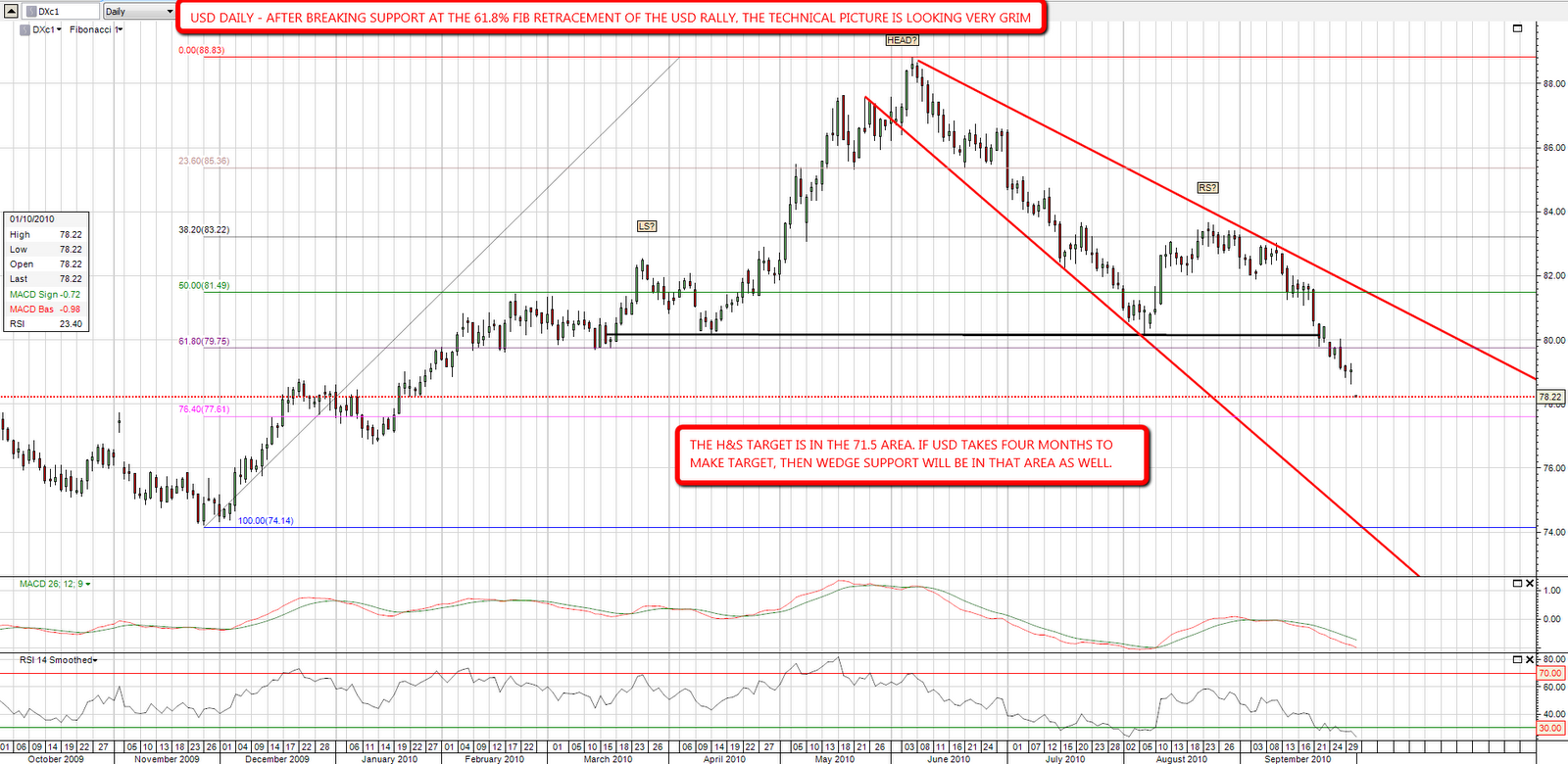
Cluedo jokes aside though. I've been looking at the technical picture on USD and it really is starting to look very grim. The Fed is inflicting damage to USD, and IMO at least to the long term health of the US economy, on a scale that Osama Bin Laden could only dream of managing. Ben Bernanke could well succeed in doing to USD what the PIIGs have failed to do so far to the Euro.

After breaking support at the 61.8% fib retracement of the USD rally, a new low is looking very possible. If we take three or four months to reach it, then the wedge target would be at the same level as the H&S target:

A similarly bleak picture in the inverse can be seen on EURUSD:

The picture looks marginally less optimistic on GBPUSD, where the big rising wedge that is forming looks potentially longer term bearish for cable at least. It is a monster pattern though, and GBPUSD could run up a lot further within it. I would point out though that rising wedges break up 31% of the time and that this rising wedge could also be an IHS with an upsloping neckline:

One thing I've been watching as the markets in the developed world have stalled in the last two weeks is how emerging markets and commodities have continued to run up. I've posted the rising wedges on GYX and EEM in recent days to show the big rising wedges on both. GYX continued up to hit the upper wedge trendline on Friday:

That looked encouraging for the bear side until I looked at the updated EEM chart, where the upper trendline has been hit and then gapped through. That could still be a wedge overthrow but this is not at all encouraging for seeing an interim top in the near future:

One of the few bright spots for bears at the moment has been the lagging financial sector, where XLF has been strongly underperforming SPX. I'm wondering though whether that is going to help the bears during what is beginning to look like a run on USD. That run on USD might help the bears only if the run triggers a general flight from all US denominated assets over the next few months, and it is possible that we are seeing the start of that at the moment:

I was reading earlier this week that on current trends the Fed is likely to overtake both Japan and China within two months to become the largest holder of US treasuries in the world. Every dollar of that holding has been purchased with a freshly printed dollar, so in effect the US has just been printing money to finance the ever increasing fiscal deficits. That is a policy that, when sustained, has only ever ended one way historically. Ben Bernanke is determined to avoid deflation, and he has the tools to avoid it for certain. You should always be careful what you wish for however, you might just get it. 🙂

Anyway, just some weekend thoughts. It's my birthday today and I'll be going to a wonderful restaurant / pub with the family for a great lazy afternoon. This being the UK, the weather stinks of course, but we'll be staying inside. Everyone have a great rest of the weekend. (Note from Tim: Happy Birthday, SHJ! We love ya!)

Pendulum Swings to ‘D’

By -

Anxiety is rising… I know this from the emails I am getting.  If I
have to hear the words "treasury bonds" one more time, why… :-)  But
of course we are going to hear about T Bonds… just look at the yield. 
It is now the 'in' thing and it feels okay.  Time for the big D
to hit the airwaves.  Step right up and dance everybody, just like you
used to do in the discos when that awful music compelled you to get in
line and shake yer thang.

Tyx

Back in the spring I was taunting the inflationists
with the chart that showed bullish ascending triangles and symmetrical
triangles in various treasury bond funds of varying durations (TLT, IEF
& IEI) after the long bond failed to break the "line in the sand" at
the monthly EMA 100.  The i Boys (and girls) largely took this in
stride or ignored it in favor of chasing down the dreams of rising asset
values into perpetuity.

Now, the input is about deflation, 24/7 and it generally comes from some
very smart people (I have always contended that the average d Boy is
more financially astute than the average i Boy – and I'm an i Boy!) and
cites some very smart sources.  But sorry d Boys, you will not sway me
until my own analysis sways me.  How can you sway someone who has been
awaiting your event for so long?

It still says here that your 'event' – regardless of how destructive it
may be for the US and other entities that are levered off the balance
sheet without the reserves to help compensate -is a lever in its own
right.  Your treasured T Bond is what Bernanke needs.  I did not and do
not know how he got his gun reloaded and got intellectuals and the herd
alike into the Bond, nor do I care.

Anyone who could read a chart and maintain an independent viewpoint
(from the respective I & D dogma) could see the bond was going to
rise.  Now, on cue we have the mini hysteria.  It's Prechter
time!  Personally, I have short, middle and long term plans on how to
use Prechter time, beginning with being aware of what this smart man
recommends and as I have done over the years, actually implementing some
of it.  But it does not end with that.  No, not by a long shot.

The last time I was scolded by a d Boy was over at SeekingAlpha in early
2009, as I forecast bullish on copper and oil.  They are scolding again
and while things could be very tricky and difficult in the coming
months, they are just getting cooking my friends.

Also for reference:

Suddenly Treasury Bonds Are Not So Bearish, Are They?  April 27, 2010
D Boys Coming Out to Play  May 20, 2010

And there were plenty more.  All I ask is that readers resist the
compelling urge to herd.  Whether one case or the other (i or d) is
right or wrong ultimately is not the issue so much as the proven
destructiveness of allowing one's market stance to be whipsawed around
by very smart people with very persuasive arguments.  These are the
markets, and they go to their own  beat.

Edit (1:30)  You are a stout and savvy reader of this blog and
have not yet turned me off with a contemptuous "screw you".  Therefore, I
need not put any of my own words to the inherent meaning of the MSM
blurb below:

A big beneficiary has been bond funds, which offer regular fixed interest payments.

As
investors pulled billions out of stocks, they plowed $185.31 billion
into bond mutual funds in the first seven months of this year, and total
bond fund investments for the year are on track to approach the record
set in 2009.

Charles
Biderman, chief executive of TrimTabs, a funds researcher, said it was
no wonder people were putting their money in bonds given the dismal
performance of equities over the past decade. The Dow Jones industrial
average started the decade around 11,500 but closed on Friday at
10,213. “People have lost a lot of money over the last 10 years in the
stock market, while there has been a bull market in bonds,” he said.
“In the financial markets, there is one truism: flow follows
performance.”


Dow, Dow-Gold Ratio & Junk to ‘Investment Grade’ Debt Ratios

By -

The following is excerpted from NFTRH96 (August 8, 2010):

Dow Big Picture Status

Dialing out to the monthly view shows all appears to be well with the
Dow. America’s most watched index held an important support level after
faking a breakdown at the end of Q2. Also of note is that the Dow
remains above our long-watched EMA 20, which supported the entire
cyclical bull market (2003-2007).

On the bear side, there is the possible formation of an H&S top not
unlike the one that confirmed into Armageddon ’08. Risk remains high for
both bulls and bears until the Dow either declines below support and
the downward sloping neck line or breaks to new highs for the recovery.
In short, the Dow – along with many other markets – is not yet showing
its hand. The scale in my biased view, tilts toward bearish however.

Dow

Dow-Gold Ratio

The DGR did however, show its hand when the upward recovery AKA bear
flag AKA post-crash rebound known here as Hope ’09 failed and broke down
out of the channel.  As with many other markets, the Dow is currently
rising in relation to gold to test the breakdown. If DGR breaks up into
the channel and breaks the resistive moving average, NFTRH will be
forced to reconsider its stance. As yet however, no resolution and the
current stance remains favored.

Dow-gold

Junk Debt to ‘Investment Grade’ Debt Ratios

As frustrating as the market’s would-be topping process has been of
late, bears will take negative divergence where they can find it. While
nominal HYG (highly speculative junk debt) is at new highs, its ratio to
the relative quality of investment grade corporate bonds (LQD) is
flashing a non-confirmation as this is a sign of smarter (less dumb?)
money slinking toward the sidelines of the speculation trade.

Hyg

This ratio is a leading indicator and its lower low and status below
resistance is considered a bearish divergence to the higher low and
proximity above support of nominal HYG. In other words, the dumbest
speculators appear to be taking HYG higher.

The above are a few of the important indicators included in this week's NFTRH
We also took an extensive look at the gold stock sector, with a
historical view of what does and does not constitute good buying
opportunities in the sector.  Updated status, and implications of the
gold-silver ratio and gold's consolidation vs. the euro and several
other currencies was reviewed as well as the current state of the US
dollar and long term treasury bonds, both important determinants of the
probabilities for near term events with regard to the
deflation/inflation debate.