

See this Bloomberg article for a look at the ingredients in a policy stew that looks like it was scraped off the floor of Worst Cooks in America. Click the headline for the article.


Slope initially began as a blog, so this is where most of the website’s content resides. Here we have tens of thousands of posts dating back over a decade. These are listed in reverse chronological order. Click on any category icon below to see posts tagged with that particular subject, or click on a word in the category cloud on the right side of the screen for more specific choices.
See this Bloomberg article for a look at the ingredients in a policy stew that looks like it was scraped off the floor of Worst Cooks in America. Click the headline for the article.
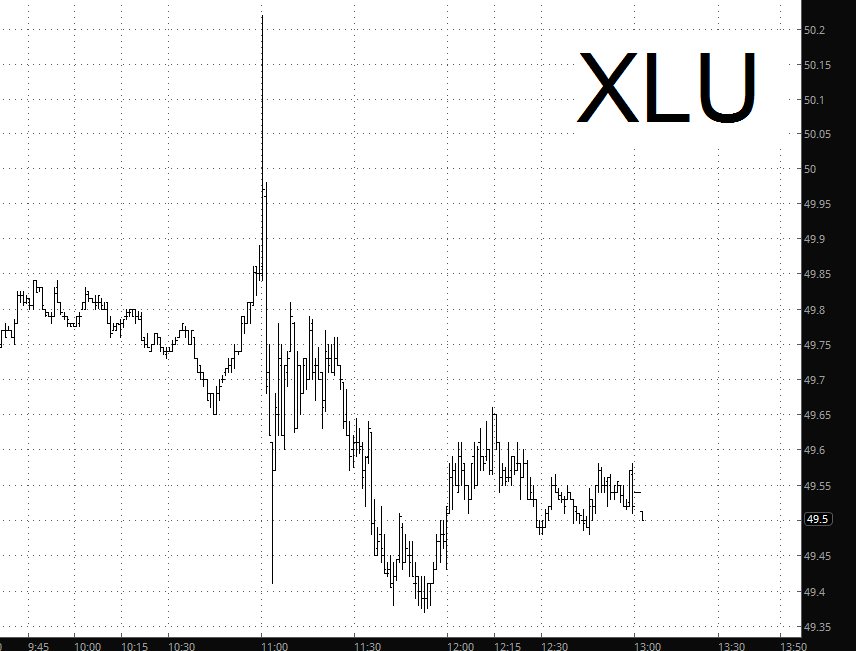
As usual, Fed Day gave us quite a ride. The big news was that our friends at the FOMC plan to give us another 3 rate hikes this year instead of 4. Guess how many Fed meetings there are with accompanying press conferences left this year? Three. How about that.
My stomach went into a knot the moment the news came out, because everything – – EVERYTHING – – went against me big time. It didn’t last though. Just imagine how many people were short the utilities and got stopped out, all because of a stupid, multi-second Fed spike.
If I were to make a list of the things I want to write about, at the BOTTOM would be this stupid market, and at the TOP would be SlopeCharts. So – – get used to it – – you’re going to be hearing about my new favorite product a lot. At least until common sense returns.
Instead of doing a post of charts that would literally be about five feet tall, I’m going to provide you with the clean, simple URLs that will provide you ten really fascinating charts from the SWELL system. Just click any of these to see it in all its SlopeChartian glory. Enjoy!
Update: This article ultimately leans toward the view that the reasons for a rising curve will be inflationary. But I woke up in the middle of the night and my thoughts drifted to the components of the article (yeah, that’s pretty sad, I know), and with further consideration I am leaning toward neutral or even a bit into the deflationary camp. The reasons will be the stuff of another article.
Think back to the blaring headlines about the Great Promotion Rotation in the financial media in 2013. Perhaps the media circus started in January of that year when The Economist asked the question of whether the rise in bond yields signaled a “flight” out bonds and into equities. It was probably an earnest and right minded question asked by The Economist, but you know our friends in the greater financial media; get a good story and flog the hell out of it to harvest eyeballs. Reality be damned, man, it’s the eyeballs that matter!
As the mini hysteria grew that year we called it a “Great Promotion” (by the financial media) in expectation that the Continuum’s limiter (the red monthly EMA 100 on the 30 year bond yield chart below) would hold once again, just as it had during Bill Gross’s inflation hysterics that signaled a top in inflationary angst in early 2011. By the end of 2013, our ears were ringing with the media buzz and drone about the “Great Rotation”.
If you don’t immediately recognise the title for today’s post then I must first warn you that your knowledge of Lewis Carroll’s literary works is dangerously deficient.
So why am I thinking of Alice in Wonderland today? Well it is Fed day, and for me the Fed always bring Wonderland to mind. I was talking to my older son a few weeks ago explaining that in the same way that lawyers trained for years to achieve a state where they could swallow (figurative) camels and yet still strain at gnats, economists went through a process where after years of patient study that seemed to require at least a PhD, they achieved a state where measures that looked reckless or even suicidal to the less trained eye were revealed as both sensible and necessary.
He asked whether the Fed’s track record at steering the economy in the past was impressive, and I told him that it had delivered a succession of ever greater disasters over recent decades. He then asked why people still nonetheless trusted the Fed to deliver policy, and I replied that people had to believe that the Fed knew what they are doing, as the alternative was just too terrifying. I added that the Fed never admitted to making a mistake, which reassured many, and that Ben Bernanke had an impressively bushy beard that had inspired confidence, though Yellen had needed to manage without one so far for technical reasons. (more…)