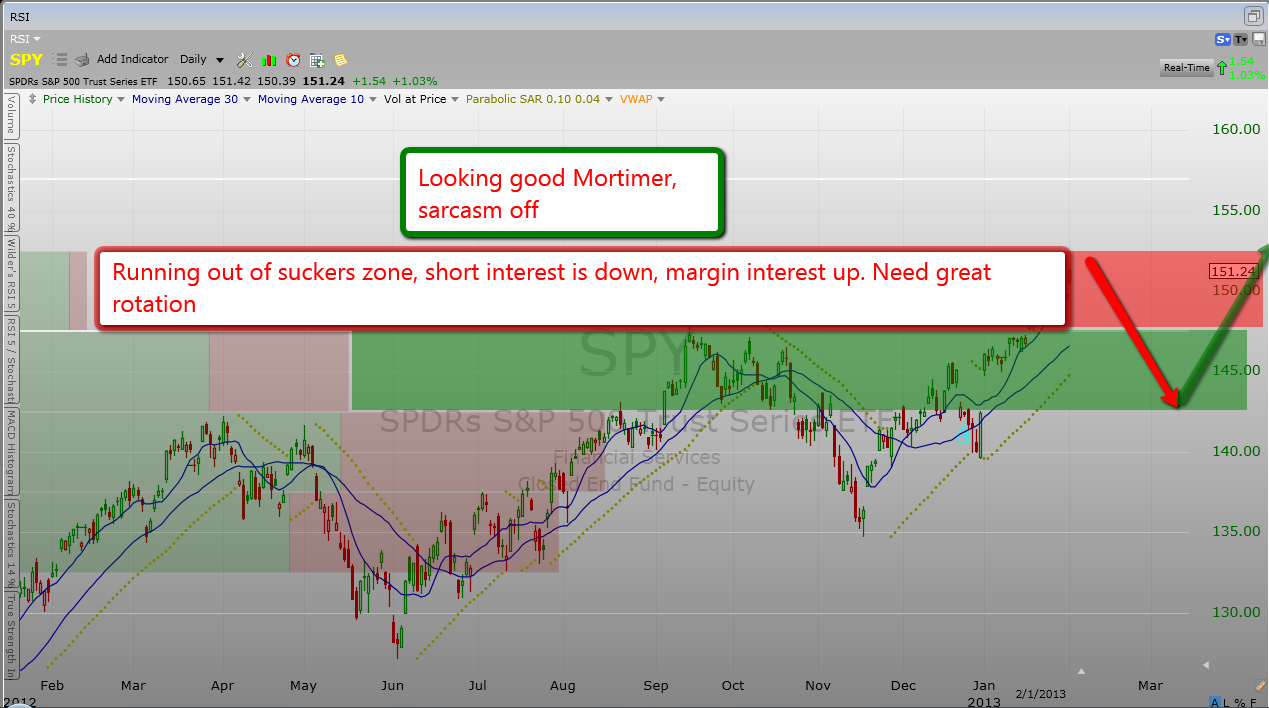
The Federal Reserve would have you believe that their policies are helping the U.S. economy and at worst, they are benign. The political elite would have you believe that all is well and getting better every month. The financial elites are telling you time to rotate out of those bond and money market accounts because the Fed saved us, and the Administrations policies are working. Get ready for the next boom.
Slope of Hope Blog Posts
Slope initially began as a blog, so this is where most of the website’s content resides. Here we have tens of thousands of posts dating back over a decade. These are listed in reverse chronological order. Click on any category icon below to see posts tagged with that particular subject, or click on a word in the category cloud on the right side of the screen for more specific choices.
Choose a Trade that Fits Your Risk Profile
There is a reason why out-of-the-money options are so cheap; it’s the equivalent of buying a lottery ticket. And gamblers love lottery tickets.
But unlike the typical lottery system where the seller of the ticket pays only a small portion of the overall proceeds in the form of winnings, options are a zero-sum game in the truest sense of the definition – winner’s profits are loser’s losses. And the majority of loser’s losses typically come in the form of speculative out-of-the-money plays.
The winners know how to skew the results. Moreover, they know the risk-reward and the probability of success BEFORE each trade.
In the options world the gambler is defined by a trader who buys a call or put with a delta of .35 and below. (Delta is the probability that an option will expire in the money.)
Like lottery tickets in the store, options with deltas this low have a low probability of success. But because of their cheap price and high-profit potential, they lure in newbie options traders.
This is why I prefer to take the other side in this zero-sum game. I do so by essentially taking the other side of the trade – by selling options to the speculative crowd.
Money Flow for January Week Five (by Strawberry Blonde)
Further to my last weekly market update, this week's update will look at:
- 6 Major Indices
- 9 Major Sectors
- Ratio Charts comparing the SPX to other Major World Indices
6 Major Indices
As shown on the Weekly charts and 1-Week percentage gained/lost graph below of the Major Indices, all but one closed higher on the week than the prior week. Rather than the Dow Transports Index leading on this week's gains (as it has in the past few weeks), it was the one that lost a minor amount. The Nasdaq 100 gained the most, and the Russell 2000 gained the least.
A Touchy Subject – Part 1 (by Mark St.Cyr)
I believe I’m going to touch on a subject that might make a few
uncomfortable. However, I think it’s a subject that needs to be
addressed for it could have far-reaching implications to whether it
moves web traffic as many think it does. Or, could be a catalyst with
dramatic monetary implications in ways some would never expect. The
subject – porn.
No, I’m not going to sink us into the gutter. However, something is
happening via what we deem as “search” that a great many might be
unaware. The resulting backlash or acceptance of new policies could
alter many things we take for granted. i.e., What’s available or
delivered to us on the web.
Another way to put it would be; what you or I currently take for
granted as in our expectancy of the results delivered to us via our
search queries in Google®. This policy change could possibly exclude you
from viewing (or reading) certain results be it now, or in the future.
Currently we take for granted when we initiate a search we have an
expectancy as to see everything in an unadulterated format if we have
adjusted our settings as to be unfiltered. Make sense that’s not only
what one would expect. It’s also what one wants. Results that should be
presented or delivered for us to choose from. The good, the bad, and the
ugly. Yet, if there’s a policy change that now no longer allows you to
see what you expected to see – would you know it? Hence, lies the crux
of this discussion.
Some Things Never Change
The founding principles behind futures markets are for
businesses to hedge their positions. Ranging from General Mills buying sugar to
lock in their costs, to General Motors shorting the Yen in order to lock in
their agreed contract prices in Japan.
For a while I studied Larry Williams’ method on swing
trading commodities and it completely resonated with me. Mainly the basis of
his trading is COT analysis and seasonal patterns. Which is an oversimplification,
but nonetheless I finally felt like I was seeing what moved the market and
riding with the whales that moved those markets. The greatest part was, in
order to be wrong the market had to prove the big boys wrong who were betting
billions.
The S&P 500 E-mini, is an extremely liquid and cost
effective hedge/insurance product for the equity markets. I assume this as the
guiding fundamental truth of the market place. Another truth about the market
place is that it spends 80% of the time range bound, which means our goal
should be to devise a strategy to exploit the range. In short, mean reversion.