

Apparently, there was a BBC program back in 1995 called Tomorrow’s World which set about to do the impossible: speculate what life would be like thirty full years into the future. That would be………well, us. Right now. It’s interesting to look at some of the predictions made back then (and, I’ve got to tell you, 1995 honestly doesn’t feel that terribly long ago to me).
They predicted "business barons" and banks would take control of the internet by 2000, establishing a "supernet" which they restricted access to.
Well…………close! I mean, the barons (paging Mark Zuckerberg!) don’t restrict access, because they want as many people spending as much of their lives as possible hanging out on their sites. But the Internet, free as it is, still feels under the thumb of a handful of mega-giants.
The program speculated space mining would become a lucrative industry, with companies excavating asteroids near Earth for precious metals. The show also suggested space junk would become such a problem it would not be safe for astronauts. The answer - a gigantic foam gel to slow down debris.
Errr, I’d say that’s a hard miss. Not a lot of asteroid mining happening these days, although there is this tidbit of footage from an actual comet that I think is incredibly cool:
The program featured a man of the future (wearing a fetching VR headset), his wife and a young girl in what appears to be modern-day London. In one section, the floating head of a woman comes out of a "smart speaker" to tell the man it has been a year since his holiday to "Indo Disney." She encourages him to take another holiday via a "shuttle to Bangalore" - which would only take 40 minutes.
So I guess the idea here is that instead of spending an entire day traveling to a place and then wandering around, it would be faster and cheap just to visit it virtually. Listen, I have been hearing this kind of thing since the early 1980s – – the whole telepresence schtick. Trust me, if people want to hang out in Tahiti, they’re going to fly to Tahiti. Putting on a pair of Quest goggles and pretending you are there isn’t going to cut it.
It featured a woman going to a bank, complaining there were no humans, and then withdrawing 100 "Euro marks." The bank gives her the money after scanning a chip in her arm.
A chip…………..in her arm. Ouch! Well, this is actually kind of close, because I often pay for something just by tapping my phone onto a device, which is precisely the same idea but didn’t involve a surgeon slicing into my doughy flesh.
What was particularly odd about this BBC series is that, in order to understand what like in 2025 would be like, they sought the opinion of this guy:

Hoo boy. Look, just because someone is incredibly brilliant in a particular topic (like, say, theoretical physics) doesn’t mean they are amazing forecasters. Do you really think Stephen Hawking has absolutely any concept about broad social trends and where they are all taking us? All he was able to offer up was that we could expect “big changes.” Thanks for that, professor.
Cleary if a person from 1995 zipped into the present day and just hung out for twenty-four hours, I think what would amaze them wouldn’t be the chips in our arms, or our asteroid mining, or our thriving virtual travel industry, none of which exist. Instead, the most obvious change, which is so ubiquitous it would astonish our time-travelling visitor, is this:
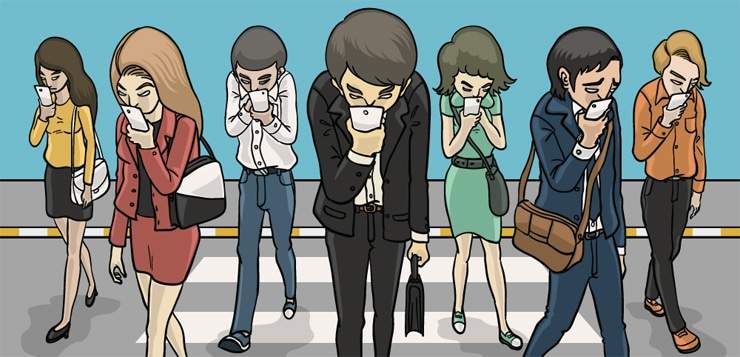
And I strongly suspect, after witnessing this for a short while, they would seriously considering going back to 1995 and checking out the latest news about Bill Clinton and Michael Jordan.
