

How We Turn Volatility into Opportunity
As a lifelong member of the Sloper community, I’d like to begin with a heartfelt thank you to Tim and to all of you for creating a space where ideas flourish and market challenges are faced head-on. Being part of this group has been a privilege, and I continue to learn from the wisdom and camaraderie shared here. This shared wisdom has reinforced an important truth: volatility, while daunting to some, is often where the greatest opportunities lie for those willing to embrace it. It’s remarkable how many traders—some of them seasoned professionals—hesitate when faced with volatile markets. But the truth is, these conditions often present the greatest opportunities.
One of the most beautiful aspects of options trading is its flexibility. Unlike stock investors who need a market to move up or down to generate returns, options traders can profit in bull, bear, or sideways markets. The key lies in understanding how to use these tools effectively. Over the past month or so, while many investors have struggled to eke out gains, strategies like bear call spreads and other credit spreads have delivered consistent and often outsized returns for those of us who embrace volatility.
Take a simple bear call spread on the S&P 500 ETF (SPY), for example. It’s a strategy I’ve used frequently in recent months, and it demonstrates the versatility of options and the power of probabilities. As of this writing, SPY is trading around $593.70.
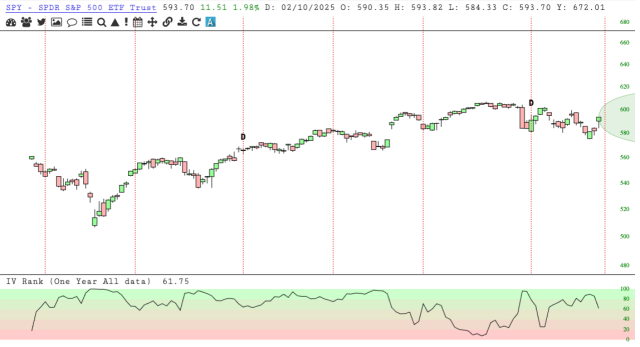
My goal is to establish a short-term bear call spread, expiring in roughly 30 to 60 days, with an 80% to 85% probability of success. This trade benefits from time decay—every day that passes without SPY rising above our short strike brings us closer to a profit.
To construct the spread, I begin by identifying the short strike, which will define both the trade’s probability of success and its premium. Using either the probability metrics on my platform or the option’s delta, I look for a short strike with a delta between 0.15 and 0.20.
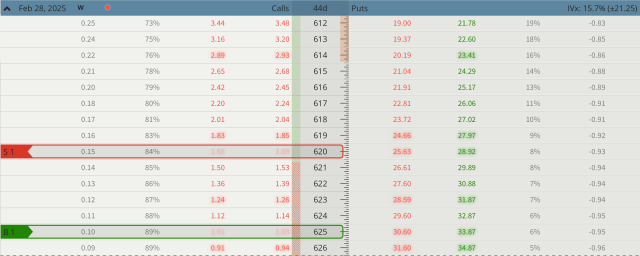
For this example, the 620 call fits well. It has an 84% probability of success and is positioned just outside the upward bounds of expected range which is roughly 614.50. I pair this with a long 625 call to complete the spread, creating a defined-risk position.
The trade structure looks like this:
- Short Call Strike: SPY February 28, 2025, 620 call
- Long Call Strike: SPY February 28, 2025, 625 call
- Net Credit: $0.67, or $67 per spread
- Max Risk: $433 per spread
- Max Potential Return: 15.5%
- Probability of Success: 84%
As long as SPY remains below the 620 strike at expiration, this trade will realize its maximum profit. My preference, however, is to close the position early—typically when I can lock in 50% to 75% of the original credit. For this trade, that means buying back the spread when it’s priced between $0.30 and $0.15. This approach reduces risk while allowing me to redeploy capital into other opportunities.
Why does this strategy work? Time decay, or theta, is our ally here. As the days pass, the value of the option premium we collected erodes, bringing us closer to profitability. And because this is a defined-risk trade, we know both our maximum gain and loss at the outset, allowing us to size the position appropriately.
Position sizing and risk management are where many traders stumble. For me, no single trade represents more than approximately 1% to 5% of my portfolio. This disciplined approach not only aligns with the “law of large numbers” but also ensures that no single outcome can derail my long-term success. I also set a stop-loss at 1 to 2 times the original credit. For this trade, I would exit if the spread price rose to approximately $1.34 to $2.01.
The beauty of this strategy lies in its simplicity. With a defined-risk, high-probability trade like this, we can be wrong in our directional assumption and still make a profit. That’s a testament to the power of probabilities.
Before I close, I want to once again thank the Sloper community. Your insights and fellowship remind me why this pursuit is about more than just returns—it’s about learning, growing, and facing the market’s challenges together. The road ahead will surely bring more challenges, but with the right tools and the right mindset, those challenges can become opportunities.
If you want to deepen your understanding of options trading and stay informed with actionable insights, I encourage you to sign up for my Free Weekly Newsletter. I created The Option Premium free weekly newsletter to share the strategies and insights that have helped me navigate the ups and downs of trading options professionally for 22 years. Each week, I’ll send you practical ideas and lessons that can help you trade with greater confidence and clarity—no fluff, no marketing nonsense, just real value.
