

The Quiet Power Behind Smarter Options Trades
What Is IV Rank Again?
IV Rank measures where implied volatility (IV) is currently positioned relative to its historical range over a specific period (usually 52 weeks). The calculation is straightforward:

For instance:
- An IV Rank of 80% means the current implied volatility is higher than 80% of the time in the past year.
- An IV Rank of 20% means it’s lower than 80% of the time.
When IV Rank is high, options are more expensive because the market expects more volatility. When it’s low, options are cheaper due to a lower expected price movement.
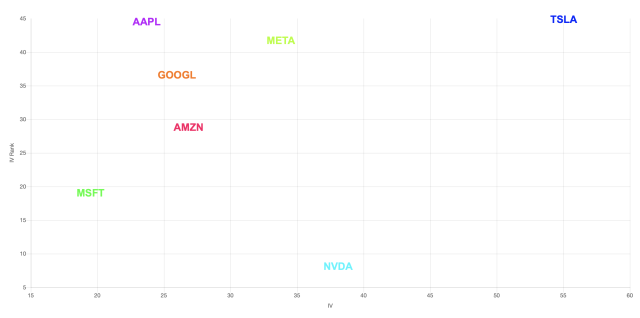
Example 1: Tesla (TSLA)
Tesla is notorious for its price swings and high implied volatility. It’s a stock where IV Rank frequently reaches extreme levels.
Scenario 1: High IV Rank
Tesla’s IV Rank is 45%. This suggests that Tesla’s options are somewhat expensive, implying that there’s greater uncertainty or a catalyst (like earnings, regulatory news, or new product announcements) causing heightened volatility expectations.
- Strategy: This could be an ideal time to sell options, specifically credit spreads or covered calls.For example, if you’re neutral or slightly bearish on TSLA in the short term, you might sell a bear call spread(selling a call with a lower strike and buying a call with a higher strike) or a bull put spread (selling a put with a higher strike and buying a put with a lower strike). These strategies take advantage of time decay and the probability that volatility will decrease if a catalyst passes.
- Why it works: The elevated IV increases the premiums you collect. After the event that caused high volatility passes, the implied volatility tends to contract, causing the options’ prices to fall, which benefits the seller.
Scenario 2: Low IV Rank
Now, let’s say Tesla’s IV Rank is 15%. The market isn’t expecting much price movement, and options are relatively cheap.
- Strategy: This could be a good time to buy options if you believe a big move is about to happen (due to an earnings report, product release, or other market-moving events). For instance, if you believe Tesla’s stock is due for a major move after earnings, you might buy a long straddle (buying both a call and a put at the same strike price) or long strangle (buying a put and a call with different strike prices). The goal is to capitalize on a sharp move in either direction once the event occurs.
- Why it works: The options are cheaper due to the lower implied volatility, and if Tesla moves significantly in either direction, your options may generate a large return, especially after the volatility rises following the event.
Example 2: Apple (AAPL)
Apple is one of the most widely traded stocks in the world and experiences periods of both high and low implied volatility, especially around earnings announcements.
Scenario 1: High IV Rank
Apple’s IV Rank is also 45%. This means that options are somewhat expensive, and the market is expecting decent price swings in the near term.
- Strategy: Selling options is generally more attractive in this environment. You could sell a covered call if you own Apple stock, or a naked call/naked put if you don’t mind taking on additional risk (note that naked options can be very risky).A bull put spread (buying a put at one strike price and selling another at a lower strike) is also a good strategy to limit risk while still benefiting from high premiums.
- Why it works: You can collect a larger premium from selling these options because of the elevated IV. If implied volatility drops (a phenomenon called volatility crush), options’ prices will fall, which benefits you as a seller.
Scenario 2: Low IV Rank
Now let’s say Apple’s IV Rank is 20%, indicating that volatility expectations are low, and options are relatively cheap.
- Strategy: This could be an attractive time to buy options for a directional bet. If you think Apple could make a big move after an event, buying long calls or puts would be a good strategy.Alternatively, you could consider a long calendar spread (selling a shorter-term option while buying a longer-term option), as you can take advantage of the lower option pricing while profiting from time decay.
- Why it works: With lower implied volatility, you’re able to buy options at a cheaper price, and if Apple makes a strong move, you’ll capture a larger percentage of that move since you’re paying a lower premium up front.
Conclusion
IV Rank is one of the simplest yet most powerful tools in the options trader’s toolkit. It helps you assess whether options are overpriced or underpriced, which can guide your decision to buy or sell options.
- When IV Rank is high, options are more expensive, so it’s often better to sell options and take advantage of premium decay.
- When IV Rank is low, options are cheaper, making it a better time to buy options if you anticipate a significant price move.
By understanding and using IV Rank properly, you can align your options strategies with market conditions, which ultimately increases your chances of success in the long run. I’ll go over several examples of how I use IV rank as well as other important indicators in the near future Stay tuned!
I want to encourage all of you interested in trading options to sign-up for my free weekly newsletter. No, I’m not going to send you more than the one email a week and no, I’m not running a service. I’m a trader. This is completely free from all marketing. You will find educational topics, research, actionable trade ideas, weekly indicators and more each week. I’ve been on Slope for a long, long time and would love your all of your support. Thanks.
Click the following to sign-up for:
If social media is your thing follow me on:
