Slope of Hope Blog Posts

Slope initially began as a blog, so this is where most of the website’s content resides. Here we have tens of thousands of posts dating back over a decade. These are listed in reverse chronological order. Click on any category icon below to see posts tagged with that particular subject, or click on a word in the category cloud on the right side of the screen for more specific choices.

Weekly Sector Report | 05/28/10 (by Leisa)

By -

(click on all graphics to make larger/clearer)

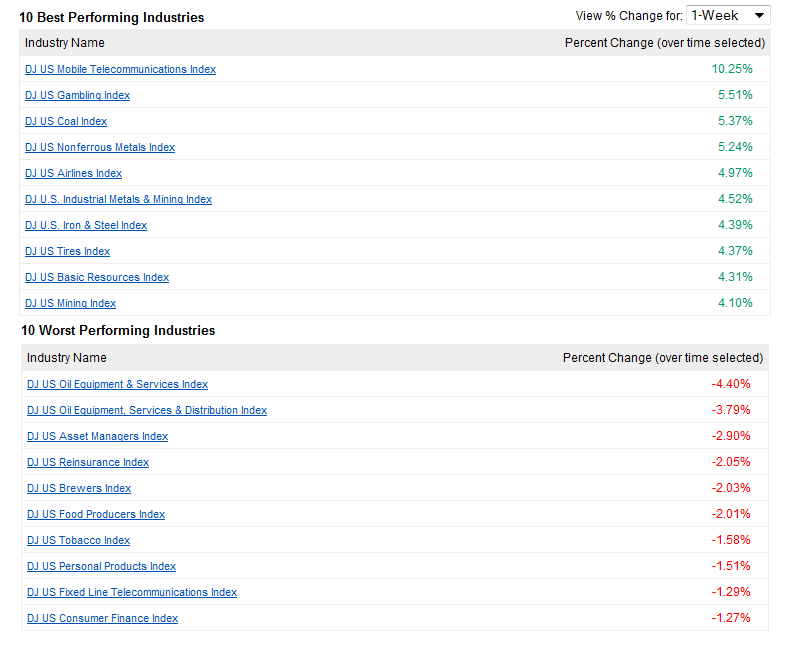
Last week was quite a rebound in the market with the broad market index advancing .52%.  There was a notable rebound in many of the sectors. Here are the top/bottom 10 industries for last week.  This information is available to non-subscribers at the WSJ Industry Page, which you can find here.


There is always a bull/bear market somewhere…just make sure that you are looking in the right places.
I've prepared for the the detail chart book which you can find here.  Because it is month end, I also included the monthly charts.  IN ADDITION, I created performance charts for all 24 Sectors! I think that you'll find them interesting because I started with March 1, 2009 through May 28.  I've also included bookmarks to make this report more navigable.
If you are not familiar with performance charts, they measure the price performance relative to a starting place. Here's an example of a performance chart for the Total Stock Market Index from 03/01/09 through 05/31/10:


Note the volume by price bars.  If we break down through the yellow area, I believe that we could quickly cut through the blue area where there is little "price memory" in the market.   The market did manage to gird it's loins and hurdle above its moving averages.  I use the 13 + 34 exponential moving averages combined with the 89 day simple moving average.  I have Osso to thank for the suggestion of taking the 89 day moving average from an exponential to a simple basis.

You’ll Turn Blue and Die | Gartman’s Trading Rules (by Leisa)

By -

This is a retread post from my blog. It was originally posted on March 8, 2008. As a follow on to my evangelizing the utility of a blog, I wanted to say that I was able to search for these rules and retrieve them instantly. I hope that you find these useful to your trading education.


My best girlfriend's in-laws
have a really neat cabin on the Potomac river. It is on a point on a
creek off the river, and just a beautiful, restful place. During our
first visit, my daughter was a toddler. There was water all around, and
as any of you know, despite one's best efforts, children do manage to
separate themselves from you. One only has to pick up the paper to see
the tragic consequences.

It's hard to explain drowning to a 
toddler. So I adopted a tactic that would make the results of her going
into the water abundantly clear. I took her to the water. I explained
that it was deep and that she could not swim. I then said, "If you get
in the water and sink; you will turn blue and die." I asked if she
understood that. Now, I did not tell her any of this to give her
permission to wander around with this graven image in her head while I
kicked back and had cocktails. Rather, I wanted her to understand the
consequence of venturing into the water without a parent.

With
respect to investing and trading, all of us read the admonitions of
experienced folks that give us a list of warnings. We all read them.
Some read them and think that they are immune to them. Dennis Gartman
has a widely published list of rules that I thought I would resurrect. I
picked these up from The Big Picture (Barry Ritholtz's blog) which he published from John
Mauldin's newsletter.

To keep within the theme of this post, I
would title these: Dennis Gartman's Rules of Trading: If you break
them, your portfolio will turn blue and die"

R U L E # 1
Never, ever, under any
circumstance, should one add to a losing position … not EVER!

Averaging down into a losing trade is the only thing that will
assuredly take you out of the investment business. This is what took
LTCM out. This is what took Barings Brothers out; this is what took
Sumitomo Copper out, and this is what takes most losing investors out.

R U L E # 2
Never, ever, under any
circumstance, should one add to a losing position … not EVER!

We trust our point is made. If "location, location, location" are
the first three rules of investing in real estate, then the first two
rules of trading equities, debt, commodities, currencies, and so on are
these: never add to a losing position.

R U L E # 3
Learn
to trade like a mercenary guerrilla.

The great Jesse
Livermore once said that it is not our duty to trade upon the bullish
side, nor the bearish side, but upon the winning side. This is
brilliance of the first order. We must indeed learn to fight/invest on
the winning side, and we must be willing to change sides immediately
when one side has gained the upper hand.

R U L E # 4 DON'T
HOLD ON TO LOSING POSITIONS
Capital is in two varieties: Mental
and Real, and, of the two, the mental capital is the most important.

Holding on to losing positions costs real capital as one's account
balance is depleted, but it can exhaust one's mental capital even more
seriously as one holds to the losing trade, becoming more and more
fearful with each passing minute, day and week, avoiding potentially
profitable trades while one nurtures the losing position.

R
U L E # 5
GO WHERE THE STRENGTH IS
The objective of
what we are after is not to buy low and to sell high, but to buy high
and to sell higher, or to sell short low and to buy lower.

We
can never know what price is really "low," nor what price is really
"high." We can, however, have a modest chance at knowing what the trend
is and acting on that trend. We can buy higher and we can sell higher
still if the trend is up. Conversely, we can sell short at low prices
and we can cover at lower prices if the trend is still down. However,
we've no idea how high high is, nor how low low is.

R U L
E # 6

Sell markets that show the greatest weakness; buy
markets that show the greatest strength.

Metaphorically,
when bearish we need to throw our rocks into the wettest paper sack for
it will break the most readily, while in bull markets we need to ride
the strongest wind for it shall carry us farther than others.

R
U L E # 7

In a Bull Market we can only be long or
neutral; in a bear market we can only be bearish or neutral.

In
a bull market we can be neutral, modestly long, or aggressively
long–getting into the last position after a protracted bull run into
which we've added to our winning position all along the way. Conversely,
in a bear market we can be neutral, modestly short, or aggressively
short, but never, ever can we–or should we–be the opposite way even so
slightly.

R U L E # 8
"Markets can
remain illogical far longer than you or I can remain solvent."

The University of Chicago "boys" have argued for decades that the
markets are rational, but we in the markets every day know otherwise. We
must learn to accept that irrationality, deal with it, and move on.

R U L E # 9
Trading runs in cycles; some
are good, some are bad, and there is nothing we can do about that other
than accept it and act accordingly.

Thus, when things are
going well, trade often, trade large, and try to maximize the good
fortune that is being bestowed upon you. However, when trading poorly,
trade infrequently, trade very small, and continue to get steadily
smaller until the winds have changed and the trading "gods" have chosen
to smile upon you once again.

R U L E # 10
To
trade/invest successfully, think like a fundamentalist; trade like a
technician.

It is obviously imperative that we understand
the economic fundamentals that will drive a market higher or lower, but
we must understand the technicals as well. When we do, then and only
then can we, or should we, trade.

R U L E # 11
Keep
your technical systems simple.

The greatest
traders/investors we've had the honor to know over the years continue to
employ the simplest trading schemes. They draw simple trend lines, they
see and act on simple technical signals, they react swiftly, and they
attribute it to their knowledge gained over the years that complexity is
the home of the young and untested.

R U L E # 12
In
trading/investing, an understanding of mass psychology is often more
important than an understanding of economics.

Markets are,
as we like to say, the sum total of the wisdom and stupidity of all who
trade in them, and they are collectively given over to the most basic
components of the collective psychology. The dot-com bubble was indeed a
bubble, but it grew from a small group to a larger group to the largest
group, collectively fed by mass mania, until it ended. The economists
among us missed the bull-run entirely, but that proves only that markets
can indeed remain irrational, and that economic fundamentals may
eventually hold the day but in the interim, psychology holds the moment.

And finally the most important rule of all:

R U L E
# 13

Do more of that which is working and do less of
that which is not.

This is a simple rule in writing; this
is a difficult rule to act upon. However, it synthesizes all the modest
wisdom we've accumulated over thirty years of watching and trading in
markets. Adding to a winning trade while cutting back on losing trades
is the one true rule that holds–and it holds in life as well as in trading/investing.


Dennis Gartman: This
is what I have learned about the world of investing over three decades.
I try each day to stand by my rules. I fail miserably at times, for I
break them often, and when I do I lose money and mental capital, until
such time as I return to my rules and try my very best to hold strongly
to them. The losses incurred are the inevitable tithe I must make to the
markets to atone for my trading sins. I accept them, and I move on, but
only after vowing that "I'll never do that again."

Finding Your Inner Blogger (by Leisa)

By -

Most people think of blogging as very public affair. They would no more write a public blog than they would run naked through a crowded square. I'm writing today to encourage you to create a your own private blog. If you first shuddered upon reading that, I want you to re-read it. "Private" is the operative word. You can easily set up a blog on Blogger (and I presume other venues, but my experience is with Blogger) in such a way that it is private only to you.

However, if you have Unibomber or Ted Bundy tendencies, then I would suggest to you that a private blog on the internet would not be a wise choice. Rather, I'm writing this post today for those of you who have slapped your head or kicked yourself in the tush because you had a market/trade idea that you let get away from you. Accordingly, I'm putting on my evangelical blogging hat, and I'm knocking at your door–politely and with respect–to evangelize the importance of writing.

One of my favorite authors is Jose Ortega y Gasset. I found this quote which resonated deeply with me, and I wanted to share with you:

"The so-called spirit is an all too ethereal agent, permanently in danger of being lost in the labyrinth of its own infinite possibilities. Thinking is too easy. The mind in its flight rarely meets with resistance. Hence the vital importance for the intellectual of touching concrete objects and of learning discipline in his intercourse with them. . . Without the check of visible and palpable things, the spirit in its high-flown arrogance would be sheer madness. The body is the tutor and the policeman of the spirit."


Jose Ortega y Gasset, Man the Technician (essay)

". . .the vital importance for the intellectual of touching concrete objects and of learning discipline in his intercourse with them"   Is not writing the concretization of thought?  If you find writing agonizing, it is with good reason.  Writing is what ensnares your mind's flights of fancy and imposes order.  Writing forces you to wrestle your ideas to the ground so that they become accessible, practicable and, most importantly, executable.

Your writing is the score of your mind's symphony of ideas.  When it written, it is memorialized and accessible to you for further tweaking.  The process is not meant to be easy.  The process is meant to be discomfiting enough because it forces you to make your thinking productive and actionable.  No longer are your thoughts an ethereal agent.  I would re-write (with great reverence to satisfy my own selfish purposes here), JOyG's last phrase.


(image above courtesy of Marlen Pens)

I will concede that some of you are tapping your toe and saying "No way!".  You are a minimalist!  You care only about your charts!  Like all over- zealous door-knockers, I have an answer to that objection.  A blog will help you post your charts and document your thinking.  You can use labels that will allow you to post just your trade journal.  You can upload your annotated charts, state your trade criteria and—most importantly–detail your post mortem.

Perhaps your trade is so splendiferous that you want to memorialize it in its own special category.  Add a tag!  By simply clicking on your labels you can easily find all of your splendiferous trades.  For a trade that went woefully awry, memorialize that one too with its own tag. 
The bog serves as an image posting service too.  Rather than posting random images, why not have your images inserted into a blog page (with your notes).  You can share the image easily by clicking on it and posting the http address–you can share the image without sharing your post.  How useful is that?!!


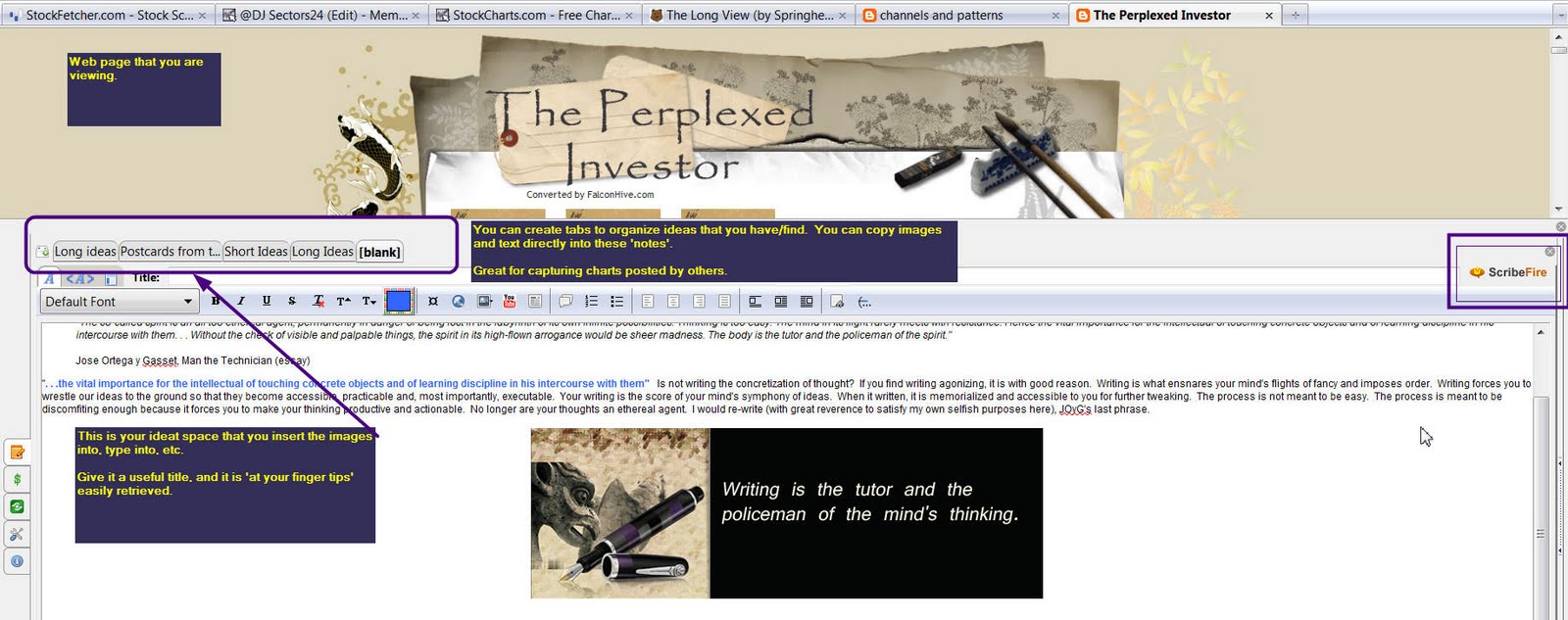
There is one more tool that I want to share with you.  It is ScribeFire (an extension for Firefox and now Google Chrome).  What I like about Scribefire (click on graphic to left to be transported) for Firefox is that it can be used as a split screen.  This split screen allows you to seamlessly add stuff to it that you find on the internet that is interesting to you.  it is easier than bookmarking 'stuff."   Here's a picture


Snap27


Still not convinced? I will head out your door after leaving you with this one last thought.  If you missed my post on Finding your Inner Genius (Slope of Hope post), I hope that you will take time to read it.  One of the characteristics of the great geniuses is their collective obsession with keeping a notebook with them at all times.

I promise you this:  Many of the great ideas that you have come to you will be lost to the ether IF YOU DON'T WRITE IT DOWN.  The insight part of your brain works when you are not forcing it to work.  Your having pen/paper or some other means of capturing the product of that insight will enable you to integrate into those moments when your brain is in forced labor mode.


Not only must you write stuff down, you will need to revisit your stuff…and revise, refine and revel in your own genius.  You will write stuff so sublime you will hardly recognize it as your own work.  You will also write stuff that will make you wonder how you could have been so stupid.  With your private blog, your private stupidity is yours and yours alone–so there is no risk!

PikeRiver

Imagine your brain's thinking as a river. Your ideas a collection of silt and gems. Your writing is your tool for prospecting that great river.  Those jewels you can bring forth to the world to share–or just make them available to your conscious mind.

I will let myself out!  Thanks for letting me evangelize a bit.

Weekly Sector Report | 05/21/10 (by Leisa)

By -

24_snap

An unusual week where all 24 sectors were negative AND, notably, in the larger list of 147 sectors, there were no positive sectors. An unusual and brutal week if you were long. If you were short, then it was manna from heaven.
You may download the full report here.

I also wanted to point out the sectors that have had a subsequent violation of the February low.

Health Care               
Oil & Gas 
Telecommunications      
Utilities

NYSE Composite: Historical View (by Leisa)

By -

Below is a chart of the of the NYSE Composite over a 20 year period. The chart type is Renko, and I've include the volume by price bars. I find Renko charts useful in looking at longer periods of time, as I believe such charts confer perspective.

As you can see, we are approaching a long price bar indicative of a consolidation  of transactions in this area for this time period.  

   
Nya_0521


Some of you may not be familiar with the NYSE Composite Index.  Here is an explanation.

Index Description
The NYSE Composite Index is designed to measure the performance of all common stocks listed on the NYSE, including ADRs, REITs and tracking stocks. In January 2003 the NYSE reintroduced the NYSE Composite Index under a new methodology that is fully transparent and rule-based. Under the new methodology, all closed-end funds, ETFs, limited partnerships and derivatives are excluded from the index. As of year-end 2004, the NYSE Composite consists of over 2,000 U.S. and non-U.S. stocks. It is a measure of the changes in aggregate market value of all NYSE-listed common stocks, adjusted to eliminate the effects of capitalization changes, new listings and delistings. The index is weighted using free-float market capitalization and calculated on both price and total return basis.

Here's the same chart using the $COMPQ 

Compq

What is actionable from these charts?  I see not action from these charts, but rather, understanding.  These price and volume profiles, to my mind anyway, suggest important inflection points that may not be readily discernible from traditionally derived pivot points constructed on shorter term data.  If anything these views are a larger terrain map.

Below is a chart (09/06/09) that I presented in the comments section here and on my blog.  This chart kept me from getting short when many were vociferously calling for THE top in the bear market rally.  This chart was met dismissively by some who had other, supposedly superior methods of analyzing the market.  I don't have fancy charts nor fancy methods. I hope I never do.   But I do know the power of price vacuums in the fossil record of charts, and I do understand the powerful motivation of under performing money managers–it is a brand of fear that moves markets upwards.  I credit Rev Shark (James DePorre) with cultivating that understanding of that uniquely powerful fear and its robust effect on market movements.

$NYA_090609

As I present this chart, I acknowledge that I could have easily been wrong. So don't believe for a minute that I'm crowing or ascribing that this chart has any prescience beyond the two weights of evidence (vacuum/fear) that I believed improved the probabilities of upward price movement back in September 2009.  The current dynamic, both in price and emotion is likely the obverse of September 2009, though it is likely that the market will come to that realization violently.

There is no exclusivity in gaining entrance to Club Wrong–just make sure that your ticket fee is not exorbitant.