
Slope of Hope Blog Posts

Slope initially began as a blog, so this is where most of the website’s content resides. Here we have tens of thousands of posts dating back over a decade. These are listed in reverse chronological order. Click on any category icon below to see posts tagged with that particular subject, or click on a word in the category cloud on the right side of the screen for more specific choices.

Pullback Monday (by Springheel Jack)

By -

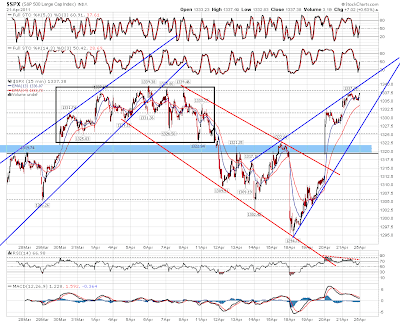
It used to be that you could count on Monday to be a bullish day. No longer, as seven out of the last nine, and all of the last four Mondays have closed down on SPX. There's a good chance that today will be the same as SPX and NDX look overextended short term. Here the picture on the SPX 15min where some retracement looks likely, though it might be limited by the support trendline:

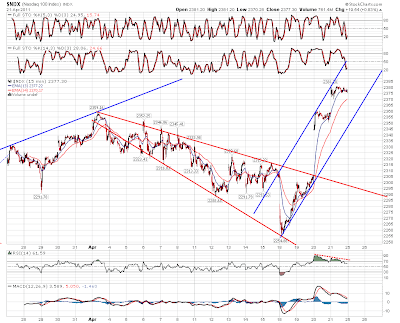
NDX is in a sort of channel, though with the two big gaps it's a strange looking chart:

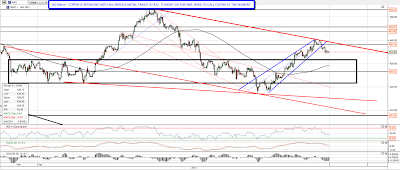
Copper's made a short term high on the 60min chart and is retracing. The obvious first target is at 432 though it might well go further. Copper's hard to call at the moment and I'm going to run some fib calculations today to see if copper might be in a bullish gartley pattern. if so we'll see more downside here:

Some mixed looking charts this morning. Vix has decisively broken support at 15 on the daily chart, and I'm expecting it to drop quite a bit further. That wouldn't necessarily mean that equities rise a lot, though it's bullish for sure:

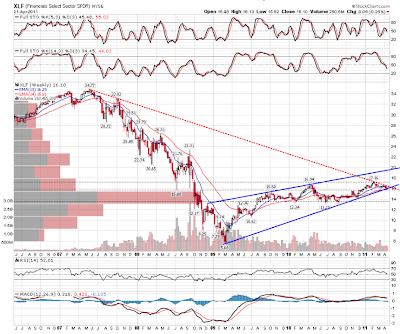
XLF is still stalled under declining resistance on the daily chart. If that were to break up it would look very bullish, but for the moment XLF is sitting on support:

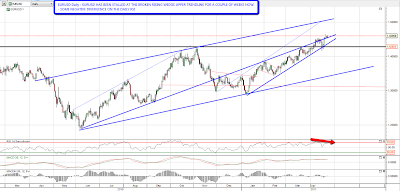
EURUSD is still hugging the broken rising wedge upper trendline as support. Some negative divergence is developing on RSI and if EURUSD can't break up soon that will start to look increasingly bearish:

The star of the show today is silver however, which took out the 1980 high at 49.45 overnight. Silver's now up almost 150% since it broke the 2008 highs in September and I'm sure everyone's wondering whether this is a blow-off top. If they aren't then they should be:

I'm leaning short on equities today. The stats are good for a gapfill on a gap up, Monday's have been bearish lately and ES looks as though it should retest broken resistance at 1319. We'll see.

Optimal Puts vs. Index ETFs for Hedging

By -

Hey Fellow Slopers,

This another post that might be a little basic for some of you, but a question came up recently about the differences between hedging with inverse ETFs and optimal puts, and since I know there are some self-described beginners among Slope lurkers, I thought it would be worth an elaboration here.

Inverse ETFs can be useful tools in hedging against market, sector, or industry risk, but there are a few reasons why investors may want to consider using optimal puts to provide downside protection for their portfolios (a quick reminder: optimal puts are the ones which will give you the exact level of protection you want at the lowest possible cost):

  • Ability to hedge against idiosyncratic (or, stock-specific) risk. Say you own a particular stock and you are unwilling or unable to sell some of your stake in it to reduce your downside risk. If the stock has options traded on it, you may be able to use optimal puts to hedge against a decline due to an event specific to that stock. Inverse ETFs can be used to offset market risk or industry risk, but not stock-specific risk. For example, if you owned Toreador Resources Corp. (TRGL — a stock we mentioned in a post here last month,"Market Neutral: Short TRGL, Long IMO") at the beginning of the year, owning optimal puts on it could have limited your downside as TRGL declined since then, but owning shares of the ProShares Short Oil & Gas ETF (DDG) wouldn't have, as that inverse ETF has declined year-to-date as well, as the chart below shows.  TRGL
  • Precision. Say you own 824 shares of Exxon Mobil, and you'd like to know how to hedge that position against a greater-than-17% loss. Using Portfolio Armor (available as a web app and as an Apple iOS app), you could simply enter "XOM" in the symbol field, "824" in the number of shares field, and "17%" in the threshold field, and then Portfolio Armor would use its algorithm to scan for the optimal puts to give you that level of protection at the lowest cost.1
  • Ability to cap cost at the outset. It's not always clear how investors who use inverse ETFs decide how much of their portfolios to allocate to them — I've asked Inverse ETF investors about this in the past, and in response have been told they "feel comfortable with" some small percentage. To use a round number here, let's say an investor decided to allocate 10% of his portfolio to an unleveraged, inverse index ETF, such as ProShares Short S&P 500 (SH), to provide him some downside protection against a market correction. What if the S&P 500 went on to stage a rally instead — what if it went up another 25% over the next several months? In that case, the investor's portfolio might be 2.5% lower than it would have been had he not purchased that downside protection. What if, instead, the investor bought the optimal puts to hedge against a greater-than-20% decline in the ETF that tracks the S&P 500, the SPDR S&P 500 (SPY)? As of Wednesday's close, the cost of those optimal puts was 0.86%; if the investor bought enough of those optimal puts to hedge his whole portfolio, their drag on his performance in the event of a 25% market rally would be capped at 0.86%.2

It's worth noting that, in that last case, part of the reason the optimal puts on SPY are so cheap is that volatility is still relatively low. The VIX volatility index closed Wednesday at 15.07, close to its 52-week low of 14.30 (its 52-week high was 48.2). Volatility can spike quite quickly though, so if you are considering hedging, you may want to consider doing so while volatility remains relatively low.

Disclosure: I am short TRGL.

1In that case, Portfolio Armor would round down the number of shares you entered to the nearest hundred (since one put option contract represents the right to sell one hundred shares of the underlying security), and then present you with eight of the put option contracts that would slightly over-hedge the 800 shares they cover, so that the total value of your 824 shares would be protected against a greater-than-17% loss.

2For the sake of simplicity there, I ignored the transaction fees of purchasing the ETF and the options, and I ignored the management fee of the ETF.

Wild Reversal (by Springheel Jack)

By -

What a wild week. The bearish push down on Monday accompanied by a series of bearish trendline breaks has been followed by an even stronger push up, and as I write ES has peaked almost ten points above the 1319 level that held as resistance on Friday. The short side isn't quite dead in the water yet, but they're in serious trouble, and ES is now close to a new high that should signal that we are in a new wave up. On NQ resistance on the possible diamond top is now being tested and if NQ can retake 2350 and stay above it then I'd be inclined to write this pattern off:

On ES the only remaining H&S pattern in play is the continuation IHS that will indicate to the 1446 area if ES can make a new high. A couple of points worth noting as well on this chart are the broadening formation that has broken up with a target at 1348, though this isn't a pattern with a strong track record, and the resistance level and trendline at 1329, which is where ES is stalling at the time of writing. We could see a reversal from this level this morning, as the ES 60min RSI is very overbought:

Copper has also reversed back up, though not as strongly, and I'm looking for a short term high in the 431.5 area, which is also a potential IHS neckline. A rising wedge has formed from Monday's low which supports a retracement here and the obvious target for that retracement would be the 423.5 area. A break back below 420 would look bearish and would kill off the potential IHS, though I'd be watching for a double bottom with positive divergence there:

EURUSD gapped below the rising wedge trendline and then gapped back above it leaving a little island bottom on the trading hours daily chart (XEU). EURUSD is now back at 1.45 resistance and has made a marginal new high, which is very bullish. AUDUSD is also breaking up, so the outlook for USD is deteriorating very fast:

TLT consolidated above broken declining resistance yesterday, and the obvious next resistance level is 93.7. If we are seeing a major break up on equities however, then bonds are likely to struggle at best and I'd expect TLT to reverse back down. Bonds are strongly inversely correlated with equities, so I'm treating this break up with extreme caution until we see where equities are going:

I was looking through some precious metals charts yesterday, just to see how the other precious metals were doing. Platinum was interesting, as it hasn't participated in the latest stage of the PMs rally so far, though it rose very strongly from the late 2008 lows into early 2010, and is still up a lot more than gold over the same period. It looks rangebound at the moment on the weekly chart:

The really interesting chart was the weekly chart for palladium though, which has even outperformed silver from the late 2008 lows. The chart looks particularly appealing as there is a tight rising channel and a very obvious target in the 925 area. Of all the PM charts palladium looks the most compelling long at this level:

Overall on equities this reversal looks very bullish, but they're short term overbought and at serious resistance, so I'm expecting some retracement from here today. A gap fill looks very ambitious and I'd be surprised to see that. The obvious target for a retracement on ES within this bullish context would be broken resistance in the 1319 area.

Hedging Update

By -

Hey Fellow Slopers,

In the table below, I've updated the costs (as of Thursday's close) of hedging the Dow-, NASDAQ 100-, and S&P 500-tracking ETFs against greater-than-20% declines over the next several months, using the optimal puts, along with the costs of similarly hedging a handful of their most widely-traded components. In addition, this week I added five precious metals ETFs to the table. First, a reminder about why I've used 20% as a decline threshold, and what I mean by "optimal puts".

As I mentioned last time, the threshold I usually use when I hedge is 20% (i.e., I want protection against any decline worse than that). The idea for a 20% threshold came from a comment fund manager (and Stanford finance Ph.D.) John Hussman made in October 2008:

An intolerable loss, in my view, is one that requires a heroic recovery simply to break even… a short-term loss of 20%, particularly after the market has become severely depressed, should not be at all intolerable to long-term investors because such losses are generally reversed in the first few months of an advance (or even a powerful bear market rally).

"Optimal puts" are the ones that will give you the level of protection you want at the lowest possible cost. With Portfolio Armor (available as a web app, and an iOS app) you just enter the symbol of the stock or ETF you’re looking to hedge, the number of shares you own, and the maximum decline you’re willing to risk, (your threshold). Then the app uses an algorithm developed by a finance Ph.D. candidate to sort through and analyze all of the available puts for your position, scanning for the optimal ones.

What jumped out at me in putting together this table was the cost of hedging GLD against a greater-than-20% decline over the next several months: 0.31%. With the cost of downside protection this low, if you're long GLD, you might want to consider hedging it here, even if you're bullish on it in the mid- to long-term.

Symbol

Name

Cost of Protection (as % of Position value)

Widely-Traded Stocks

INTC

Intel

3.06%**

CSCO

Cisco Systems

3.09%**

MSFT

Microsoft

2.%**

ORCL

Oracle

2.07%*

BAC

Bank of America

6.02%***

F

Ford

4.32%*

GE

GE

2.35%*

PFE

Pfizer

1.51%*

WFC

Wells Fargo

4.71%**

T

AT&T

1.55%**

AA

Alcoa

3.57% **

Major Index ETFs

QQQ

PowerShares QQQ Trust

1.48%*

SPY

SPDR S&P 500

1.04%*

DIA

SPDR Dow Jones Industrial Average

0.82%*

Precious Metals ETFs

GLD

SPDR Gold Trust

0.31%*

SLV

iShares Silver Trust

4.48%**

DBP

PowerShares DB Precious Metals

1.4%**

SGOL

ETFS Physical Swiss Gold Shares

1.09%*

SIVR

ETFS Physical Silver Shares

3.82%*

*Based on optimal puts expiring in September, 2011

**Based on optimal puts expiring in October, 2011

***Based on optimal puts expiring in November, 2011

Disclosure: I'm holding some puts on DIA.

Key Level on Australian Dollar (by Springheel Jack)

By -

Another day of sideways chop yesterday, and SPX has built up a worrying series of topping candles. These don't always signal a trend change, but they do that much of the time, and that is a real concern here until overhead resistance is broken. Here it is on the SPX daily chart:

To add to the worrying technical picture, the Russell 2000 broke down from the recent rising channel yesterday, and that is a warning signal to consider seriously:

On the bull side NDX bottomed yesterday at one of my support trendlines and it might well hold there

I have mixed feelings about equities here and there is a real risk that we are seeing a double top on SPX if it can't break up from here soon. Copper has broken up very convincingly but if SPX just chops sideways until copper reaches the potential IHS neckline at 4.55 that would be a warning signal. As it is copper is still some way short of there, though it has broken 4.45 with confidence and looks likely to reach 4.55 next. I won't post the copper chart today as I already have seven other charts I'd like to post, and yesterday's chart still covers it well, but if HG/copper should retrace to 446, that should be a nice long entry level with a target at 4.55.

The US dollar had another bad night, and is now below 75.5. EURUSD has now reached the upper wedge trendline in the 1.44 area and we might see a reversal here:

The really interesting forex chart today though is AUDUSD, where AUD is hitting a four year rising wedge upper trendline intersecting with another 18 year support / resistance trendline. If we are going to see a reversal on AUDUSD anytime soon, this is the place. Here's the setup on the weekly chart:

I was looking at 30yr treasury yields this morning for a directional clue on equities. That tends to trend up or down with equities, but sometimes weakens ahead of them. I'm not seeing any reason to think these are about to reverse seriously, though they're obviously overbought on the 60min RSI:

The last chart of the day is the very interesting chart for the Nikkei. I had a look at that yesterday after a talking head on Bloomberg suggested that Nikkei might be a long term buying opportunity. Looking at the chart, I'm inclined to agree, as the Nikkei has recovered and retested the broken rising channel lower trendline. As long as that trendline holds the Nikkei's looking pretty solid. :

I don't expect a serious equities reversal here, and I'm not really expecting to see one. There are some worrying signs of weakness though, and until ES and NQ break up through 1338 and 2350 respectively, there's definitely some reason for short term caution on equities.