
Slope of Hope Blog Posts

Slope initially began as a blog, so this is where most of the website’s content resides. Here we have tens of thousands of posts dating back over a decade. These are listed in reverse chronological order. Click on any category icon below to see posts tagged with that particular subject, or click on a word in the category cloud on the right side of the screen for more specific choices.

Hedging Update (by Dave Pinsen)

By -

The VIX spiked 18.45% Wednesday, raising hedging costs in many cases. In the table below, I've updated the costs (as of Wednesday's close) of hedging three major index-tracking ETFs against greater-than-20% declines over the several months, using the optimal puts, along with the costs of similarly hedging a handful of their most widely-traded components, and several other ETFs.

Two new ETF additions this week

This week, I added the Financial Select Sector SPDR (XLF), and iShares MSCI Emerging Markets (EEM). First, a reminder about why I've used 20% as a decline threshold, and what "optimal puts" means in this context.

Decline thresholds

As I've mentioned before the threshold I usually use when I hedge is 20% (i.e., I want protection against any decline worse than that). The idea for a 20% threshold came from a comment fund manager (and Stanford finance Ph.D.) John Hussman made in October 2008:

An intolerable loss, in my view, is one that requires a heroic recovery simply to break even… a short-term loss of 20%, particularly after the market has become severely depressed, should not be at all intolerable to long-term investors because such losses are generally reversed in the first few months of an advance (or even a powerful bear market rally).

Optimal puts

Optimal puts are the ones that will give you the level of protection you want at the lowest possible cost. With Portfolio Armor (available as a web app, and an iOS app) you just enter the symbol of the stock or ETF you’re looking to hedge, the number of shares you own, and the maximum decline you’re willing to risk, (your threshold). Then the app uses an algorithm developed by a finance Ph.D. candidate to sort through and analyze all of the available puts for your position, scanning for the optimal ones.

A note about costs

To be conservative, Portfolio Armor calculates hedging costs using the ask price of the optimal puts. In many cases, you may be able to buy the puts for a lower cost (between the bid and the ask prices).

Costs (as of Wednesday's close) of hedging against >20% declines

Symbol

Name

Cost of Protection (as % of Position value)

Widely-Traded Stocks

INTC

Intel

3.37%***

CSCO

Cisco Systems

3.30%***

MSFT

Microsoft

3.07%***

LVLT

Level 3 Communications, Inc.

11.4%**

BAC

Bank of America

5.25%***

F

Ford

3.30%**

GE

GE

2.51%**

PFE

Pfizer

2.42%**

SIRI

Sirius XM Radio

No optimal puts: cost exceeds threshold

S

Sprint Nextel

14.9%***

Major Index ETFs

QQQ

PowerShares QQQ Trust

1.48%**

SPY

SPDR S&P 500

1.29%**

DIA

SPDR Dow Jones Industrial Average

1.13%**

Precious Metals ETFs

GLD

SPDR Gold Trust

0.49%**

SLV

iShares Silver Trust

8.35%***

SGOL

ETFS Physical Swiss Gold Shares

2.49%**

SIVR

ETFS Physical Silver Shares

7.27%**

Internet ETF
HHH Merrill Lynch Internet HOLDRs 2.56%*
Other Sector ETFs
XLF Financial Select Sector SPDR 2.53%**
EEM iShares MSCI Emerging Markets 2.86%**

*Based on optimal puts expiring in November, 2011

**Based on optimal puts expiring in December, 2011

***Based on optimal puts expiring in January, 2012

Thank you

The Portfolio Armor iOS app cracked into the top-20 finance iOS apps this week:

App Shopper

Thanks to those of you woul downloaded it.

Bearish Monday (by Springheel Jack)

By -

For a long time Mondays were reliably bullish on SPX. No longer as SPX has closed down for the last six Mondays running, and eight of the last nine Mondays. Hard to say how this one will go, as EURUSD is bouncing after a very steep decline and both copper and silver have made nice intermediate lows with positive RSI divergence on the hourly chart. What is clear looking through various indices this morning though is that Dow, Transports and SPX have not made the obvious downside support trendlines. Here's the 60min SPX chart showing the downside target which is now in the 1323-5 area:

Nasdaq is harder to call, as there are two gap zones on the 60min chart and the upper one has been acting as good support. That may well hold even if the other indices dip a bit further to make their targets:

Looking at the Vix chart which has pinocchioed above the daily bollinger bands on each of the last two days, and then closed back within it, we have reached a significant resistance level which might deliver a bounce on equities. That's easiest to see on the 30min chart:

Notwithstanding any bounce this week though, I'm very doubtful that we've seen a major low on commodities, so I'm expecting this bounce to be a good time to pick short entries for the next move down. I don't have a good read on silver directly, but the position looks pretty clear on the gold daily chart, where there's a broadening ascending wedge extending back to the beginning of 2009. The support trendline is very strong with six touches and the downside target there would be in the 1350 area. As it happens however, there is an excellent alternative non-trendline target that must be considered, and that is support at the daily 150 SMA, which has also held six times since May 2009, and might hold again. The daily 150 SMA target would be in the 1400-1410 area. If the 150 SMA is broken, the wedge trendline should hold as support:

The move up in silver was so violent that all trendlines were broken, but the recent low almost reached the broken resistance trendline on the monthly chart that held from 2004 through to the end of 2010. That could hold as support, but if gold breaks the daily 150 SMA then it would be hard to see silver not retracing to the 30 area or below, with the obvious support then being at 28:

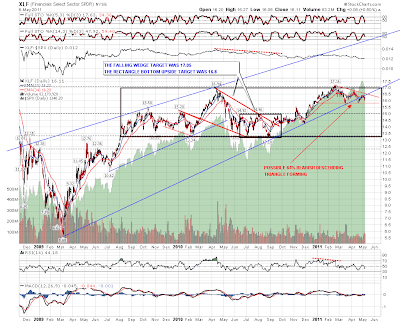
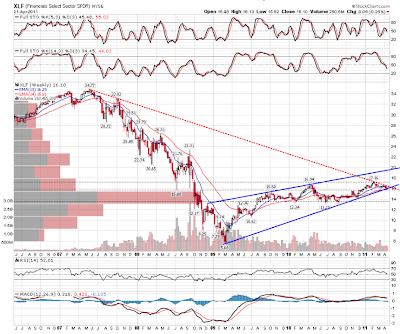
I thought I'd have a look at XLF today, as that is at an interesting stage. On the weekly chart declining resistance from the bubble high in 2007 is still holding:

There isn't much in the way of strong trendlines on the XLF daily chart, but it's interesting that XLF peaked just above the target for the falling wedge in 2010, and there is clearly a strong resistance zone in the 17.0 – 17.2 area, and even stronger support in the 13.2 – 13.4 area. Overall XLF might well be in a bullish rectangle that has formed since August 2009, and if so I'd expect to see XLF break down towards rectangle support soon. A possible 64% bearish descending triangle is also forming, but we'd need to see another hit of declining resistance to strengthen the pattern:

Overall I think the odds favor a gap fill and consolidation today. Most of those down Mondays recently haven't been down much. If SPX can hit the support trendline in the 1323-5 area then we should see a strong bounce from there:

Chartwork on BAC (Mike Paulenoff)

By -

My near-term and 6-month pattern and momentum work on Bank of America (BAC) indicate that the price structure has some unfinished business on the downside prior to embarking on a sustainable rally period.

The very negative juxtaposition of the 21, 55, and 200 DMA's is creating significant downward price pressure, which, when coupled with the pattern that BAC has carved out off of its January recovery high at 15.31, projects lower prices into the 11.85/50 area next.

Such as decline will represent a retest of the Nov-Dec 2010 lows in and around 11.00. It will be during a retest that I will be watching closely for a significant upside reversal technical signal that BAC has finished its post-Jan 2011 correction. This should take the form of a multi-month, double-bottom base pattern that will have the potential to propel BAC to 15.00/30 and then 17.00-18.00 thereafter.

Only a sustained climb above 12.85 will begin to neutralize the current negative technical set-up, while a climb above 14.15 is needed to trigger initial upside reversal signals.

2ZsAvj8Sz
Originally published on MPTrader.com.

Pullback Monday (by Springheel Jack)

By -

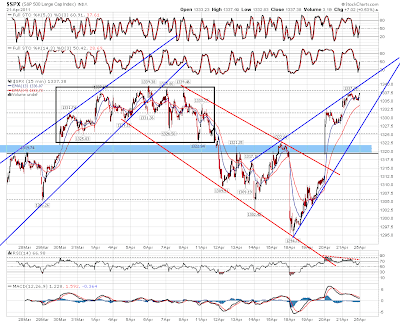
It used to be that you could count on Monday to be a bullish day. No longer, as seven out of the last nine, and all of the last four Mondays have closed down on SPX. There's a good chance that today will be the same as SPX and NDX look overextended short term. Here the picture on the SPX 15min where some retracement looks likely, though it might be limited by the support trendline:

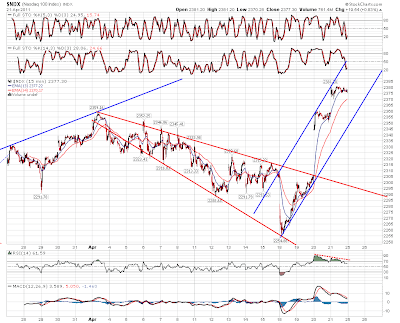
NDX is in a sort of channel, though with the two big gaps it's a strange looking chart:

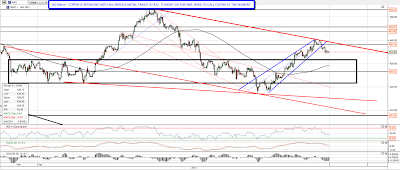
Copper's made a short term high on the 60min chart and is retracing. The obvious first target is at 432 though it might well go further. Copper's hard to call at the moment and I'm going to run some fib calculations today to see if copper might be in a bullish gartley pattern. if so we'll see more downside here:

Some mixed looking charts this morning. Vix has decisively broken support at 15 on the daily chart, and I'm expecting it to drop quite a bit further. That wouldn't necessarily mean that equities rise a lot, though it's bullish for sure:

XLF is still stalled under declining resistance on the daily chart. If that were to break up it would look very bullish, but for the moment XLF is sitting on support:

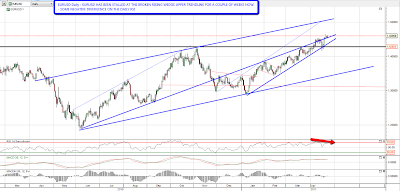
EURUSD is still hugging the broken rising wedge upper trendline as support. Some negative divergence is developing on RSI and if EURUSD can't break up soon that will start to look increasingly bearish:

The star of the show today is silver however, which took out the 1980 high at 49.45 overnight. Silver's now up almost 150% since it broke the 2008 highs in September and I'm sure everyone's wondering whether this is a blow-off top. If they aren't then they should be:

I'm leaning short on equities today. The stats are good for a gapfill on a gap up, Monday's have been bearish lately and ES looks as though it should retest broken resistance at 1319. We'll see.