
Slope of Hope Blog Posts

Slope initially began as a blog, so this is where most of the website’s content resides. Here we have tens of thousands of posts dating back over a decade. These are listed in reverse chronological order. Click on any category icon below to see posts tagged with that particular subject, or click on a word in the category cloud on the right side of the screen for more specific choices.

Lost Opportunity Cost (by David Kern)

By -

I received an interesting piece of mail this week.  If you invest/trade the markets long enough, you’ll get these sort of mailings fairly regularly.

It was an invitation to participate in a class action lawsuit over something Apple did between 2001 and 2005.  I don’t really know or care what they were sued over, but Apple settled – and the cash is now available to be claimed.  Essentially, if you bought shares of Apple during that time you might be entitled to some portion of a settlement.  I did a search of my trading records, and sure enough – there it was.  I’d bought AAPL on 11 Oct 2005 and sold on 18 Oct 2005: a quick 4% gain.  However, as I reviewed more of the legal mumbo-jumbo, it became clear that my take on the lawsuit settlement would amount to $0.07 (estimated) per share.  Bottom line – not worth my time to even fill out the class action paperwork.  The 4% I made on the trade four years ago far exceeded any reimbursement that I would receive from this settlement.

The interesting thing was realizing that the price I paid for AAPL at that time was $50.59 per share.  Wow, wouldn’t it be nice to have kept those shares?  My unrealized gain today would be 646%!  That’s not really” go-crazy-retire-to-Fiji money”, but it’s well over 100% gain annualized…  Why did I sell at that time?  Probably a stop, could have been an itchy trigger finger with a desire to book gains – really I don’t remember.  When I look at the chart from 2005, it’s really a facepalm moment.

This has been an introspective moment over the weekend, as it’s caused me to question some of my approach to trading the markets.  I assess that I do above average at picking what to buy, and I’m usually pretty good on when to buy also – but my timing on when to sell has had some sucktastic moments.  I’ve experimented with putting trailing stops on everything – only to be whipsawed out of stocks that continued up-up-and-away.  I’ve bought uptrending stocks that then paused and/or retraced just after I buy  – so I sold (locking in a loss) only to find them explode upward the next week.  I’m starting to think that I need to slow down my timeline a little; step back from every wiggle of the chart and let my trading positions work for me.

I’ve believed for a long time that “buy and hold” is a steaming load of crap.  There are a plethora of market indicators that clearly show market trend, and it’s foolish to go long in a bear market or short in a bull market.  My favorite indicators for trend are the market breadth and bullish percents (which as of this writing still show a bull market).  These work well and consistently.  My issue seems to be finding my rhythm for when to take profits or cut losses, and I’m open to ideas on how to improve my game.  I don’t care to hear the Warren Buffet answer (who has said his time horizon is to never sell), but I feel there’s gotta be a better system for when to sell.

By the way – going back to the question of buy and hold AAPL from Oct 2005 – I don’t think that would have been a good idea at all.  There were a couple of clearly defined downtrends the first half of 2006 and most of 2008.  I think any reasonable trader wouldn’t sit on his hands through that bleeding.  Certainly I couldn’t have, considering the market breadth and bullish percents clearly showed defensive situations during that timeframe.  What do you think?

Weekly Sector Report | 01/21/11 (by Leisa)

By -

The week saw the broad market index decline 1.05%. Only two sectors, media (+1.3%) and utilities (+.42%), were positive. Here is the weekly profile on the sectors (click all images for enhanced viewing):

For the subsectors, here is a graphic of the top/bottom performers.  GE led the Diversified Industrials with a 4.9% change for the week:

This week short interest changes were reported. Familiar sectors are still on the top 10 list.  I am also including for you the top absolute % changes in short interest so that you can see where the bears are increasing their holdings.

As is usual, I have prepared for you a chart book.  I have a lagniappe for you!  I included chart thumbnails for the 148 subsectors as well as the 24 sectors (in addition to the detailed weekly/daily charts).  Sometimes the bird's eye view helps build perspective.  You can find the chart book here.

And finally, I will close with the chart of the total stock market index–both daily and weekly. First the daily, then the weekly. 

The weekly chart (2nd chart) shows no damage to the trend lines, and the daily chart is showing some bumping against its trend lines.  (Note that a 13 EMA on a weekly chart is a 13 week EMA, while on a daily chart it is a 13 day EMA). I hope you find this information and the weekly chart book download helpful to your due diligence efforts.

(Source:  http://theperplexedinvestor.blogspot.com/)

Undecided (by Springheel Jack)

By -

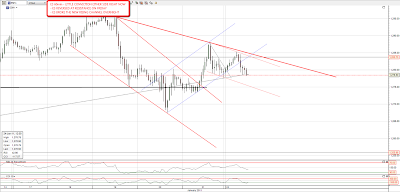
There are some days when the market direction stands out strongly, and others when it really doesn't. So far this is one of the latter kind, with equities dithering between support and resistance without any conviction so far. On ES declining resistance is at 1285-6, and a break up through there would look very bullish, and there are support levels just below at 1278, 1274 and the 20 day SMA at 1272. A break of 1272 would look very bearish and would suggest a hit of the daily rising wedge support at 1262 ES:

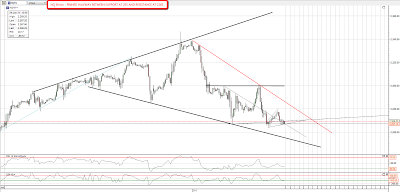
NQ looks equally uninspiring, seemingly pinned halfway between declining resistance at 2285 and broadening top support at 1255:

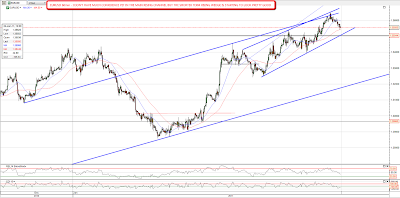
There's a mixed picture elsewhere. EURUSD is still looking stronger than I expected, but recent action has formed a promising rising wedge:

Oil looks bullish with a hit of strong support but will turn bearish on an hourly close below 88.3:

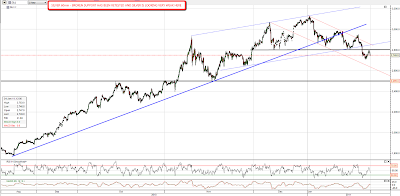
Silver looks bearish with a test of broken support overnight and failure there:

The real question today is whether we have topped or are topping? That could still go either way. A break of declining resistance on ES and NQ would open the way to a new high or double-top, and a break below support on NQ would be a very strong signal that we have already topped.

BAC Earnings vs. Balance Sheet Risk (by Runedge)

By -

I spent the weekend going back to Q1 2007 through the most current quarter and pulled financial data from BAC financial statements (yeah, I know, I need a life).  What I want to understand is very simple. Does BAC have the earning potential to absorb a further drop in home prices.  

I'm sharing this data as part of a group think exercise and asking for any feedback that can help all of us. Before I show the two simple charts, let me shed some light on the terminology for those who actually did something more social this weekend versus study bank financials.

Total Net Revenue is broken into two groups: 

1 – Net Interest Income (interest income minus interest expense)

2 – Non Interest Income

Combing the two gives you total revenue.   That revenue then needs to cover three main expenses:

1 - Non Interest Expense (staff, legal, pretty much all operating expenses)

2 - Provisions for credit losses

3 – Income to shareholders.

The first chart I show is Total Net Revenue minus Non Interest Expense (in other words income left to cover provisions for credit losses and income to shareholders) VS Provisions for Credit Losses.  This one is simple and not good looking.  Since Q1 2009 income available to service provisions has dropped dramatically and shown no recovery.  At the same time provisions have also dropped.  Sure there is some tweaking of provisions to prevent / minimize losses but the question that needs to be answered is will the red line (provisions for credit losses) be forced to trend up again.   To answer this question, I then looked at total loans and leases on the balance sheet and allowance for credit losses (the amount reserved for future credit losses).  


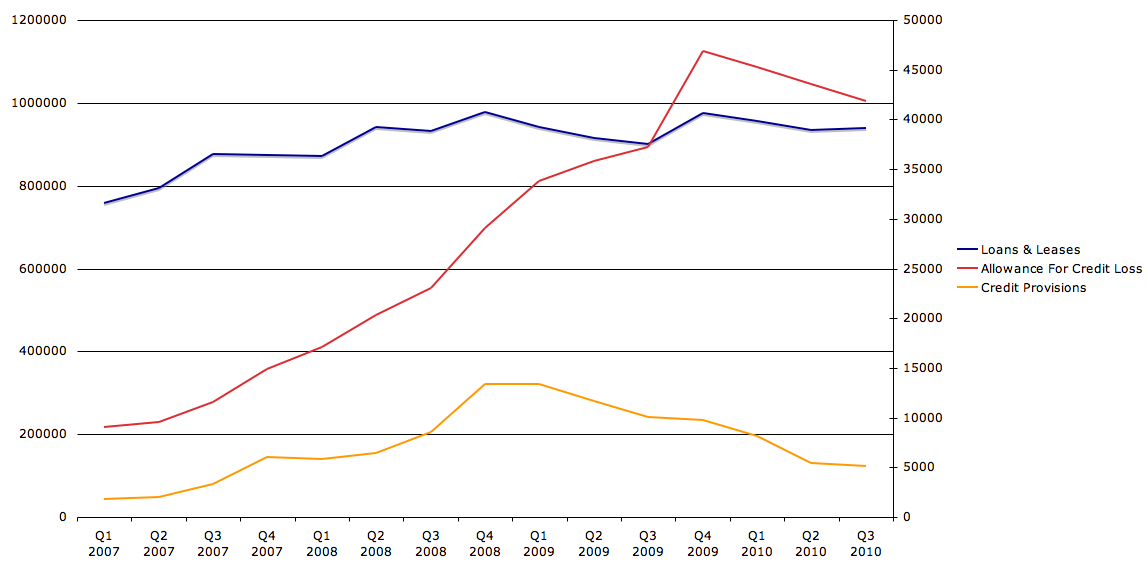
This chart shows Loans & Leases  VS Allowance For Credit Losses VS Provisions for Credit Losses. Some observations, loans and leases for the most part have stayed flat and through Q4 2009 allowance for credit losses did move up rather significantly.  Since that time they have begun moving back down. As of right now BAC has reserved for a 4.45% losses to total loans and leases.  Assuming all loans and leases are held at par then in other words the balance sheet is priced at 95.55% of par.  

The question I am struggling to understand is does this data alone and the realization that shadow inventory has grown the past year show that provisions (the orange line) will be forced to move up again regardless of the future of home prices.  Provisions are made up of two components:

1 – Changes to allowance for credit losses (balance sheet adjustment)

2 – Actual loss incurred during a given quarter

Provisions have been moving down since Q4 2008, a year ahead of the move down in allowance for credit losses.  In other words BAC through 2008 was realizing lower losses yet reserving at a higher rate.   Why would you reserve for future losses unless you were all but certain of those losses.  If anything you would reserve as little as possible in the face of diminishing earnings (chart 1 above). 

Banks have reported a time line in excess of 14 months from default to REO so there is a lag time between the actual loss incurred and the balance sheet adjustment.  


Submitted by Runedge.  If you would like to visit my blog please go to - Ultra Trading

The Health Of The Consumer (By Runedge)

By -

There is a lot of talk in the financial media about the strength of the consumer.  Pundits will tell us to never count the consumer out.  The holiday season was strong, iPad sales are strong, the high end consumer is spending.  In a word, nonsense.   

The number of people in some form of default on their mortgage continues to rise.  The average time from the first missed payment to REO is in excess of fourteen months and higher depending on who is reporting.  Imagine not making a mortgage payment for fourteen months.  What do you do with that money?  You don't save it all.  You spend it on things you are "entitled" to because the sad truth right now is our society for the most part feels entitled.

Consumers guard their credit card and HELOCs because it is their only form of credit and yet the banks spin this as a positive about their assets, their credit quality.  Again, I say nonsense.  I came across two charts that really support this view.  

For the first time in over sixty years, Americans had a net withdrawal of financial assets, whether it be savings, 401K plans, etc.  Americans are suffering hard right now.  One in five are employed part time. Part time work is necessary and there is nothing wrong with that form of employment but the reality is you cannot grow an economy with limited wages and reduced benefits.


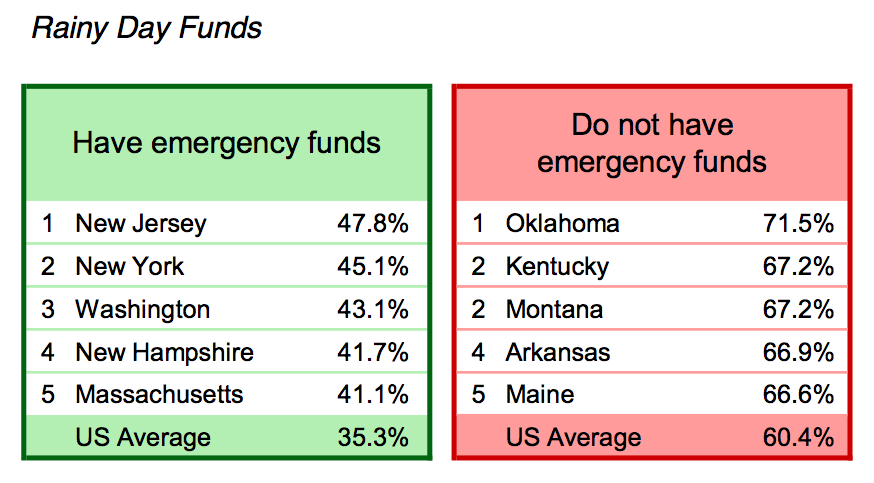
Now this one was the scary report from FINRA.  The simple question, how many Americans have available funds to cover three months of normal expenses.  35.3% do while 60.4% do not.  GOD forbid someone loses a job, for every three that lose work today, two need immediate government aid.  One in seven Americans are on food stamps.  There are many people hurting right now and for the media and financial system to spin it as all is well is very sad.  


Submitted by Runedge.  If you would like to follow my blog please visit - Ultra Trading