

Risk, Reward, and Position Sizing
Yesterday Tim offered a potential trade opportunity in Axon Enterprise (AXON). Here is the post for reference: Axon Trade Today, I want to share an alternative way to trade AXON—one that a professional options trader might consider when leveraging Tim’s expert technical analysis
A bear call spread, also known as a short call vertical spread, is one of my go-to strategies in options trading, primarily because of its defined risk and flexibility. As the name suggests, it’s a bearish strategy, but it doesn’t require the underlying stock to move lower to be profitable. Unlike buying or selling stocks, where outcomes are binary—up or down—a bear call spread can generate returns if the stock price stays flat, moves slightly higher, or declines. This versatility makes it a valuable tool for traders who want to align their positions with probabilities rather than predictions.
Liquidity plays a crucial role in the effectiveness of this strategy. For instance, AXON is not a highly liquid product, with an at-the-money bid-ask spread as narrow that is quite wide, making it a so-so candidate for efficient trading.
When employing bear call spreads, I tend to focus exclusively on highly liquid products, where the narrower spreads minimize friction and maximize potential returns.
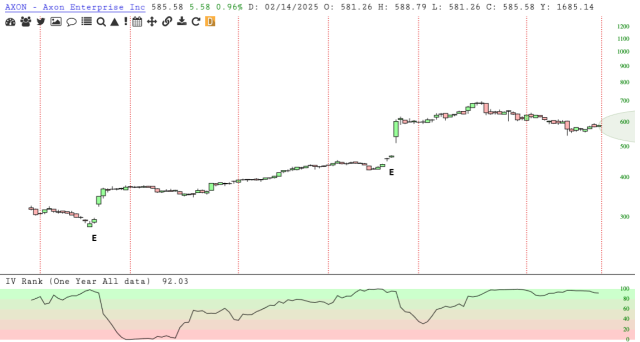
AXON is trading at $585.58, with a high IV rank. This presents an opportunity to place a bear call spread with a high probability of success.
To construct the trade, I look for options expiring in 30 to 60 days, with a focus, in this example, on strikes with an 80% probability of expiring out-of-the-money (OTM). In this example, the February 21, 2025, expiration cycle with 36 days left fits the criteria. The 650 call strike, offering an 82% probability of success, serves as my short strike, which defines both the trade’s probability of success and its overall premium.
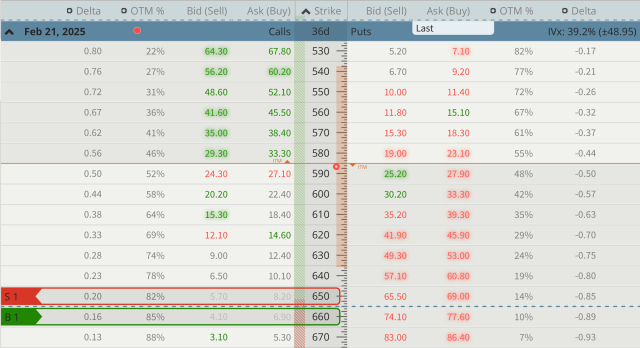
After selecting the short call strike, I evaluate spreads of various widths—three, four, or five strikes wide, if they are available. In the case of AXON we only have 10-strike wide spreads.
The width of the spread determines both the risk and the capital required for the trade. For instance, a 650/660 bear call spread involves selling the 650 call and buying the 660 call for a net credit of $1.45, or $145 per spread. This setup carries a maximum risk of $855 and offers a potential return of 17.2%, provided AXON stays below 650 at expiration. However, rather than holding until expiration, I typically close the position early to lock in profits, aiming to buy back the spread when its value drops to 50% to 75% of the original credit—roughly $0.72 to $0.36 in this case.
Remember, the bid-ask spread is wide so setting a limit order is essential. Oftentimes, if I want to take on a position with a bid-ask spread that is wider than my liking I start with a smaller position size to test execution efficiency. If the spread tightens or fills easily, I scale up incrementally. Place a limit order near the mid-point of the bid-ask spread. Use tools or platforms that show the mid-point to guide your pricing. Be patient—trades in less liquid markets often take longer to fill. Personally, I tend to avoid them altogether. Instead, I stick to a curated list of about 50 stocks and 30 ETFs that I review regularly. If you’re interested, I discuss these in detail each week in my free newsletter. Sign up here to learn more!
Risk management is non-negotiable when trading bear call spreads—or any strategy. By knowing both the maximum profit and loss before placing a trade, I can precisely size my positions. This disciplined approach not only allows the Law of Large Numbers to work in my favor but also provides peace of mind. Additionally, I set a stop-loss at 1 to 2 times the original credit. For this example, if the spread’s value rises to $2.90 to $4.35, I exit the trade to prevent outsized losses.
Bear call spreads highlight the importance of integrating probabilities into trading decisions. They enable traders to align their strategies with the most likely outcomes, manage risk effectively, and capitalize on market opportunities with confidence. By focusing on liquid products, adhering to disciplined position sizing, and leveraging the flexibility of this strategy, traders can approach the market with a probabilistic mindset—one that prioritizes consistency and long-term success over speculative leaps.
Kindest,
Andy Crowder, The Option Premium
