

Earnings announcements inject a unique kind of volatility into the market. As anticipation builds, implied volatility (IV) rises, pushing options prices higher. This happens whether investors are speculating on big moves or hedging against potential surprises. Regardless of the reason, the effect is the same: a temporary inflation of option premiums.
This volatility presents an opportunity for strategic traders. My approach during earnings season is straightforward: I identify high-probability setups where I can sell inflated options premiums for optimal returns. By focusing on statistical probabilities rather than predictions, I eliminate guesswork and rely on the law of large numbers to deliver consistent outcomes. Managing sequence risk—the risk of a series of trades failing—is equally crucial for long-term success.
Educational Corner: Understanding Implied Volatility During Earnings
- Why IV Rises: Ahead of earnings, uncertainty drives up demand for options as traders speculate on big moves or hedge positions.
- IV (Volatility) Crush: Once earnings are announced, this uncertainty evaporates, causing IV—and options prices—to drop sharply.
- Your Edge: Selling options at high IV levels allows you to capitalize on this expected “crush” in volatility.
🎯 Subscribe here and let’s trade smarter together: The Option Premium
Iron Condors: A Go-To Strategy for Earnings
Among the strategies in my earnings toolkit, the iron condor is a standout. This strategy involves selling both a bear call spread (for the upside) and a bull put spread (for the downside), creating a range where the stock is expected to trade. Here’s the beauty: by positioning strikes outside the expected move, you increase the probability of success.
Key Components of an Iron Condor:
- Expected Move: Derived from options pricing, this is the market’s estimate of how much a stock is likely to move post-earnings.
- Liquidity: Focus on highly liquid stocks to ensure tight bid-ask spreads and smooth trade execution.
IV Metrics: Use IV Rank and IV Percentile to screen for stocks with historically elevated IV. High IV levels mean inflated premiums, which are ideal for selling.
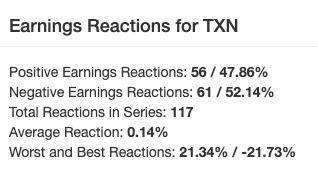
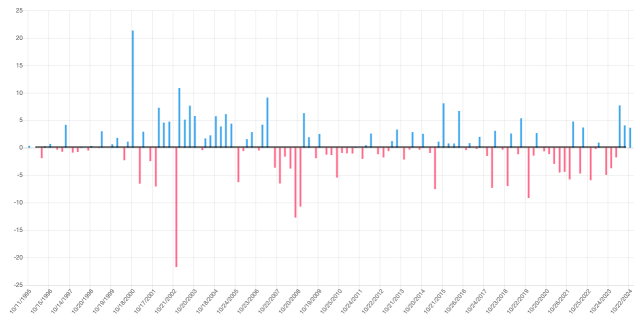
TXN has opened post-earnings typically within +/- 5%. We need to keep that in mind when we look to see what the expected move is for the expiration cycle we use for our trade.
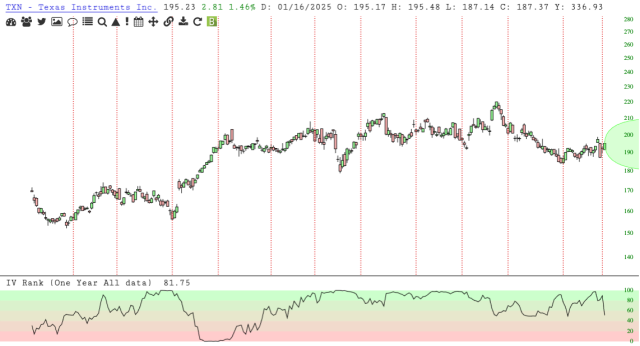
Example Trade: Texas Instruments (TXN)
With TXN trading around $195.23, we find an opportunity as the company approaches its earnings announcement. Historical data shows that TXN typically moves within +/- 5% post-earnings—a useful guideline for setting up an iron condor.
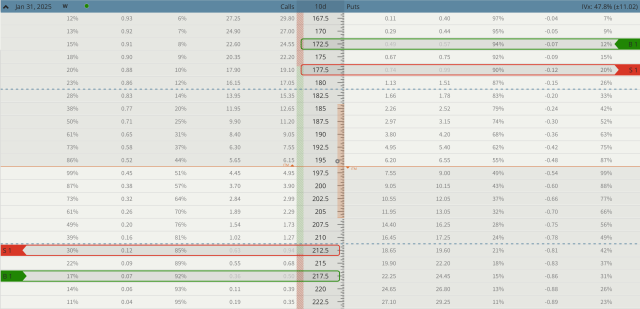
- Calculate the Expected Move:
For the expiration cycle following the announcement, the expected move is approximately $20: from $185 to just over 205 (this can be seen in the light orange vertical bar in the image below). - Choose Strikes Outside the Range:
- Bear Call Spread (Upside): Sell the $212.5 call and buy the $217.5 call.
- Probability of success: 85%.
- Bull Put Spread (Downside): Sell the $177.5 put and buy the $172.5 put.
- Probability of success: 90%.
- Bear Call Spread (Upside): Sell the $212.5 call and buy the $217.5 call.
- Define the Range and Return:
- Breakeven Points: $176.82 (downside) and $213.18 (upside).
- Margin of Error: 9.1% downside and 8.8% upside.
- Net Credit: $0.68, or $68 per spread
- Max Risk: $432 per spread
- Max Potential Return: 15.7%
This setup uses historical patterns, temporary IV spikes, and statistical probabilities to create a balanced risk-reward trade. This is a simple example of how I approach earnings trades and is not intended as advice. My goal is to outline the basic strategy without diving into the finer details. Over the next few weeks, I’ll provide more in-depth explanations using examples with highly liquid options.
Why Probabilities Matter
Earnings trades are rooted in probabilities, not instincts. Historical data shows that actual post-earnings moves are smaller than expected moves roughly 80% of the time. This means traders selling options at inflated prices often benefit when the market’s reaction is less dramatic than anticipated.
Risk Management: The Backbone of Success
Because earnings trades revolve around short-term binary events, strict risk management is essential:
- Position Sizing: Limit risk to no more than 2-5% of your portfolio per trade to mitigate potential losses.
- Avoid Emotional Decisions: Let probabilities guide your trades and resist the urge to “double down” after a loss.
- Accept the Math: Over time, the law of large numbers ensures that wins outweigh losses if you stay disciplined.
Looking Ahead: A Season of Learning
This earnings season, I’ll be providing weekly reports, videos , and in-depth analysis to help traders navigate the challenges of trading around earnings and the overall market. From managing risk to adapting to unexpected outcomes, I cover it all.
Earnings season isn’t about crystal balls or bold bets—it’s about understanding probabilities, managing risk, and using data to guide your decisions. Stay focused, remain disciplined, and let the numbers work in your favor. Success in options trading is a marathon, not a sprint.
Let the probabilities work in your favor,
Andy Crowder
🎯 Ready to Elevate Your Options Trading?
Subscribe to The Option Premium—a free weekly newsletter delivering:
✅ Actionable strategies and ideas, portfolio-focused results.
✅ Step-by-step trade breakdowns.
✅ Market insights for all conditions (bullish, bearish, or neutral).
