

How Options Traders Measure Market Expectations
Most traders focus on price. They watch charts, analyze earnings reports, and debate whether a stock will go up or down. But price alone doesn’t tell you much. Expectations do.
In options trading, the market’s expectations aren’t hidden—they’re built into the options prices themselves. The expected move tells you how far a stock is likely to move over a given period, based on what the options market is pricing in. While it won’t tell you which direction a stock will go, it gives you a reasonable estimate of how much movement is already anticipated. For traders, that information is far more useful than any price target.
It’s not magic, nor a guarantee of where prices will land—it’s simply math. But in a world where traders chase headlines, gut feelings, and social media hype, expected move gives you something far more valuable: a rational framework for risk.
What Is the Expected Move?
The expected move is how far the market anticipates a stock or index will move—up or down—within a given timeframe. It’s derived from options prices and implied volatility (IV) and tells you the range where the stock is likely to land with about a 68% probability (one standard deviation).
Think of it this way: If you’re buying/selling an option or setting up a potential trade, wouldn’t you want to know what the market already expects?
Most trading platforms calculate this for you, showing the expected move directly on the options chain. If AAPL is trading for roughly $239 has an expected move of ±$13.50 for the next 30 days, that means the market sees a high probability that AAPL will trade between $225.50 and $252.50 by expiration. In most cases, you can see what the expected move is for each expiration cycle on your trading platform which allows you to make trades over different durations with more precision.
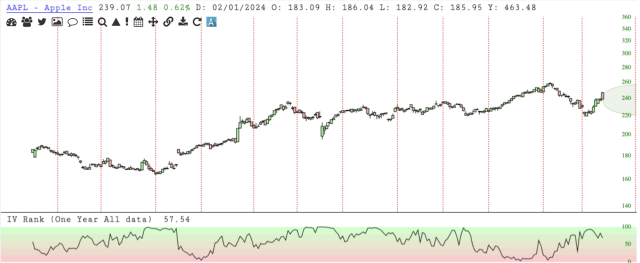
Here’s why that’s important: If you’re selling a $260/265 bear call spread or a $215/210 bull put spread, you’re betting on an outcome the market sees as likely. That doesn’t mean it will happen—it does mean you’re selling premium at a higher than normal rate (as seen through IV Rank) for a high-probability event…and that’s what we want to see if we are using options selling strategies.
The Role of IV Rank in Expected Moves
Implied Volatility (IV) plays a huge role in determining expected move. But just looking at IV isn’t enough—you need IV Rank (IVR) to tell you whether current IV levels are high or low relative to history.
- High IV Rank (above 50%) → Options are expensive. The market expects a bigger move. This is when option sellers look for opportunities.
- Low IV Rank (below 50%) → Options are cheap. The market is pricing in low volatility. This is when option buyers get better deals.
If IV Rank is sky-high before earnings, it’s a signal that traders are pricing in a massive move. More often than not, reality doesn’t live up to expectations, and IV collapses after the event, crushing options buyers who paid a premium.
How to Use Expected Move in Your Trading
✅ For Option Buyers: Avoid paying high IV premiums unless you truly expect a major move. Low IV Rank can offer better entry points for long calls, and puts.
✅ For Option Sellers: High IV Rank + wide expected moves = prime opportunity to sell premium via strangles, iron condors, and credit spreads.
✅ For Risk Management: If you’re holding stocks, knowing the expected move can help anticipate potential swings and hedge accordingly.
Final Thoughts
Markets don’t care about your predictions. But if you understand how far they’re likely to move, you’re already ahead of 90% of traders.
Expected move + IV Rank is the trader’s cheat code—it tells you whether you’re making a reasonable trade or throwing money at a long shot.
Master these two metrics, and you’ll be trading with far more knowledge. 🚀
If you’re ready to start trading smarter, with high-probability strategies, and a focus on consistent income over long-term speculation, I invite you to join me at The Option Premium.
📩 Sign up for my free newsletter here → [The Option Premium]
I want to encourage all of you interested in trading options to sign-up for my free weekly newsletter. No, I’m not going to send you more than the one email a week and no, I’m not running a service. I’m a trader. This is completely free from all marketing. You will find educational topics, research, actionable trade ideas, weekly indicators and more each week. I’ve been on Slope for a long, long time and would appreciate all of your support. As always, thanks for your time!
Kindest,
Andy Crowder
