
Slope of Hope Blog Posts

Slope initially began as a blog, so this is where most of the website’s content resides. Here we have tens of thousands of posts dating back over a decade. These are listed in reverse chronological order. Click on any category icon below to see posts tagged with that particular subject, or click on a word in the category cloud on the right side of the screen for more specific choices.

The S&P, the Dollar, and Libya

By -

Its funny, post history everyone will want to blame a sell off in the markets on Libya. The reality is that the Mr. Market has a mind of his own that is very difficult to understand. Sometimes he wants to go up when there is only bad news and even while Egypt wants to rebel and put at risk the largest oil stores in the world and sometimes he wants to go down when a little country with a relatively small amount of Oil contributed to the world oil markets is also falling into revolution. The reality, is that the markets were going to go down regardless of Libya and seemed to want to go up regardless of the any reasonable analysis of Benny BURNake and the Ink Jets, the Banks, the manipulated data or the vast amount of unemployment. Below is an example of why…a 35 year trend line can do the trick especially when combined with a 75% retracement from the highs.

2011-02-23_1357_SP500Marked 
for a more detailled view of this chart click here

2011-02-23_1159_DollarMarked 
For a more detailled view of this chart click here.

…get your army boots on because its not long before they will be needed.

Also for more information regarding the dollar please read this post.


What Are the Odds? (by Springheel Jack)

By -

I was taking a lot of flak last week for posting broken support trendlines on ES and NQ and suggesting (gasp) that this POMO driven market might ever retrace even to provide a bigger dip to buy. Here we are this morning and the opening gaps down on ES and NQ are looking likely to be substantial. Will it last? Perhaps, and I think the obvious retracement targets are at a lower level than I'm seeing this morning. We'll see.

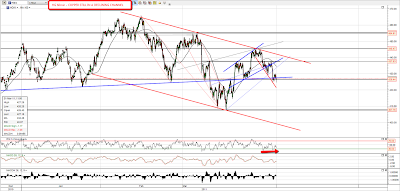
First up this morning is the ES 60min chart, where I'm seeing an obvious target at the 1310 level, for a wedge turned channel support trendline and potential HS pattern neckline:

The target is less clear on NQ, but I'm liking 2388 as another potential HS pattern neckline, and NQ has reversed in the pre-market (so far) at the obvious short term resistance area, which is the broken wedge turned channel support trendline:

Oil's been spiking heavily on the news that unrest in the Middle East may topple some incompetent kleptocrat dictators in the oil rich countries. I've been having a close look at the oil chart and the last low has established a rising channel with the next target just over 98. There is some longer term resistance at 96.6:

I've been watching USDJPY (inverted yen) in recent days and I'm wondering if the Yen is likely to make one last outing as a flight to safety trade before it resumes the march to likely oblivion. It looks promising:

I saw an amusing headline from those sly wits at Bloomberg this morning and it read ' Stocks in developed countries are rising the most since 1998 while emerging markets slump, a sign the U.S. is returning to its role as the engine of world growth aided by a recovery in Europe.' What is it exactly that the US is doing to be the engine of world growth at the moment? Simple, the US is the world's leading manufacturer of money, and is exporting it worldwide along with its inseparable companion, asset inflation. Fun while it lasts, but it can only last until the first serious revolt in the bond markets, and after that the US will have to consider alternative ways of boosting growth with an empty wallet and deflating assets.

I haven't called a top here, and I'm not planning to, as the end of QE2 is still months away and it's hard to see how we can see a major top until it ends. Nonetheless I think this bull market is unlike other bull markets in a number of important ways, mainly that it's stronger and faster than any bull market since WWII, and that it is the only bull market supported by huge deficit spending and money printing since WWII. These characteristics are obviously linked and considering the prospects for this bull market without considering the future of quantitative easing is a nonsense.

What's my point? I was reading the other day that no bull market since WWII had more than one correction over 10% before it ended, and as the retracement last year was 17%, that ruled out a retracement larger than 10% this year. For the obvious reasons that's not really applicable to the bull market we're trading here, and if, like QE1 last year, QE2 finishes with the Fed talking about an exit strategy for quantitative easing and without announcing QE3, then a major retracement this year is very much on the cards, and if there is no QE3, the bull market may well finish with QE2.

I've been watching the emerging markets too, as they have often worked well as a lead indicator for SPX in the past. EEM starting to underperform SPX was one of the indicators for the equities top last year and we're seeing something similar now. That amusing Bloomberg headline could have been posted in March 2010 as well looking at this chart. The bottom section of the chart is EEM:SPX and that definitely looks interesting here:

Why's that interesting now? Well I posted yesterday that the main resistance trendline on SPX had either broken or overthrown, and I'm watching carefully to see how far this retracement now goes. On the SPX daily chart my targets are in the 1315 area for the lower trendline of a possible rising channel since July, 1295 area for the lower trendline of the rising wedge on SPX, and if that last target breaks with conviction the technical wedge target would be 1040 SPX, with the overthrow ruling out the possibility that the wedge would become a rising channel. I'm not expecting to see that, but with what the EEM chart is showing it's worth bearing in mind:

The buy the dippers should be out in force today, and we might bounce from the open, but if not I have 1310 ES and 2338 NQ as the likely reversal targets and I'll be watching those.

Has the Euro bottomed? (by Springheel Jack)

By -

Yesterday and overnight were so dull that there's not really much to add about equities today. IWM made the upside target on the small rising wedge and we might see a retracement today into the 81.5 area:

Copper and silver made new highs yesterday, though gold didn't which was interesting. The most interesting thing that may be happening at the moment though is the possible low on EURUSD. I noted yesterday that EURUSD broke through the lower trendline of the falling wedge. That wasn't followed through and so it raises the significant possibility that this is a wedge overthrow after an ABC correction. An IHS could now be forming with the neckline at 1.350-1.355. There's a nice writeup on this as a possible reversal area for EURUSD from a blogger friend of mine at his blog MarketLetters:

I know almost everyone seems to be expecting EURUSD to go much lower here but I have very serious doubts about that. I have two big active perfect channels on EURUSD, and the last high wasn't at a significant level on either. If this has been an ABC correction then I'd expect the real test to be in the 1.40 area, though to get there might break the main support trendline on USD. I'm watching EURUSD carefully here and at the moment I'm leaning long.Here's the EURUSD daily chart with the two major channels marked, one rising and the larger one falling:

AUDUSD hasn't made my target trendline but I'm wondering now whether it will, as it bounced at a level yesterday which established a possible channel support trendline that is exactly parallel to the current resistance trendline. That may therefore have also been a significant low on AUDUSD:

John Murphy posted an interesting chart the other day, and it was a chart of the SPXEW, the version of SPX that gives equal weight to the components. John Murphy made the point that the SPXEW, which gives much lower weights to financials particularly, is now almost back to the 2007 highs. There were a couple of interesting things to note about the four year chart, mainly that SPXEW has a perfect rising channel from the March 2009 low just like SPX, and that it made a lower high when SPX peaked in October 2007:

Looking at the move from the July 2010 low on the hourly chart I was surprised to see that there is no rising wedge on SPXEW. Instead we have another perfect rising channel, though we have been seeing a thorough test of the mid-channel line:

Food for thought. I'm leaning short without great conviction today, but we're still just below main rising wedge resistance on ES, and IWM looks due for some retracement here.

Lost Opportunity Cost (by David Kern)

By -

I received an interesting piece of mail this week.  If you invest/trade the markets long enough, you’ll get these sort of mailings fairly regularly.

It was an invitation to participate in a class action lawsuit over something Apple did between 2001 and 2005.  I don’t really know or care what they were sued over, but Apple settled – and the cash is now available to be claimed.  Essentially, if you bought shares of Apple during that time you might be entitled to some portion of a settlement.  I did a search of my trading records, and sure enough – there it was.  I’d bought AAPL on 11 Oct 2005 and sold on 18 Oct 2005: a quick 4% gain.  However, as I reviewed more of the legal mumbo-jumbo, it became clear that my take on the lawsuit settlement would amount to $0.07 (estimated) per share.  Bottom line – not worth my time to even fill out the class action paperwork.  The 4% I made on the trade four years ago far exceeded any reimbursement that I would receive from this settlement.

The interesting thing was realizing that the price I paid for AAPL at that time was $50.59 per share.  Wow, wouldn’t it be nice to have kept those shares?  My unrealized gain today would be 646%!  That’s not really” go-crazy-retire-to-Fiji money”, but it’s well over 100% gain annualized…  Why did I sell at that time?  Probably a stop, could have been an itchy trigger finger with a desire to book gains – really I don’t remember.  When I look at the chart from 2005, it’s really a facepalm moment.

This has been an introspective moment over the weekend, as it’s caused me to question some of my approach to trading the markets.  I assess that I do above average at picking what to buy, and I’m usually pretty good on when to buy also – but my timing on when to sell has had some sucktastic moments.  I’ve experimented with putting trailing stops on everything – only to be whipsawed out of stocks that continued up-up-and-away.  I’ve bought uptrending stocks that then paused and/or retraced just after I buy  – so I sold (locking in a loss) only to find them explode upward the next week.  I’m starting to think that I need to slow down my timeline a little; step back from every wiggle of the chart and let my trading positions work for me.

I’ve believed for a long time that “buy and hold” is a steaming load of crap.  There are a plethora of market indicators that clearly show market trend, and it’s foolish to go long in a bear market or short in a bull market.  My favorite indicators for trend are the market breadth and bullish percents (which as of this writing still show a bull market).  These work well and consistently.  My issue seems to be finding my rhythm for when to take profits or cut losses, and I’m open to ideas on how to improve my game.  I don’t care to hear the Warren Buffet answer (who has said his time horizon is to never sell), but I feel there’s gotta be a better system for when to sell.

By the way – going back to the question of buy and hold AAPL from Oct 2005 – I don’t think that would have been a good idea at all.  There were a couple of clearly defined downtrends the first half of 2006 and most of 2008.  I think any reasonable trader wouldn’t sit on his hands through that bleeding.  Certainly I couldn’t have, considering the market breadth and bullish percents clearly showed defensive situations during that timeframe.  What do you think?